Showing posts with label Dragon Age. Show all posts

Thursday, December 29, 2016

The Shattered War - RELEASED!


You can now play The Shattered War!

Please download it from:
http://www.nexusmods.com/dragonage/mods/4606?

Download, upvote, tell your friends, play and enjoy.  I sincerely hope you enjoy the adventure, as it's been a tremendous undertaking to complete.

The last few weeks have been a whirlwind of ridiculous amounts of testing, bug fixing and overall improvements to the mod in terms of flow, appearance, and overall polish. While I'll be the first to admit it's still by no means perfect, it's now reached a state where I'm happy to say that I've put in the required effort to be happy with it as a release. I am hopefully that there will not be a need to do any significant bug-fix updates to the mod.

Please, download The Shattered War and enjoy another adventure in Thedas.

Sunday, November 6, 2016

Release Schedule

I realise I have been posting extremely infrequently here, but I have reached the point where I am going to commit to having a release of the Shattered War before the end of the year.

My posts have been infrequent not only due to me being able to spend less time on the project than I would like due to other personal commitments, but also because updates on bug fixes don't really seem as though they would be that interesting to people. I can assure you that they're not particularly interesting to write.

But more importantly, there will be a release coming within the next two months. In anticipation of this, I'd like to share some stats about the size and scope of The Shattered War:

  • Over 3500 lines of voiced dialogue across dozens of characters.
  • 30 completely new hand crafted areas to explore, including, villages, forests, ruins and mountains.
  • Lots of side-quests, each with multiple options for resolution.
  • Special hidden set-items that require puzzle solving to find.
  • Fully fleshed out companions, each with their own backstory and romance subplot.
  • An adventure of substantial size: a testing run takes me over 10 hours from start to finish, and I know exactly where I'm going and what I'm doing.
  • A main plot where you can't do everything, you must make choices and take sides, and this will affect how characters treat you and your ultimate ending.
Needless to say, this has been a massive undertaking, and processing voice acted lines and ironing out all the potential issues relating to the various choices the player can make has been a far more time consuming process than I expected. I've had some amazing voice acting from a bunch of people, and I'm grateful for all the talent that they have provided.  However, effectively creating an expansion for Dragon Age: Origins has been no small undertaking.

I should say that there are certain issues that I have been unable to rectify. For example, there are a few characters I was unable to find voice actors for, but I want to get a playable form of the adventure out for people. I can potentially revisit some of these issues if the release garners enough interest from people to help me solve such problems.

In short, stay tuned for more information in the near future, and I hope you'll be keen to play The Shattered War.


Monday, June 13, 2016

Bug Testing

Despite the long time between posts, The Shattered War is drawing nearer to release. I'm currently going through what I hope will be my final phase of playtesting and tweaking now that voice work integration is essentially complete.

I'm about two hours into my current playthrough, and while there are some minor cosmetic issues, everything is mostly looking pretty good by now. A complete run of the game will probably add up to at least 10 hours (though likely more), and the wide variety of choices means that it is absolutely impossible to experience all the content of the game in a single run.

No one wants to see this released more than me, and I feel more than a little disappointed and frankly a bit sheepish that it's taken me so long to get the mod to a releasable state. The scope and scale of this project were possibly a little too bold, and the sheer time and dedication required to get full voice acting means it has been a massive undertaking for one person. While my efforts have probably been a bit lax for a while, I'm keen to get The Shattered War completed and in the hands of anyone who still wants to revisit the world of Dragon Age in its Origins incarnation.

I'm hoping there are still people out there who want so explore the world of Thedas and a new adventure and story within its bounds.

Monday, November 9, 2015

Voices, glorious voices


After a substantial casting round, I managed to find voice actors for all but four roles for The Shattered War - and all of those roles are for Orlesians. Looks like I have my work cut out for me finding people who can and are willing to voice Orlesian characters, but even without them, I've got a whole lot more voice actors and characters added to the roster. The people I've been receiving lines from have been talented and almost universally friendly and professional.

Of course, all of the voice actors who contribute will be credited in the final product, but I feel I should reiterate here how important they are to the project and how grateful I am to them for their efforts. Since I set the bar for this adventure to feel like a "real" Dragon Age experience, I can't deliver that unless I have full voice acting for the entire project.

I could have delivered it quite some time ago if I didn't have this restriction, and arguably a lot more people would have played it if I had done so. Personally I don't think DA:O's combat has aged well, but I'm hopefully that people will persevere through that to experience this adventure and the myriad of choices and characters voiced by these talented actors.

That said their work is just the start for me. After the voice actors have done the hard work of acting their lines, is then up to me to make sure that the delivery matches the overall tone I'm looking for - mostly this is the case because in the scripts I provide appropriate context and emotional direction where necessary - but still give the voice actors enough leeway to give their own interpretation and representation of the character. Some of the lines have been delivered in ways slightly different to how I imagined them, but have been absolutely brilliant and given characters more depth to their personality.

The next step is make sure that there's appropriate silence (or lack thereof) on either side of the line - if a character is having a monologue/dialogue then there needs to be appropriate gaps between each sentence, but if there's an argument or an interjection, there's obviously virtually no gap present.

Then I have to ensure that the overall volume levels are consistent across all characters. For this I have a line of reference dialogue that I use as the benchmark volume to compare all other lines against. If a character is angry and shouting, it'll obviously be a bit louder than the reference line, if they're sad or otherwise speaking quietly, it will be a bit softer, but ultimately the aim is to ensure that all lines within the game have a consistent volume so individual characters do not have vastly different volumes so the player would have to adjust their speaker/headset volume up and down while playing.

These things might seem trivial, but their important for making sure that there's a consistent experience for the player. Finally, once all that is done, it's time to integrate the line into the game, including setting the camera angle, facial expression/tone and individual hand/arm/head/body movements to match the lines being spoken.

This process then has to be repeated to every single line of dialogue I receive. As you can imagine, this can be quite time consuming. Nevertheless, the end result is fantastic, and thanks to the efforts of the wonderful voice actors I've been working with, the characters in The Shattered War are really coming to life beautifully.

Monday, March 16, 2015

Lore consistency, story depth, and changes

Modding has been a little light on in the last few weeks, because I'd been told that there were some significant lore reveals in Dragon Age: Inquisition (DAI). Since I care about how my story relates to lore as it stands in the Dragon Age setting, I wanted to make sure that I wasn't writing anything that would contradict established. Admittedly changing things now would be pretty tough, but I just wanted to check nonetheless, just in case there were any inconsistencies and if there were any corrections I needed/could make. I will, however, keep the post spoiler free for DAI

This actually took a lot longer than I was hoping. The problem is that DAI is *big*, but a lot of its size comes from breadth rather than depth. The main story arc is actually pretty damn short - my initial assessment when I started playing DAI was that it was more of a Skyrim approach, and the more I played it, the more it felt that way. There is a lot of "content", but a lot of it doesn't really have much relevance. There are a bunch of lore tidbits hidden away in various sidequests here and there, but many of the quests are very shallow in terms of story depth. There are a handful that have some lore in them, albeit in a subtle world-building style, small mentions and snippets of information, meaning that you really need to do a *lot* in order to dig into the depths of the lore. Given that there were a couple of instances relatively early on in the game where I was doing a quest that seemed "insignificant" (even including a couple of the War Table operations), but actually gave some very interesting lore information, I realised that this would be a serious undertaking. On the plus side, it has reinforced my dedication for getting The Shattered War complete, because DAI has left the lore and world in a far more interesting state than at the end of DA2.

Fortunately for me, there were no issues with anything that I've written. Now, I'm actually pretty happy about this. Keep in mind that I wrote this story in its entirety after finishing Dragon Age: Origins. While yes, I'm taking damn forever to release the mod, even though I went out on a fairly serious limb for some of the lore, everything I've done has slotted in nicely with some fairly significant developments that have occurred in Dragon Age 2 and also DAI, and only a few minor details needed tweaking. What's even more interesting is that I feel I definitely captured some of the themes and precursors to events I knew nothing about while writing and developing the story.

This isn't to say that the mod hasn't changed during development. Various plot ideas and quests were canned, others changed in terms of implementation or details for various reasons, and a couple of new smaller items added along the way. Sometimes it was toolset limitations that meant I could not do particular set pieces or level designs that I was hoping for. In other cases, my playtesting made me realise that a particular approach wasn't really working that well and I needed to take a different tack in order to make it more interesting for the player. It's my hope that I will have created an interesting and enjoyable adventure for people - and given the different ways that things can play out, one that they'll be willing to revisit and make completely different choices when they do.

Sunday, January 19, 2014

Testing and Internals

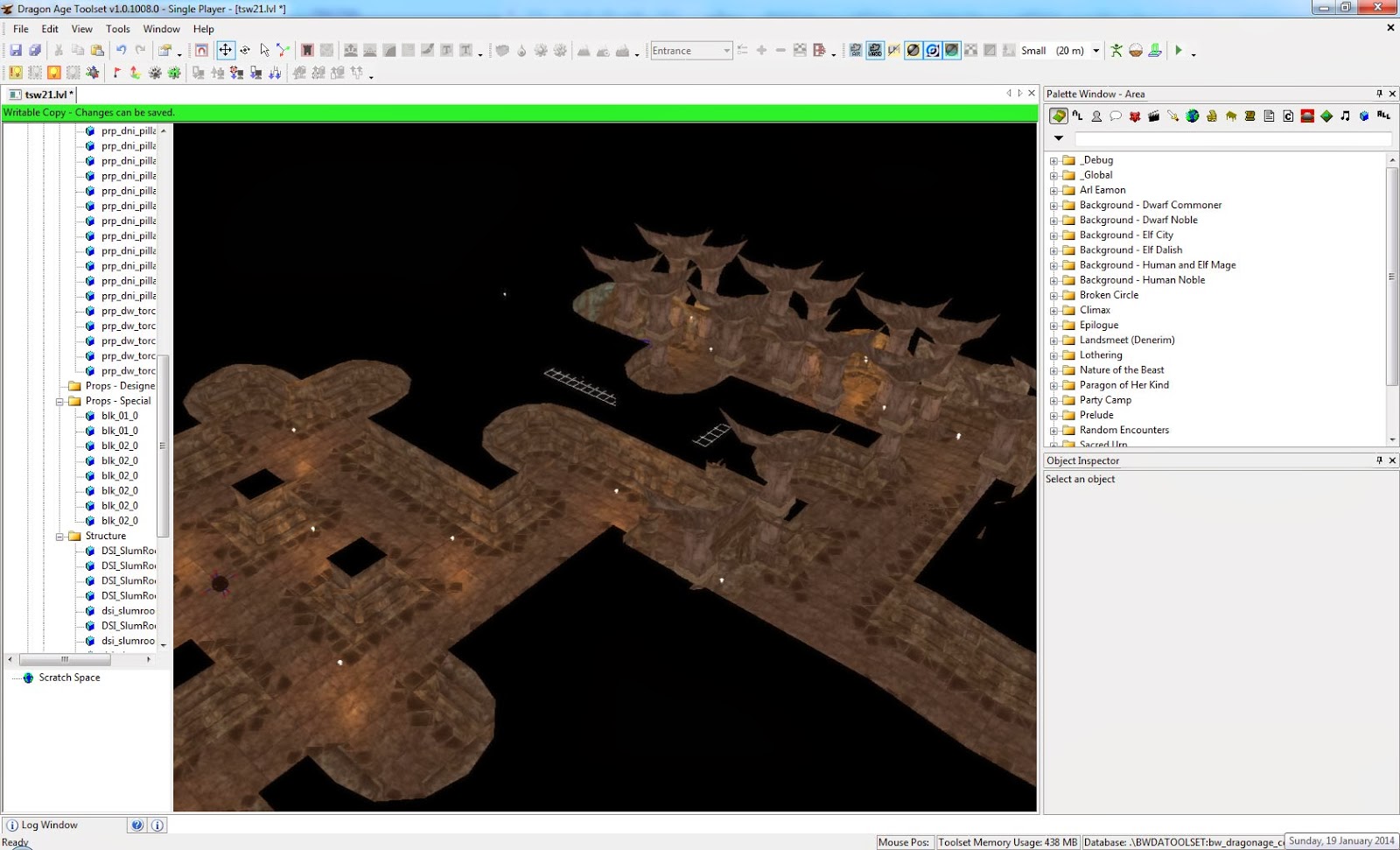
In addition to my ongoing testing, I've been working on some level design lately that is a little more challenging than previously - primarily because I'm working on an interior rather than an exterior.  I don't think it's a significant spoiler to say that the vast majority of The Shattered War will occur outdoors.  This is an adventure focused on the events of an area within the wilderness, and the natural landscapes, forests, hills, valleys, and the settlements built on these are where the bulk of the action will occur.

However, there are some times where the player will have to go indoors. For these areas, I've largely been taking existing areas from the campaign and making some modifications so that they're not immediately recognisable - but I'm hopeful that this will be to far better effect than was done in Dragon Age 2.  I'm definitely avoid repetition within my own adventure, but there are a couple of layouts that will likely seem very familiar to those who know the campaign intimately.

That said, I have been working on getting the structure down of some completely new areas largely created from scratch.  Here I've been using an existing levels as a base, but only as a starting point from which to add my own rooms - effectively stripping the original level down to very little before adding my own new rooms in.  This gets around some of the initial level creation issues, and also gives me a base of model names for room components and structure models to use for my own work.  I became quite familiar with model names for exteriors, so having to do interiors meant learning a whole new set of model names, which increases the amount of time taken by quite a bit.  Also critical in indoor levels is ensuring that everything is lined up. Exteriors are a bit easier to "eyeball it", when it comes to placement, but interiors really require that everything fits together nicely in order to work properly.

Working shot of part of an interior

This shot is one of the "easy" options - stone corridors are far easier to match up than caverns and cave interiors.  What's worse is that the models in Dragon Age really don't match up very nicely and often require you to match specific pieces with each other, making it harder to get a more unique look and design without copying the original Dragon Age levels. I want to ensure that the "special" locations in The Shattered War are exactly that - special - and not make the player think "wait, I've been here before." Hence the need for the effort required to create these unique interiors for the adventure. 

Sunday, January 5, 2014

Bugs squashing continues...

Yes, it's been more than a couple of weeks since my last update, so my apologies for the silence. Again, I'm aiming to have regular updates, but I'm trying to make sure that I don't just put content like "found 5 bugs, fixed spelling mistakes" or the like.

As for details of the progress I've been making, there are a few fairly significant things that I've managed.

I've finished processing all the voice cuts for one of the party companions. I've previously described that this can be a fairly time consuming process, and this represents a considerable chunk of time, as that's over 300 lines of dialogue for this character. To give you an impression of how much dialogue that actually is, here's a list of the number of lines of personal dialogue for characters in Mass Effect 2.

Now, the numbers there don't actually represent ALL the possible lines of dialogue for ME2 characters, but given that The Shattered War is a one-man development effort, you can see that there's a LOT of content for players to experience.

Taraz is a dwarf with plenty to say.

Secondly, I've worked on creating several sets of items that the player can find - customised sets with their own backstory and codex entries, and the items offer significant bonuses to the player should they explore enough and solve the puzzles required to find them.  There is a major set each for the warrior, rogue and mage, so no matter your character or party composition, they will be useful.

This has also meant that I've finished up a couple of the puzzles I mentioned in a previous post that will allow the player to get their hands on some of these items, and done a bunch of bugtesting to make they work without a hitch. That took a little finesse, as they were initially unsolvable due to some errors I'd made.

Aside from those two major things, I've been doing quite a bit of playtesting on the major plot quests of the game, which are all looking fairly solid at this point. This also included a number of cosmetic changes just to add more flavour to the experience - added ambient NPCs and behaviours that are shown in response to the player's actions so that they can see some of the effects that their choices are having. For example, if a player rescues a group of people, these people will then return to the town they are from, going about their business and other people in that town may comment on their rescue. 

Small things like this aren't critical to the plot, but they do reinforce the work I've put into place to make sure that the game will react to the decisions that players make. Seeing effects and consequences is one of the major goals of my design for The Shattered War, so I'm confident that touches like this will make it a memorable experience.

Monday, December 2, 2013

Filling out content

In addition to the playtesting I've been doing to piece the core plot of the game together from start to finish, I've also been working on designing and adding in some extra content that has been in my mind for a while. I'm talking about "light content", which is the little subquests that revolve more around exploration and puzzle solving that reward the inquisitive player.  Generally, these things are much less time consuming and demanding to implement for me than fully fledged quests. Think of these quests like the "Chanter's Board" quests from Dragon Age, but without a central location to kick them off for you.

There are a few things that I want to make sure that I do with these quests in order to make them interesting, and so am trying to follow a few principles when creating them.

Don't make it immediately obvious

The point here is that I want the player to start the quest by finding something, not by going to a person with a marker above their head or a notice board in the middle of a village. It could be a journal, a scrap of paper, a strange item, some kind of key, or anything really.  The main point is that the player should find something that gives them a clue that there is something else that they could do or find.


Require exploration
These objects should be spread out across the areas that the player will explore - they won't just be found in the main locations that every player will have to visit. The levels I've created for the mod are reasonably large - and I'd like to encourage players to explore them. With many modern games, we're often forced down very linear paths, so trying to get players to search and experience the fun of exploration is something I'd like to be able to do.

Monsters are easy to find, these should require more effort

Puzzles can be fun
One thing I find really annoying about puzzles in many games is that they're either really obscure and illogical (the worst of Monkey Island syndrome, or Anna), or blatantly obvious (Towers of Hanoi).  The other annoyance is when puzzles are presented in a way that they're not solvable when you encounter them, either because you don't have the right skills/items to solve them (e.g. Batman, Assassin's Creed), or worse, that the player cannot complete the puzzle until they are explicitly told what to do. Where I implement puzzles, I want the player to be given enough information to carry them out, but without beating them over the head with an answer. This is a tough balance, but I'm hoping to provide a mix of puzzles that should be interesting.

Use player skills
Skills like tracking, herbalism, pick pocketing and the like are things that are often neglected by designers. Even in Dragon Age itself, it felt like these were mostly for facilitating combat rather than being useful for anything else.  I want to be able to use these skills to assist, or possibly even be required to complete some of these quests.

Give rewards
The player should get something from these kinds of quests. They're exploring, uncovering secrets and the like, and thus should be rewarded with different and unique items as a result. This is the icing on the cake to make the player go "that was awesome!" This is where I'll be giving out the most interesting and powerful items in the game, because it rewards dedicated players, and makes people want to explore and find those hidden secrets.

So that's my update for this week. Stay tuned for another update next week!


Saturday, July 28, 2012

New Shattered War Trailer

In order to showcase some of the work that I've been doing recently on The Shattered War, I thought it was time to release something that people could look at to see and hear everything as it goes on during the game. To that end, I have a brand new trailer showcasing some of the voice work and level design that has been taking place over the past few months.


In addition, for those who want a bit of a closer look at some of the action, I've got a screenshot for your viewing pleasure.

Fighting to save a town

Until next time...

Monday, April 2, 2012

Shattered War Characters: Farouk

It's time to meet another character from the cast of The Shattered War. In today's post, I'll introduce a key NPC from the adventure: The Templar Commander Farouk.

Farouk was born into a Chasind family, but his the rest of his family was killed by The Chantry under suspicion of being apostates. In an act of kindness, of the templars rescued him, for he was just a young boy at the time. As a result, he was raised by the Chantry and soon led into the life of a Templar after becoming a devout follower of the Maker. He does not consider himself one of the Chasind people, and is grateful for path his life has taken.

"Templars act to protect the safety of everyone, and sometimes that means making hard decisions in an instant. The Chantry trusts us with that power, with that burden."

He takes his duties as a templar very seriously, and rarely engages in humour. He is greatly distrustful of any mages outside of his jurisdiction, particularly Dalish elves, but is even suspicious of Grey Wardens who are also mages. He does not hate apostates, but will attempt to bring them to the Circle/Chantry in order to fulfill his duty. While he has no love for mages and does not trust them, he does not wish to chain them up, and finds the Qunari treatment of mages distasteful. However, if a mage was deemed to be a maleficar, he would see them killed instantly.

 "Rest assured that the Chantry recognises those who follow their duty."


In the Shattered War, Farouk is responsible for the templars within Fort Velen, and is responsible for overseeing mages who are part of the militia force. While he shares the same rank as Norvac, he makes no claims for seniority, as he recognizes Norvac's greater experience in conducting military operations.

As a significant character in The Shattered War, he will be an important character for players during their adventure. It will be their choice as to whether the relationship with him will be friendly or antagonistic...

Tuesday, March 27, 2012

Shattered War: Staying true to Dragon Age - conflicts

As part of my modding effort in creating The Shattered War, I feel it is important to stay true to the world created by the Dragon Age series.  On a simple level this comes down to the pure lore aspects. Geography, history, the role of the Chantry, why dwarves can't be mages; the basic facts and figures that make up the world of Thedas. However, in order to stay true to the series, it's important to keep some thematic considerations consistent as well. While I'll look at some of the general themes in the future, in this post I'd like to look at some of the conflicts that help inform the Dragon Age setting.

The Darkspawn Threat
The first foray into the world of Thedas came as a result of the blight, and the grave threat of the creatures known as darkspawn. While considered by many to be nothing more than the creations of tales to scare children, the threat of darkspawn proved all too real for the inhabitants of the land of Ferelden. These creatures are brutal, ruthless and vicious monsters that murder (or if you're unfortunate enough, kidnap) people. Typically mindless and lacking direction and intelligence, they rely on the archdemon to control them and provide them with a purpose. The archdemons could only be defeated by people from the order known as the Grey Wardens - who are sworn to protect Thedas from these beasts.

 No ogres and no swords make Grey Wardens "something something".

The events of Awakening uncovered the ability for some darkspawn to have independent thought, though only after beeing freed from the "song" which speaks to them. The exact nature of this "song" is still unknown, and while some darkspawn may have even allied themselves with the Grey Wardens to seek an end to the darkspawn problem. Yet given the presence of darkspawn is anecdotally proven to harm the land and potentially kill non-darkspawn, such a peace may be difficult. The nature of the control of the darkspawn and their potential to kill others remain mysterious to be solved for either good or ill. The player's experience in The Shattered War will see them facing darkspawn, and dealing with the dangers that they pose.

Mage versus Templar
Now while many people might be sick of the mage templar argument thanks to Dragon Age 2, I had written the ideas for these conflicts to appear in The Shattered War after playing Dragon Age: Origins. The scope for conflict between these two factions is immense, and can take many different forms. The potential for the player to have killed the majority of the mages in Ferelden in DA:O is representative of a long-standing uneasy relationship between the two.

Angry Anders. Me no like templar! Anders SMASH!

The true problem is that the forces to rock the boat can come from both sides. Some templars are heavy handed in their treatment of mages, yet some mages wish to rebel against the Templars in a violent fashion, potentially leading to as escalation of conflict that can only end badly. Of course, the players will have a role in this conflict within The Shattered War. However, in comparison to Dragon Age 2, the players will have more of an impact in how those events play out. While the player may have to deal with the extremes of either end in terms of their allegiances, their choices will cause an effect in how these people view their character. The path to brokering peace requires a great deal of compromise, and a silver tongue alone will not be sufficient for reason to take the place of fighting.

Political Tension
Political tension is a key part of the Dragon Age world of Thedas. The Mage/Templar conflict is one such example, as are tensions with the Qunari but there is internal strife within Ferelden in DA:O, long standing emnity between Ferelden and Orlais, and Orlais itself is driven by political intrigue. To ignore the backdrop of factions vying for control and power would be to remove much of the interest from the world. In the Shattered War, the player is in The Frostback Mountains, which are a border between Ferelden and Orlais, and also home to the Avvars. People in the region have been at the forefront of the conflict between the two nations, leading to strong emotions on all sides.

 When you live here, conflict is a way of life

The are not only the issues at hand like the threat of darkspawn to deal with, but also the issue of how to gain the trust and cooperation of the people living in the region. Betrayal and bloodshed runs deep, so trust is a commodity that must be earned. Small scale tension is every bit as important as that occuring on the larger scale, and both will be seen during the events of The Shattered War. There are no right or wrong choices, and achieving an ideal outcome will be extremely difficult, if not outright impossible. Some wars require terrible sacrifices in order to prevail.


These conflicts are an essential part of what has shaped Dragon Age thus far, so in order to stay true to Dragon Age lore, it is vital that these conflicts appear within The Shattered War. Rest assured that all three shall appear in varying degrees, and all will play a part in not only the journey of the player through The Shattered War, but also its conclusion.

Monday, March 5, 2012

Shattered War exclusions

I'm taking a bit of a different approach for today's blog about The Shattered War. Recently I've been covering things that I've included and the decisions I've made. Thanks to a suggestion from a friend, today's post is going to cover things that didn't make the cut.  That's right, I'm going to be talking about things I decided not to include and why.

Companion Abilities
The plan here was to make some custom abilities for each companion that would set them apart from the regular warriors, rogues and mages. Not only that, but these abilities would vary in their effectiveness and strength based upon the player's interaction with them. Take Fialeth, the elven rogue, who prefers to fight with a dual-wield style. If the player encouraged her to pursue an aggressive or angry method to resolve her issue, then the ability would cause her to inflict more damage. Alternatively, a player pursuing a path of reconciliation would provide Fialeth with the ability to avoid damage.


Gifts
I was never a huge fan of the gift system in Dragon Age: Origins. It felt a little clunky most of the time, and felt like a means to smooth over relations with characters whom you fundamentally disagreed with. On the whole I felt the rivalry system introduced in Dragon Age 2 was a lot better, another design choice led by Alpha Protocol.

The friendship/rivalry system was one of the improvements of DA2

In sort of a combination of the above two issues, I am looking to implement small bonuses to attributes (just like DA:O did) but to give different bonuses based on whether the companions like or dislike you. Of course, the bonuses provided will be to different attributes based on the companion and how they feel about you.

Custom Models
Basically, I don't have the necessary modelling skills, and I don't know the process for including new models. In addition, it would be vital the new models follow the same sort of artistic style present in the original game, as I wouldn't want something that feels out of place with existing content.

No Area Reuse
There will be some areas that will be reused from Origins within the game. In virtually all cases I'll make some modifications so that they're not immediately recognisable from the original game, and there will only be a few areas that I'll appropriate as part of the adventure. I'm also limiting this exclusively to interior areas; my ability to create interiors is not as high working with exterior/landscape levels, so I've focused more on my strengths. This helps reduce my workload and enable me to get the mod released earlier.

When you're outside, expect completely new terrain


Minor Characters & Ambient Consequences
One initial plan for The Shattered War was to have a large number of "ambient consequences". This involved having a significant cast of "ambient" characters in the adventure - NPCs that either only speak in barkstrings (ie one-line conversations that do not go into letterbox format) upon the player interacting with them, or simply holding background banter as the player passes.

The concept was that the player would make many minor decisions throughout the adventure or perform with varying degrees of success in battle, and these would be reflected in these "background" conversations.  For example, one sidequest may see the player placing poison to kill off dangerous and aggressive wildlife. This would subsequently result in the player overhearing a conversation between people where a Mabari had died. Alternatively, if the player didn't carry out, the people would comment on how the region was unsafe. Another example is where the player fights alongside allies - their survival (or not) would be reflected in conversation later on.

 The people around this campfire won't be as talkative as I originally planned

Unfortunately the overhead of managing and recording the necessary amount dialogue means that this idea would take a great deal of time. A lot of the necessary background work is present to enable this to happen, but I simply haven't written the associated dialogue.

So there you have it, some things that didn't make the cut within The Shattered War. I'm hopeful that the things that have remained as part of the adventure will keep players engaged and entertained.

Monday, February 20, 2012

Testing issues

As I've mentioned previously, I wanted to create a beta version of the introductory part of The Shattered War for testing by some players while I continue to work on the mod.  While for the most part this has gone smoothly, there have been a few issues that keep cropping up and causing me trouble.

One of the most frustrating is the audio for a particular dialogue not working properly - the character simply does not speak. Oddly enough, the lines work perfectly in the toolset, and I can export the dialogue without hassle. I can then even extract the sounds from the exported .fsb file and listen to them. Unfortunately, for some reason, they refuse to play in the game itself. This occurs with a couple of characters, but I can't identify any consistent issue across the various dialogues or sound files. If anyone has experienced this and/or has a solution, please let me know.

Of course, the other problem is that some characters aren't yet voiced, but that's a problem that I understand and will hopefully get the right people to solve before the final release. I've still have to produce properly annotated scripts for some of the dialogue that still needs to be recorded, which is a significant undertaking in its own right.

Taraz looking concerned (maybe about voicing issues?)

Another hassle appears to be within character creation. Specifically, the game doesn't seem to give the player enough attribute points if the player happens to click "Quick Play". If they do, then a whole lot of attribute points simply disappear into the ether, and I can't find a means to fix this.  If the player decides to create their character by going through the entire customisation process, there's no issue, but it's a potential problem.

Another problem that has come about a number of times is objects not interacting correctly.  There have been several cases where objects to do not react correctly to player manipulation. In some cases this is due to me attempting to use pre-existing mechanisms for interaction in a way that isn't supported. This generally has to be discovered by trial and error, as documentation of many of these mechanism is minimal to non-existent.  The other alternative is to simply code all my own scripts, an option I have been resorting to more frequently, albeit at the expensive of additional time.

At least we can interact with this corpse...

All that being said, testing is coming along quite well, and everything is fitting together reasonably well.  So if you're keen to check out the beta version of the introduction of the mod (and haven't already contacted me) please shoot me an email (I have a gmail address for AmstradHero) and I'll be in touch.

I do work in a bit of a vacuum at times, completing individual segments separately before doing the work that brings them together.  There are a lot of individual parts (particularly dialogue) that are complete, and I can see the end in sight for writing of dialogue.  The Shattered War may be a long time in the making, but a beta version of the introduction shouldn't be far off for those interested. With any luck, people won't have to wait a really long time for the full product!

Monday, February 13, 2012

The Shattered War: Combat Design

Since I've been doing a bit of playtesting of The Shattered War, I'd like to talk about some of the design aspects of the mod.  While I often talk about things like dialogue, choice and character design, in this post I'm going to deal with the crucial gameplay aspect of combat.

The first important decision was to decide which level to start the player. Most players who play mods, particularly a stand-alone mod not part of the main campaign, will be familiar with the Dragon Age mechanics, and know how to conduct combat. Thus I don't need to hand hold people with basic fighting tutorials (as happens within the start of DAO), or how to create a character. For most players, it's also more interesting to not start at the lowest level. As such, The Shattered War starts players around level 9, and gives them some basic supplies suitable for this level.

Of course, there will be enemies to match your level...

As the player starts as a more powerful character, their companions must also start at a higher level. Because of this, there is the possibility that the player will decide a particular playstyle is not working, or that they don't like it. As a result, I'm also going to include the possibility of re-creating a character - by adopting the re-spec mod. This has been on my to-do list for a quite a while and I've only recently begun to look at it. This is a crucial part of having an adventure starting at a higher level, as it allows the player to redesign their character and their companions to create a balanced party. This is also essential because of the limitation in the mod of there only being four companions, meaning there is not necessarily the ability for the player to simply "take a different character" if the existing character build does not suit them.

The next point is to attempt to introduce new mechanics or combat scenarios to enhance the gameplay. Due to technical and balance considerations, I am trying to avoid creating new abilities or spells for players to use. Despite this, I trying to introduce new mechanics through usable items and placeables, as well as enemies with slightly different behaviour to the default game. It is important to understand that increased difficulty does not come simply from adding more monsters, but at the same time, I do not want to introduce effects or situation that seem far fetched compared to the original campaign.

So there's a short discussion of the combat of The Shattered War, if you have any questions about the combat (or maybe even some suggestions), please feel free to comment!

Tuesday, January 17, 2012

Those little things

Sometimes life gets in the way of modding. Between work, social, musical and exercise commitments, not mention the daily routine of making sure I'm eating well and not living in a pig-sty, things have to fall off my to-do list.  Blogging tends to be the first cap off the rank there, hence why I've been a bit quiet of late. This is not to say that I haven't been thinking about game design or doing modding.

So when life gets in the way and I can't sit down for a long stint at the computer to mod for The Shattered War, I need small tasks that I can complete in short bursts.  So this is where it comes down to leaving "the little things" in a list to come back to when I have 15-30 minutes to spare rather than an hour or more.

First item on this list is processing VO lines that have been sent from voice actors. The first step here is to make sure the volume is consistent with all other lines in the mod. Sometimes this means decreasing the volume of the recording, other times increasing it, and other times I may need to do both to increase or decrease the overall volume range of the line. Once this is done, there's frequently a soft pop or tongue click that's not very audible by default, but would be in the final delivery. Then there's clipping or inserting silence at the beginning or end of each line to make sure that each line isn't just running into the next one.

Even fast talkers have to pause between sentences

The next item is codex entries, and this is an important one for me. I know some people will never check the codex once to check out the backstory of people, places or items, but for me this is a vital part of the modding process. Sure, I'm playing within the existing world of Thedas, but I'm exploring territory not really covered elsewhere, so I have a little freedom to provide background on the locations the player will visit. Every place has its own unique tales and pieces of folklore, and locations in The Shattered War are no different. The same applies to characters the players will meet, and the unique items they could acquire.

Add a couple of dozen codex entries for locations alone...

More recently, I've been looking at the various bits of text you read during load screens. Whether it's an area transition or loading a save, players deserve to see bits of information relevant to their current adventure rather than just generic bits of information recycled from the core campaign.  I want to make sure that players aren't disappointed when they are waiting on those loading screens and have something new and interesting to read.

Some of these are "little things" that many players (and modders) are often less fussed about, but I'm keen to make sure that these small touches of polish are present to make The Shattered War a more complete gaming experience. Are there any other things in this vein that players appreciate? If so, let me know those little things which really appeal to your sense of enjoyment and engagement.

Wednesday, January 11, 2012

Helping the player

One issue I constantly battle with in the design of The Shattered War is how much to help the player and hand-hold their experience. This struggle comes due to many of the modern conveniences of current video games and the way they make things just "that little bit easier" for the player.  While this might seem a somewhat trivial issue to ponder, the amount of help or assistance given to a player is a very important design consideration. A few simple tweaks can take a game that frustrates the player because they have no idea where to go or what to do, to one that annoys the player by telling them everything in minute detail. Striking a balance between these two extremes is very important for making an engaging game.

Firstly, we have things like that quest marker and quest helper. The exclamation mark to indicate a quest giver, and the question mark (or chevron in DAO, or equivalent symbol in other games) to indicate an objective or waypoint for a current quest. These are a great help for players and allow them to experience the game's content a lot more simply instead of having to talk to every single person with whom they can interact. Not every player wants to talk to a town's entire population, and sometimes players might have forgotten where a particular person is located in between play sessions. These markers assist the player in their journey, but for some they ruin the fun, removing the enjoyment they get from exploration and uncovering the gameworld on their own.

Skyrim encourages exploration, but Dragon Age could do so as well

In The Shattered War, I'm typically taking a middle road on this front.  Quest givers will have markers, and key individuals for quests will be marked, but I'll be leaving off assist markers in most cases for quests with an exploration or investigation focus. Admittedly in Dragon Age this still often simply means that the player just holds down the "highlight all interactive objects key" (default: tab), but this still gives a better sense of exploration than running from quest marker to quest marker.  Interactive objects typically warrant more interest than NPCs (the player might be able to loot them!), especially if the player has been instructed by an NPC/quest log to search items.  If I wanted to make things particularly difficult, it would be possible to only make the objects interactive (and thus able to be detected by tab) once the player got close enough to them, but this would be a sufficient break from the player's expectations that it would probably be unreasonable to do so from a design perspective.

The issue is making sure that the player is given sufficient information and encouragement. In the side quest "An Admirable Topsider" in Dragon Age, the player is told to search for three parts of a sword in the Deep Roads. However, once they have retrieved these items, they are simply told to return them to a grave, but are given no indication of where they should look for this grave. Furthermore, it is found in an area the player has already visited and cleared. In Dragon Age, a cleared area is typically exactly that - there is nothing new to be obtained or explored. The fact that this quest breaks that expectation as set by the majority of the rest of the game means that effectively the quest helper is required in order to provide the player the appropriate level of direction required to allow them to finish the quest. It's used as a lazy means to provide the player with direction that could have been provided in a written form, which would have encouraged the player to think and explore intelligently rather than trying to search the entire map, or just looking for the map marker. This would have provided the player with a much greater sense of involvement and enjoyment because they wouldn't just be simply running from point A to point B.

Surely we can give better directions than relying on these?

The next issue is how explicit to be in giving the player instructions, particularly via the quest log/journel.  Going back to games like Baldur's Gate and Morrowind, the player's journal was a lengthy and involved thing, including personal player character commentary, frequently with additional information. It was written more as prose rather than the modern equivalent, which tends to consist of simple and clear objectives. The modern school of thought on design is that when the player looks at their quest log, they want to see two things: what they have to do, and where they have to do it. "Meet Tolfdir at Sarthal" would be a quest log entry, as opposed to something like "Tolfdir gave me a lesson today on protective wards. In conclusion he decided that a practical test of my skills and that of the other students was necessary.  He suggested we travel to Sarthal to put our skills to the test, so I will need to travel there should I wish to continue my training." I'm tending towards the latter approach with my quest log entries, but still attempting to avoid unnecessary information. That said, often additional information may be accessible via additional informational codex entries rather than the quest log itself.

My aim is to give players a short and succinct description of what they need to do, but without explicitly hand-holding their way through the entire experience. Players are not stupid, so don't deserve to be treated as such.

Sunday, December 18, 2011

Testing and a Shout out

I've been feeling less than 100% over the past couple of days, but still tried to get in some modding.  I've been dealing with a swag of little issues as a result of playtesting:

A placeable not being interactive, companion attribute bonuses not appearing on the talent/skill (I think I may need to create entirely new custom abilities for this, however that is done), enemies not moving towards the player to attack (they spawn at a distance and are supposed to run towards the player), assorted scripting/tagging/plot logic errors, combat difficulty tweaking, fixing up codex entries for various items/areas/people, and a few other things besides.

The point here is to iron out all the issues in the opening few hours of the mod so I can potentially release a closed alpha/beta to a small group of willing testers in the near future. There's still lots of work to be done on the project as a whole (and there's still missing VO even in this prologue section), but I'd certainly love to here some independent opinion on the beginning of The Shattered War. Let me know if you're interested - an email to my gmail address (it's my "name" [the one in the graphic above] at gmail.com) would be fine - and I'll be in touch.

In closing, I thought I'd give a shout out to MiracleOfSound (aka Gavin Dunne) on the Escapist. Producing a new song every two weeks isn't a straightforward task, so when they're both pretty good, and game related, I can't help but love this work. Admittedly I was a fan ever since he told us we would never be better than Commander Shepard, but I really like his latest work, and like everything of late, it's all about Skyrim.

Sunday, October 16, 2011

New Shattered War shots

I know I promised my next post would be about the history of modding... but I realised that I hadn't yet posted about the recent images of The Shattered War that I've produced

There's a new wallpaper of the companion Taraz, and also this action shot from part of encounter I recently finished working on.

A much needed burst of healing

Stay tuned for more screenshots in the coming months!

Monday, September 26, 2011

The Shattered War: Teaser Trailer

Today's post is an announcement for The Shattered War!

There's a new high resolution (720p) teaser trailer out to whet your appetite for the adventures in store for all players. I've set this post to display in a resolution of 480p by default, but please increase it to 720p if you want the best possible view!


Enjoy and spread the word!

Saturday, August 27, 2011

BioWare and the irrelevance of the RPG

I noticed recently that a few people jumped on a quote from BioWare co-founder Greg Zeschuk about the RPG genre in a recent interview.

While most of the article focuses on selling The Old Republic, there was an interesting comment in response to a question about BioWare's status as "the" RPG studio.
---
Greg: "we had the RPG panel breakfast at GDC yesterday – and what was interesting about that was that we had the conversation about ‘what is an RPG’ and it’s a blend. The genres are blending right now, you’re getting lots and lots of progression and RPG elements in shooters – online persistence and so on.

It’s funny because the RPG in the context of the current world is – well, it’s not specifically irrelevant, but it’s becoming less relevant in and of itself. It’s more a function of ‘hey, this game has a great story’. For us having that emotion but also having other great features like combat and persistence of character progression and stuff."
---

As stated by many others, "RPG elements" have become increasingly pushed into other games, which has merely exacerbated the fight over "what makes an RPG?"

People have called BioShock an RPG because of the choice posed in that. I'd argue that it isn't because the choice is entirely moot. People praised The Witcher, but I found it a horrible game because I was handed a predefined character and personality and while I got to make choices, I was never roleplaying because I was always assigned Geralt's reasoning and rationale for any choice I might have made. People hated Dragon Age 2 and said it wasn't really an RPG because of an inability to affect the outcome of key events.

You can complain all you like, but you can't tell me this isn't an RPG

The story was the staple of the RPG for a long time, but now stories are common across many genres. Not all of them are great stories, but some RPGs have some pretty mediocre stories as well. Then you could argue it comes down to choices, but you occasionally get those in other games too. What about number based combat mechanics? Nope, they exist in other games as well.

The question this raises is at what point do the combinations of "RPG elements" make a game "an RPG" or "not an RPG"? As a blanket statement, I'd say that provided I can define the personality of my character and carry out actions and select dialogue that supports that character, the game is an RPG.  However, under this definition, the Witcher isn't an RPG, and hence all its fans will burn me at the stake. And where does this leave games like the "action RPG"... or heck, even things like the old gold box games, or Eye of the Beholder, or Dungeon Master? RPGs ain't RPGs.


I can't say The Witcher isn't an RPG because it has a protagonist with a set character

The difficulty of a definition is something I've discussed before, and the past year or two have done nothing to assist in defining what defines an RPG. I'll frequently see people complain about the death of the "real RPG", attacking modern RPGs like Fallout 3/New Vegas, Dragon Age 2 or Mass Effect 2, while in the same breath praising their favourite old games. The hilarity of these are when these people attempt to define their rules for what makes an RPG. Recently I saw someone comment that Dragon Age 2 wasn't an RPG because its first act forces the player to do sidequests to collect money, an argument that falls flat because the same idea was used in Baldur's Gate 2, which is held up by many as the pinnacle of RPGs. Another claim was that any game where you're given a set character isn't an RPG, but The Witcher (1 & 2) would fail that test too, and I've seen more than a handful of people declare them the "last bastion of the real RPG".

Given this issue, perhaps it would be more accurate to say that it's not the RPG that is irrelevant, but the definition of what is and isn't an RPG is irrelevant. Most genres can be fairly clearly defined: People know a first/third person shooter when they see one, or a stealth-em-up, an RTS or a puzzle game. But these genres relate to specific aspects of gameplay. If these games start including "RPG elements" (whatever they are), at what point do they switch genres and become an "RPG" or an "RPG hybrid"?

Deus Ex: Shooter? Stealth-em-up? RPG?

As for how Greg's statement reflects on BioWare's reputation, I think it's merely stating something that should have been fairly evident to people for a little while now.

BioWare have definitely been trending away from "classic" RPG mechanics for combat. There's a movement away from having a character's success determined primarily by the numbers of the character's stats and the players high level strategic direction, and a movement towards having a primarily reflex/controller-eye coordination based combat. This isn't necessarily a bad thing, but without some level of control, it takes away the feeling of character progression that has effectively been a mainstay of the RPG genre since its inception.

There are some issues with "hybrid RPGs" at the current point in time, most notably the tendency towards a reduced number of enemy types. If all the enemies you are fighting look exactly the same throughout your entire adventure, regardless of the deluge of new and deadly skills and powers you can unleash upon your enemies, there's still a feeling of a lack of progression. In an RPG, enemy variety matters - which is part of why enemy scaling makes the combat of some newer games potentially seem less epic than some older games that would start by pitting you against rats and eventually have you working your way up to fighting golems, giants, dragons and demons. I'd suggest this may be one of the major contributors to people thinking that they "don't feel like an RPG" in such games.


Turning into a golem to kill a dragon, now that feels like progress!

I think BioWare have some careful ground to tread in terms of managing the expectations of existing and new fans. I make no secret of the fact that I'm a huge fan of their games, but there are signs that give me pause for thought. The development of the Dragon Age franchise concerns me a little in that there seems to be a push to "tell the BioWare Dragon Age story" while at the same time telling players that "they get to create their own Dragon Age story."  I have no issue with developers writing the story that they want to tell, but they must be upfront with the player about how they will be able to affect the story.  If major choices are going to be "ignored" or "manipulated" to make things exactly the way the developers want them to be, then it's poor form to suggest to the player that their choices matter.

But this comment hardly signifies "the death of BioWare" as some have claimed. If anything, it's just reinforcing BioWare's trend to push the RPG genre towards a more action-oriented market that's more accessible for people who don't have the patience to mull over hundreds of different character builds and don't want to read swathes of text while playing video games. Anyone who declares this to be a bad thing doesn't really love the RPG genre, because they don't want to share it with others that find it intimidating and overwhelming, but merely keep it stagnant and isolated to a dedicated niche market.

The RPG isn't becoming irrelevant, it's becoming more commonplace.