Showing posts with label Modules. Show all posts

Tuesday, May 24, 2011

Are mods cheats?

Recently I was involved in a discussion regarding cheating in games. During this discussion, one player declared themselves to be the equivalent of the game developers, thus the arbiter of all rules within a game, and consequently assumed that using console commands to do things like giving themselves extra gold was not cheating. While there was little point in belaboring the issue, it did raise an interesting question for me about the nature of modding official adventures from game developers. The question is: at what point do mods become cheats?

In Dragon Age or Oblivion, it is a "simple" matter to include additional content in the main single player campaign or to even modify the mechanics of the game. Adding extra quests, weapons or armor, new creatures, changing creature AI, or even abilities and levelling curves are all possible. All these things result in a different experience than was created by the developers of the game, so at what point are we considered to have "cheated" by using these mods?  If someone pulls down a console window and gives themselves an extra 50 gold, almost anyone would call it a cheat. But say the player installs a mod with a large and expansive quest line, and by the end of completing that quest line, they've gained 50 gold, not to mention a bucketload of experience. Is this cheating? The end result is the same, in that it has the same (or at least similar) effect on the character as far as the "original" game is concerned, but in the latter case the player has had to "work" for their benefit rather than receiving it instantly via a console command.

Is Alley of Murders a cheat?

In both Dragon Age and Oblivion, gaining extra experience is not as much as an issue due to their level scaling of enemies (I've already discussed the pros and cons of that, so let's not cover old ground), but the additional resources of gold the player gains may allow them to buy additional equipment that would make them more powerful that they should be as part of the normal course of the game.

I'm also forced to think about a mod I installed on repeat playthrough of Oblivion that changed the levelling and skill system. Instead of magically levelling up and selecting attributes to level based upon which skills you levelled during your adventures, your attributes and levels dynamically rose in the wild, just like your skills do. Upon raising your level in a particular skill, the relevant attribute would be raised by an appropriate (fractional) value and would increment a value that was used to determine your current level. You could customise both the amount each skill contributed to your attributes and level, such that it was possible to implement a balance that effectively mimicked the original levelling system in the game without potential desire/need to metagame skill advancement to facilitate attribute increases.

It's night, so be a good player and go to bed so you can level up


To be honest, I found it a far more useful system that allowed the player to play freely without worrying that the game would become extremely difficult at later levels had they not done some metagaming to increase their attributes by significant amounts for at least part of the game. This playthrough followed a similar difficulty curve to my first playthrough, yet I found myself liking the modded levelling system a lot more than Bethesda's because it felt more immersive by taking away the arbitrary "you levelled up so now get to increase your attributes based on what you did".

So given the experience was more or less the same as an unmodded playthrough, could it still be considered cheating? At what point do mods become "cheats", and at what point does that matter in being able to make objective judgements or reviews on the game that players are given by developers or modders?

Tuesday, March 8, 2011

Two tidbits

Some people might be enjoying Dragon Age 2, but due to the archaic system of staggered release dates despite the fact that distribution networks allow for games to be in people's hands before the official day of release, I'll still have to wait a few days before I get to play.  In the intervening time, I will be modding, which tonight involves putting the finishing touches on the dialogue for one of the sidequests for The Shattered War. I really should put a few more posts about the work that has been done for The Shattered War, but a lot of my recent effort has been into the conversations, so I don't have screenshots of gorgeous new areas to show off.

However, I recently was linked to two interesting bits of information. The first is the release of Mengtzu's "Broken City" module, finishing up the stories started in Fragments of Ferelden and Dirge of Coldhearth. I'd say that Mengtzu's module development focus lies more towards combat than my own, I'd definitely recommend them to people looking for something a little bit different within the Dragon Age Origins engine. His skills have definitely improved with each release, and I'm looking forward to making the time to play through his latest work.

The other thing of interest to me was a link to a blog called The Rotted Rose, covering the development of a DAO module, and general discussion regarding RPGs. There are some interesting posts here, and I'll be having a look through his backlog at some point.  However, the point of interest is his discussion on writing RPG dialogue. I was contemplating writing a few posts on the basic elements of conversation design and writing, but those three posts have covered off on many of these elements quite well - there's no need for me to repeat what has been said there.

Thursday, January 27, 2011

Technical difficulties

Updates might be a little more sparse than usual over the next few weeks, as I'm currently being forced to use Internet through a tethered phone connection due to my current place being without any sort of telephone line or landline internet connection.

I've also been facing some problems while trying to do a little bit of gaming in between stretches of modding. My computer has taken to behaving unreliably, and erratically (and unpredictably) having the monitor go into standby mode into the middle of a game and be unable to recover. I have to do some troubleshooting, but the prime suspects at the moment appear to be either the video card or my power supply.  Fortunately I haven't (yet) experienced a crash while doing playtesting for The Shattered War, and haven't faced any difficulties while carrying out modding itself.  Fingers crossed I'll be able to identify the problem and get myself the necessary replacement part(s) in order to get back up and running at full capacity.

I will be aiming to keep up with updating every few days as I have been doing for the past number of months, but posts may be a little shorter and feature less pictures for a little while. My apologies for this, but rest assured that the amount of time I spend modding will not drop because of this!

Saturday, January 1, 2011

Who is the audience?

Recently I was posed an interesting question by a player: "When you created Alley of Murders, did you think of yourself first when creating this mod and then decide to let whoever else wished for your excellence to enjoy as well as yourself?" This was a very interesting question, and raised questions which I had answered almost without thinking because of my mindset in creating Alley of Murders. However, I did explicitly deal with this question when I was working on Fate of a City for Neverwinter Nights 2.

I had originally planned for the mod to revolve entirely around dialogue with perhaps some problem solving aspects. The idea was for it to be an entirely roleplay focused module with a vastly branching story. I felt that such types of adventures were sorely lacking when it came to user released content for NWN2, as I found the majority of them to be extremely combat focused.

As I continued to work on my mod, I came to realise that while I found it an enjoyable experience, it deviated too far from the in-built expectations of the NWN2 player community. Many of these players are longstanding fans of the D&D ruleset, and have a great passion for building characters and fighting against monsters in combat to test their mettle and skill in designing a new build. In wanting to create something that did not exist at all, I realised that I was making a niche mod that would lack appeal for many players.

Everything is better with zombies, right?

As a result, I had to rework some of the content I had already created in order to fit with a new vision for the module which would both cater to my desire to make a heavily branching story but maintaining the strong ties with the D&D ruleset and universe. My mod made heavy use of D&D's in-built alignment system in order to deal with the players actions and use key decisions in concert with their alignment to produce vastly different outcomes both during the game and its climax. Admittedly some players still had issues with the system, but I've addressed that previously. Regardless, this change allowed me to not only produce the type of game that I wanted to make, keeping it on track with my vision of creating a choice-dependent player experience/story, but also to appeal to the desire of the player base at large.


Choice: my favourite RPG drug... when it's there.

However, as I said at the start of this post, I did not explicitly consider this problem perhaps as closely as I could have done when creating Alley of Murders. But that is in part because I had answered it by default through my three goals for creating it:
1. Learn how to use the Dragon Age Toolset with a small project.
2. Demonstrate to the Dragon Age community (both modders and players) that creating quality modules with full VO to integrate seamlessly into the game was possible.
3. Create a "Dragon Age" story befitting the style and tone of the main campaign.

As someone who has been making levels for games even before Doom came out I know I have matured significantly as a modder. In my earliest days of modding, I did not even have an audience beyond myself and arguably a few friends with whom I could give my work to via floppy disk, as I had no internet (or even bulletin board) access at the time. Since that time, I have been increasingly mindful of the purpose of my mods, and identifying that mods are for the players.


Players wanted more for their Warden to do. Alley of Murders provides that.

As a modder, I love the creative process of producing a piece of work that players can enjoy. I love writing stories, dialogue, creating levels/visual effects/cinematics, scripting and even playtesting. I love that act of creation, but at the same time I know that I must keep in mind the fact that I am creating something for players, and in many cases, I am playing within a pre-defined world that people love and have analysed (and over-analysed) at great length. Knowing this, I feel it is my responsibility as a modder to conform to that world that has been created and to match it in tone, history and style. This is even more important when creating mods that add to the main campaign of the game.

As a modder I am telling a story that is uniquely mine, but if I am creating a story within a pre-defined world, then I must respect that setting. Before Dragon Age was released, I had many ideas for quests (both sidequests or main plot lines) that I had a desire to create as mods. After I played the game and read all the lore contained with the codex and other official sources, I realised that some of these stories could not be told within the Dragon Age world because they simply did not fit the image of Thedas as created by BioWare. Maybe one day I will get a chance to tell those stories, but as a modder I will did my utmost to ensure that Alley of Murders matched the vision of the official Dragon Age world.  I intend to do exactly the same thing with The Shattered War.

Saturday, November 6, 2010

Here's something I forgot earlier...

After my last post regarding Dark Times, I realised that I failed to mention another significant modding release for Dragon Age that occurred recently.

The mod in question is none other than Baldur's Gate Redux, a project designed to re-imagine Baldur's Gate 2 within Dragon Age. This release of the mod covers the beginning of the game, allowing the player to explore and escape from Irenicus' Dungeon. I believe they have plans to try and do the entire game, which will be a mammoth undertaking!

The team have put in a lot of effort to recreate the experience of BG2 and to bring some of the benefits of Dragon Age's engine as well.  I was lucky enough to try it out as part of beta testing, and I was definitely impressed.  So if you're looking for a bit of nostalgia-inducing gaming, or want to get a feel for what the fuss over BG2 is all about, then go check it out now!

Thursday, November 4, 2010

The Long Road (Dark Times Released!)

A quick post today to point readers and Dragon Age players in the direction of Dark Times: The Confederacy of Malkuth if they aren't already aware of it. This has been in development for quite some time, and it's good to see another gameplay mod released.

This is a fairly large add-on to the single player campaign of Dragon Age, and can provide a good many hours of additional gameplay to the game.  It's been a substantial undertaking of numerous modders from the Dragon Age community, and at the moment it's the largest and longest module available (probably by a fair margin, too).  I did some beta testing for the project, so I've had hands-on experience with the mod, and I even contributed my voice to one of the characters. That's right, the mod is also fully voiced.

So I know this mod has been in development for some time, and it has reminded me of how much work I still need to do in order to get The Shattered War done. Short answer? A lot. Anyway, based on recent feedback, it appears there are still some bugs being ironed out of Dark Times, but given that it's a very large module, that's not entirely surprising. Regardless, if you haven't looked at it already, I'd recommend that you go grab it!

Thursday, October 14, 2010

Personal Review: Quests and Consequence

A few days ago I talked about learning from past mistakes I'd made in my modding creations. I'd like to continue in that theme again today, this time concentrating on quest design. I'll be discussing my Neverwinter Nights 2 (NWN) mod Fate of a City again, but also referring to Alley of Murders.

Fate of a City (FoaC) had a few problems with the quests I'd developed, particularly the sidequests.  The most notable weakness of these was my tendency to "extend" quests further than players initially expected.  A simple quest to talk to someone to solve a problem would never be that simple. There would almost always be new information that would force the player to talk to yet another person in the chain and then potentially return to one (or both!) of the original people involved within the quest. While this is fine to do on occasion, repetition of this can frustrate players.

For one, the begin to feel like they are getting the run-around. They begin to realise that every quest is not going to be straightforward and there is going to be something to throw a spanner into the works. They start to become jaded - it's like watching a M. Night Shyamalan movie - you know there's going to be a twist. Worse, if the player has to traverse areas in order to talk to person a, then person b, then person a again, then back to ... you get the idea. This quickly becomes tedious. In case any game designers or modders haven't got a message they should have heard long ago: backtracking is not fun and should be avoided whenever possible!

Force Speed: Making backtracking (slightly) less painful since 2003

Backtracking is whenever you're covering ground you've covered before. Walking back over the same territory quickly becomes tedious, and doubly so if there's nothing new to make the journey interesting. Commercial games seemed to have learned from some past mistakes. The original Halo made you backtrack for almost half of the game, simply with different enemies. KotOR involved a lot of backtracking for quests that force speed helped make bearable. The Witcher "investigation" has a hideous amount of backtracking. Morrowind used silt striders to help eliminate backtracking to a degree, but it still proved tedious at times. But even Grand Commute Auto, I mean Grand Theft Auto IV had far too much menial travel with little real enjoyment - some people still haven't quite got the message. I tried to reduce backtracking tedium in FoaC by using a world map, but there was still "dead" transit time involved. Backtracking can tend to give people "courier/fedex syndrome", where they feel like a messenger running back and forth delivering or collecting packages. This isn't enjoyable, and it certainly isn't heroic. People don't play games to feel like they're doing a day job.

The issue isn't when you have quests that have twists or are lengthy and complex. The issue occurs when every quest is like this.  Quests should vary in both content, length and pacing, just to keep the player guessing. Two of the most popular quests (and probably my two most favourite) were very different in style and length. One involved exploring and finding a set of clues to lead you to a deadly "Shadow Being", one whom you had to defeat in a puzzle style manner rather than combat.  The other involved a daughter complaining about strange noises in the night, which eventually led to the discovery of two creatures having inflicted a death sentence on the father and the daughter unless the player intervened.  It started off as an investigation, resulted in a short combat, sent the player on a quest to find a cure, and finally deciding how they wanted to resolve the quest. The player had a variety of solutions, ranging from the noble path of spending exorbitant amounts of money to saving both their lives, to fleecing the family for their money and their lives.  The two quests were very different in terms of style and length, providing interesting variety for the player.

A family's fate in your hands

However, the latter brings me to another point, specifically that of unexpected consequences.  If the player chose to kill the family, then later on in the main quest one of the NPCs would choose to limit the assistance they provided. I also implemented a similar consequence in Alley of Murders (AoM), in that if the player helped an elf in one quest, it would result in someone's life being spared in another.  In FoaC, the NPC in question directly tells you that you previous actions are why she will not help you, whereas in AoM the link is only hinted at. But in either case, the consequence cannot be predicted when the player makes the initial choice.  It exists so as to enhance the cohesive nature of the world and demonstrate that actions have consequences, but the player cannot possible foresee the long-term effects of their decision.

This raises the question: Are unexpected consequences a bad thing?  Should the player's progress potentially be affected in unforeseen ways because of decisions they made in quests that seem unrelated to their current actions? One issue of concern is whether to ensure that the consequences do not penalise the player when dealing with such choices.  In FoaC, the NPC provided help in a reduced form, but this did not have any significant impact on the rewards the player received in terms of experience or money, but it may have increased the difficulty of battles at the game's climax. In AoM, the potential death of the NPC had little real effect on the player. The player received a minor monetary reward if the NPC remained alive, but otherwise had little effect on the game's mechanics.

One of these templars will always die, but the other might live

Is having unexpected consequences fair on the player? Should players be expected to have a clear understanding of the consequences of their actions in order to make a reasoned decision, or should they potentially be penalised (or alternatively be rewarded) at a future time due to past decisions? In a way this is somewhat of an argument of the visibility of mechanics versus the verisimilitude of the setting. To an extent, I must confess that I'm more of a fan of the latter because I love being presented with choice in games, but I understand that a balance must be struck between the two. The designer must strive to reinforce the basic mechanics of choice in the majority of cases, for too many decisions that result in unexpected consequences will not only serve to frustrate the player, but also ruin those special moments when the player realises that their previous decisions have come back to haunt them.

The main take home message is to ensure variance in a player's experience. Presenting the player with something unexpected will get their attention and usually make them remember their experiences, and creating something memorable and enjoyable is what designers should constantly strive to achieve.

Sunday, October 10, 2010

Personal Review: Alignment Roleplaying

Something I have to consider as a modder and aspiring game developer/designer are my previous creations and the design choices that I made for them.  In this post, I'm going to concentrate entirely on my Neverwinter Nights 2 (NWN2) module Fate of a City and discuss a core part of its design philosophy.

Fate of a City (FoaC) was highly roleplay focused, in no small part due to my initial idea for the module being entirely roleplay based. I'd first imagined it being more like an adventure game than anything else. I figured this probably wouldn't actually be terribly popular amongst the NWN2 community, so ditched that idea, but instead decided to focus heavily on alignment based roleplaying. D&D has two separate alignment axes, good and evil versus law and chaos. It is also possible to be neutral in either axis, giving a possible 9 alignments.

D&D's alignments meet Batman

In light of this, I decided to base most conversation choice around 5 possible options: Good, Lawful, Neutral, Chaotic and Evil. These options were presented in that order each time (thus giving the player some meta-game information about the tone of their choice), and every choice would modify your character's alignment in that direction to varying degrees. This did not extend to conversations where the player was simply gathering information or other factual situations - only conversations where the player was expression an opinion about a subject or making a choice. This was a core part of the module as a whole, almost every significant action or choice that the player could make was able to be tied into one of these alignment categories

This system allowed me to have players make a decision, but provide an emotional or thought process behind each choice that they could roleplay. There was a difficult balance in making the choices apply to the specific alignment while not prescribing an exact reason for a decision. Even better, because of numeric system of 0-100 in each axis used to implement alignment within NWN2, I could let the player know exactly how far they were modifying their alignment to let them know if they were perhaps drifting away from what the player considered to be their "core" alignment. I was also able to use the alignment to dictate how people in the city reacted to the player in general - a character who had an evil alignment would have an equivalent reputation because this would almost certainly be as a result of their misdeeds within the game. The alignment even affected the overall outcome at the end of the game, as the player's demeanour had a significant effect on the ending of the game also taking into consideration their other actions within the game. I'm going to pick on Fallout 3 again and say that it probably had fewer endings than FoaC, or more accurately, fewer meaningfully different endings.

Using different pictures is not providing a different ending

However, while this system had a great many benefits, it wasn't perfect. Some players did not agree with the "tone" of some of the decisions, and I received some complaints about the severity of some of the alignment swings that could occur as a result of player actions. I feel I could happily defend my choices (I think murdering people in cold blood should demand a fairly serious alignment change), but it doesn't change the fact that some people disliked them. However, more importantly, the some of the reason for this dislike is that some class choices demand that characters adhere to specific alignments: Barbarians cannot be lawful, druids must always be at least partially neutral, Warlocks must be chaotic or evil, etc, etc. By tying choices to alignment, it meant that I was tying specific classes to particular roleplaying choices within the game.

There were plenty of choices to modify a player's alignment during the game, allowing them to quite easily go from one end of each axis to the other and then back again. However, some players may have been stuck making decisions they weren't necessarily happy with because I was forcing the D&D alignment system on them and forcing them to adhere to it. While this is arguably sticking to the spirit of alignment as it is used in D&D in that it forces players to adhere to those limitations, they are precisely that: limitations. By implementing choice within alignment, I was effective limiting player choice. From a setting and D&D system point of view, it was somewhat purist, but this doesn't work as well within the context of a computer game because of those limits you are placing on the player. Sure, it prevents the paladin player from going around kicking puppies, but it also potentially prevents the warlock having a slight benevolent streak without penalising them.

Is forcing alignment a bad idea?

In hindsight, it may have been better to implement two different axes of "reputation" or something similar to keep track of the player's decisions (in a general sense rather than dealing with specific choices), and have NPC interactions be affected by these scales rather than those that could actually have an effect on core game mechanics. It is an interesting case of setting/lore consistency versus gameplay enjoyability, and one that I may have been better erring on the side of "fun" rather than the side of "mechanic correctness".

To highlight this in the context of a commercial game, a similar argument has also been raised in regards to Mass Effect 2, where players have voiced concern about being forced to pursue either the renegade or paragon path in an almost exclusive manner if they wish to be able to use the associated speech skills to obtain desirable outcomes during conversations. Players who attempt to cover their bases or maintain somewhat of a middle ground will actually end up being unable to persuade people, including party members, which will potentially result in squadmate deaths. Is this a bad thing, or is it simply providing consequences for the choices the player is making?

Thursday, July 8, 2010

Support Your Local Modder

I'd like to issue a little call-to-arms for players to support modders. Specifically, I'd like players to support the modders who are trying to produce "content" based mods rather than "customisations". By "content", I mean mods that provide "real" additions to the game, (wow, that got your attention, didn't it?) new quests, adventures, areas, fully developed party members, etc. Customisation mods are improved textures, improved appearance of faces, a new item, sex mods (which covers anything and everything from sex cutscenes, the ability to sleep with more NPCs, naked bodies, etc), changing mechanics and so on.  Yes, I'm coming at this from a biased perspective, given I have a vested interest in it as I create "content" mods, but there are plenty of other modders who I want to see supported as well. But vote number 1 for me. Yes, it is all about me. Really. So why my rallying cry to bring the gaming masses in force to blow the proverbial trumpets of war? (And if you blow a vuvuzela, I'm kicking you out of the army and feeding you to the darkspawn)

For starters, none of the top ten projects on BioWare's site are quest mods. This is despite that the "Featured Projects" section on the social site has for several past months had four modules with additional playable content; actual quests and adventures for players to experience. The information that BioWare provided on the toolset and the wiki in general was also heavily biased towards the production of quest/adventure modules, suggesting this is what they expected the community to invest their time in. However, at this point in time, I'd have to argue that all the modules that actually offer that type of content are being neglected by both the social site (for not promoting them) and its patrons (for not popularising them).

Now, some might argue it's possible that some of these issues could be fixed or mitigated on the BioWare social site. But it's not entirely the website's fault.  If you check out Dragon Age Nexus, the story is the same. The first mod that's not a cosmetic mod is Ser Gilmore, sitting down at 37. Fragments of Ferelden (61), Castle Cousland (84), Temple of Vulak (85) and King Calenhad's Tomb (96) appear to be the only other mods with actual quests in them in the top 100. Note that I hadn't even heard of the last three before I scrolled through the list today to look at them. The majority of the mods in the top 100 either involve sex/naked bodies or new (and generally horrendously overpowered) items.

DA:O, the breast RPG game since... wait, that's not right...

I'm not trying to dismiss the work of other mod authors, but I don't need or want another Morrigan appearance mod, or bigger breast mod, romance mod or more cosmetic changes to my PC or NPCs. Now, I'm no prude, but having softcore pornography in a computer game is neither titillating nor mature. I don't want a wand of "sleep-with-me-magic" to cast on a whole bunch of NPCs in the game. If that's what you're looking for, have you searched the Internet lately? I suppose Avenue Q did tell us "The Internet is for Porn". (If you don't know what I'm talking about, google it and watch the youtube video of your choice)

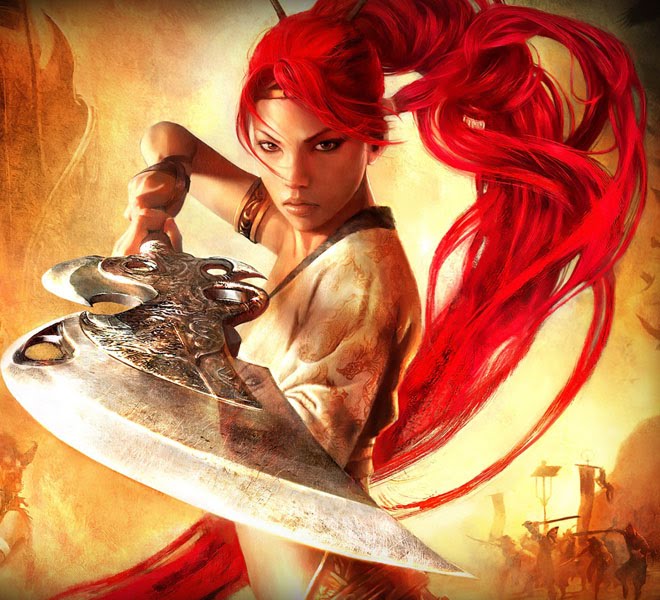
I'd also say that the quest mods out there are in general viewed with much harsher eyes than cosmetic mods. I've seen complaints posted about Alley of Murders and other people's quest mods complaining (in some cases with a fair amount of vitriol) about the quality of the mod, "plot holes", fights/enemy selection, a lack of voice acting, bad voice acting, too many homosexual romances, loot being "not phat enuf", too much blood spatter, lighting too purple, "hey, where are my ride-able horses?". Let's not forget there are mods dedicated to providing (usually overpowered) loot, homosexual romances, tougher combat, romanceable crates, etc, and they have varying quality too. For example, let's take one of the highly popular hairstyle mods. There are styles of varying quality, with some good ones, others suffering graphical issues from transparency to model clipping, and there are some which are just... well, a little "Heavenly Sword."
She's angry because someone stole her last bottle of hair dye.

My point is that if players download a customisation mod, they don't judge the models or content by the same yardstick as those produced by the developer themselves. This has been true of every modding community I've seen. Don't get me wrong, I know how hard making good 3D models is, or rewriting a combat system. In some cases, certain talented individuals are able to produce work of near-professional quality, and they are rightfully lauded praise. Unfortunately, when you're dealing with mods with playable content, the same leeway isn't given. As soon as the quality falls short of that provided by the game's developer, players are quick to criticise. Let's not forget that the content of the game itself is provided through years of work by a team of individuals who do this for a living. Modders don't have that time, and many have jobs that occupy a significant portion of their day.

Don't get me wrong, I support and popularise customisation mods which I've download and believe are well done, and there have been quite a few of them. I'm all for supporting mod authors in general, be they producing customisation or content.  However, I'm somewhat disillusioned that the player community still seems to be primarily supporting mods that are effectively cosmetic in nature. To draw a parallel, I never experimented too much with mods in Oblivion because when I looked, all I could find were mods of overpowered items, different textures, levelling systems or game mechanics. I left it and never went back. Apparently I might be a horrible person who should be punished for doing that, but I guess those are the breaks.

I don't want that to happen with Dragon Age.  It has the potential for some amazing story-telling with the ridiculously powerful toolset. However, doing that presents some significant issues that quest modders have to deal with other modders don't. Trust me on this one. The nightmare quotient from the occasionally recalcitrant toolset can be quite high at times. Even the "simple" process of creating a custom world map has only recently been "solved" (for varying values of "solved").

Modder: 0 vs Toolset/Lighting: 2

However, the story telling capability is not currently being recognised or supported by the player community at large. I know there are a number of projects in the pipeline from a number of mod authors and groups which I am certain will be quite impressive. I just hope the community is willing to support them when they come out. (Heck, if you're particularly awesome, support them now!) Unfortunately, based on the current situation, I'm not terribly optimistic that they will receive the recognition they deserve.  Please, players, modders, countrymen/women lend us your votes! Tell your friends, enemies, neighbours, random people on the street to download, vote for, popularise and comment on quest mods. Mod authors might even give out free hugs or cookies to kindly players.
Sunday, July 4, 2010

Shattered War: Character and Dialogue Creation

I haven't given a Shattered War update in a while, so I thought I'd detail some of what I've been doing.  Part of my work has involved dialogue and cutscenes in some of the early parts of the game. Good camera work is essential, but not coming from a directing/art/cinematic background, it can sometimes take me a while to work out exactly how a shot should be taken for it to be most effective.

Time has also been spent on the characters within the campaign, both good and bad, working on their backstory, motivations and so forth. This information is the kind that may not ever make it into the game (or the kind that the player might not discover even if it does), but it's essential as a writer to know exactly what makes your characters tick. To a degree, this information also helps inform the process of creating their appearance. I'm not accomplished when it comes to creating good head-morphs, but I feel I have been improving.  I feel it's important that the NPCs within Shattered War have their own unique appearance - I don't want people to have an NPC being a doppleganger for a beloved character from the original game!

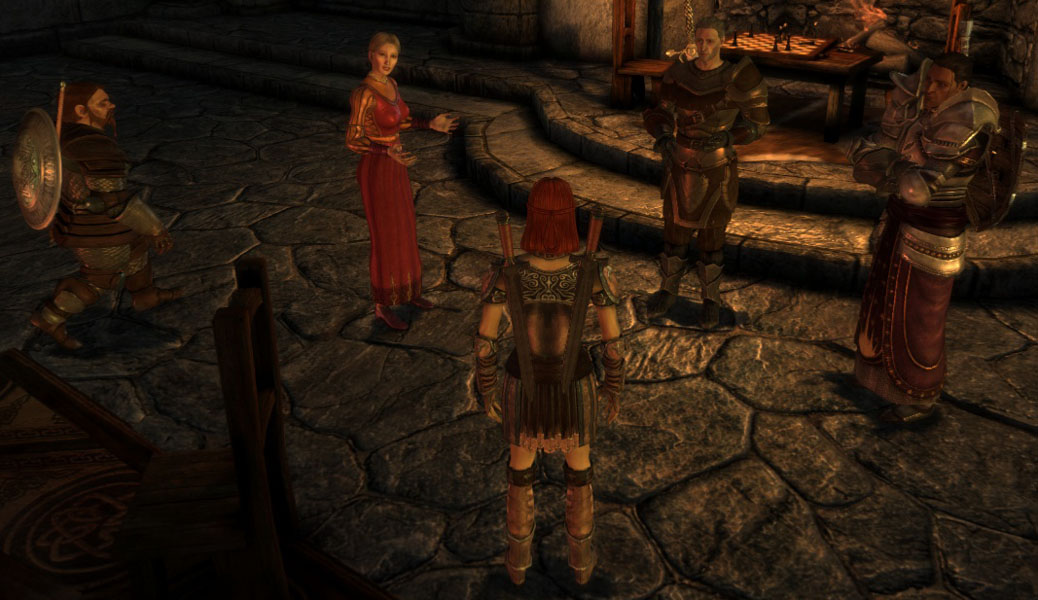
A meeting of importance

I am curious as to how much attention place on the various characters in the game. Is someone going to notice if I reuse "generic Denerim guard 13" as a minor character? Of course, characters of any significance I'm going to redo myself, but I must confess I'm tempted to use some of BioWare's head morphs for the ambient population that you never talk to properly.

I've also been devoting time to one of the party members by writing her dialogue interactions with the player, and I've increased her dialogue by around 1,000 words today. This is on top of the dialogue I've done for some other prominent characters within the story, whom you'll met on more than a few occasions. Of course, you can expect to have a choice of how you treat them... and how they subsequently react to use as a result of that

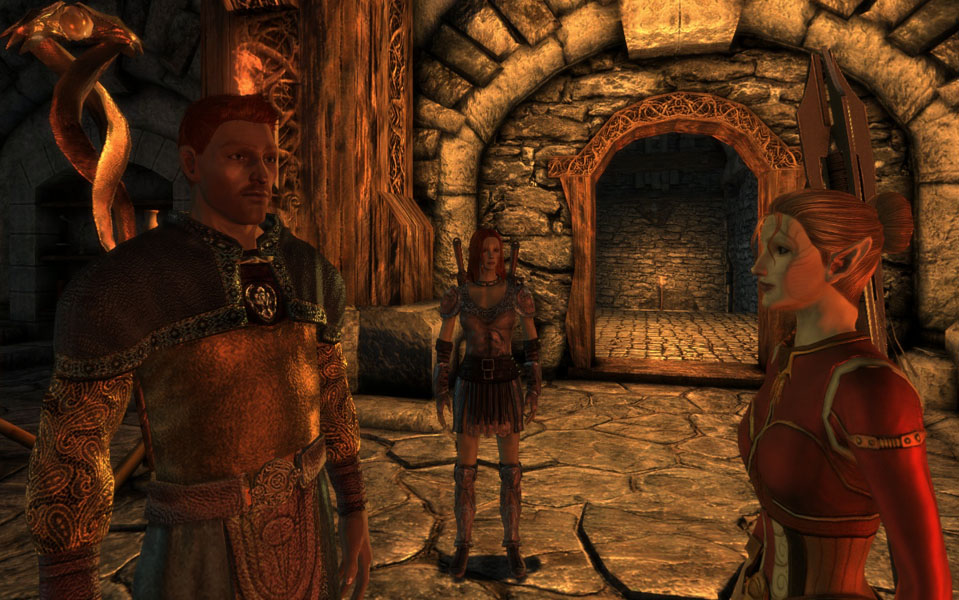
A pair of mages. Will you help or hinder them?

When creating character dialogue, particularly party companions, it's very important to try and squeeze the most out of every line. The number of lines that I'll be asking of whichever voice actors I get to provide the voice for the main companions will be quite high. As a result, I want to make sure that I'm making the best use of every single line, trying to impart as much information about the character as I can.

This also needs to be balanced against the need to give players choice, deciding whether they wish to treat the companion nicely or not, or whether they wish to pursue a romance with the character. Many players have professed their love for character romances (and the individual virtual characters of their affection), so I'm going to try and cater for something that seems to be very popular. Character romances are difficult to do well, and I've seen too many mods where a romance occurs and is consummated after a few brief exchanges.  You shouldn't expect that from The Shattered War - it's going to take time to get to know the characters, and you're going to have to prove your loyalty and dedication to them in order to become friends.

My current problem is that getting that degree of development is difficult in a tight timeframe. People complained about the lack of romances in Awakening, but given it was quite short, it would have been very difficult to do.  Yet The Shattered War will probably be shorter than Awakening, and I'm going to try and put them in.

I'm also trying to work out what players want to hear about in these development updates. Are people keen to see screenshots, hear about issues I've been facing, or see more "character interviews" like I did with Keldrin? I'm willing to try to cater to people's tastes... at least occasionally. :-)

Monday, June 21, 2010

The Shattered War Teaser Trailer

Based on the results of my poll, readers appear to be most interested in posts on game design, mod development updates and modding tutorials.

Given I've been talking about aspects of game design on a regular basis, I thought I'd put together a little something for everyone eager to hear about The Shattered War.

I've discussed several times the amount of effort that goes into things behind the scenes that people don't see. To try and illustrate this point more clearly, the following took around 11 hours of dedicated effort to complete and fiddle through issues like getting it to play nicely in Youtube. I hope you enjoy it...


PS Yes, the time on this post is accurate. That is how keen I am to give readers and players updates...

Monday, May 24, 2010

Reviews

Unfortunately I haven't been able to do much modding today. However, in order to get another update (yes, I'm trying to do them more regularly) I'm doing to do two reviews.

The first thing I'm going to discuss is Return to Korcari Wilds, which I mentioned in passing a few days ago. Now, given it's been out for a month, and already had more downloads, just as many endorsements and twice as many comments as Alley of Murders in one quarter of the time, I was expecting something pretty special. Now, I'll happily admit that I'm jealous of its statistics, but I'm more disappointed by the fact that it doesn't deliver.

Put simply, Return to Korcari Wilds is a 'dungeon' romp. It's a short and linear adventure where you kill a whole bunch of darkspawn. You're expected to encounter the three sets of NPCs in a set order - and in fact, the third one doesn't even appear until you've talked to the other two. There's no real roleplaying to speak of, and the dialogue is filled with spelling and grammatical errors. Yes, I understand that the creators speak Spanish as their first language, but there is barely a sentence that doesn't contain an error.


The combat of the mod seems like it would be very challenging for the most part. I played with a fairly high level warden and got through the majority of the fights without too much hassle, but I imagine it would be nigh on impossible for someone attempting it early in the game. An abundance of boss monsters, often with two in a fight, means that it would be very challenging.

There are a few cutscenes, notably featuring music from Prince of Persia: Warrior Within, which are reasonably well done. There are a number of pieces of custom loot, which are balanced apart from a few overpowered items; a two-handed sword with +30 spirit damage is the worst offender here. There are two companions, one of whom has a nice side quest to kill a Dragon, but again the quality control is lacking. See the mystical floating mountains of Ferelden...


However, all this said, Return to Korcari Wilds isn't a bad mod. For a straightforward combat-fest, it's fine, but the overall lack of polish made it trying for me. Given how well it has been received, I was expecting to be impressed by an adventure that integrated smoothly into the main campaign, but I was ultimately unsatisfied. This isn't to say I don't appreciate the effort that's gone into creating it, and I'd happily encourage the modders to improve upon their efforts. However, I suggest you play it expecting just to kill a bunch of enemies. With that expectation, you'll probably be happy.

The second thing I'd like to review is Warden's Fall, a short Dragon Age machinima. It's apparently going to be a series of videos telling the story of the Warden Kristoff, who seemingly takes his duty of killing darkspawn very seriously. The production values on this work are extremely high, and the people involved deserve credit for all the hard work they've put in. The only real complaint I have is that the directing during action suffers a bit from Michael-Bay-ism, or rapid-fire shots that reminded me of the second Bourne movie. However, I only comment on that because I can't find any other really constructive criticism at this point in time. The music, voice acting, cutting and sequences are well crafted and put together nicely. Seriously, go watch it if you haven't already.

I'd love to get some of the animators doing cutscenes for The Shattered War...

PS Please, give me your opinions on the texturing post I made yesterday, and vote in my poll!

Sunday, May 9, 2010

Are you paying attention?

One thing that I'm always interested to know is how much attention gamers pay to the game that they are playing. I'm not talking about how much gold they have, the amount of damage they are doing, or where their next enemies are, but the small details.

I want to know if player notice that the soldiers in Redcliff have worn armor, or shiny fresh armor made by the blacksmith, whether they spot the subtle play of shadows across the landscape, see the details in the modelling of the architecture of a building, or smile at an NPC remembering how you treated someone days ago.


To me, it seems like many gamers miss these small details because they're focused on something else. So many small details are missed by players simply because they're too engrossed in something else. I'll confess I'm guilty of it as well. The real question is, if those touches weren't there, would players then notice and then complain about it?

As a modder, I confess I get pedantic about the small touches. I care if there's a spelling mistake in a dialogue or description. I care if a character in the background of a cutscene suddenly jumps, and that the sounds in an area accurately reflect its environment, and that the music helps reflect the atmosphere. For Alley of Murders, I customised the automatically generated animations for about 80% of the dialogue so that they would fit better with the words being spoken, though admittedly sometimes it was also to prevent characters from waving their hands while they weren't actually speaking. I imagine that for most players, that was "invisible work"; they had no idea that it was done. Yet I still imagine I'll be doing a lot of it again for The Shattered War.


The reason I bring this up is because today I undertook the time-consuming and tedious process of manually editing the .plo files for the majority of the codex entries in the single player campaign. I have made these files available in a project on the BioWare social site. Why? Because this way, standalone mods can have their own set of codex entries, without having to force the user to see a horde of blank entries that exist because they are part of the main campaign.

Because of the way the codex entries are made, without these files, standalone mods would have a large swathe of empty codex entries that will never be filled because they're used by the main campaign. This way builders can add in their own entries without forcing the user to scan through a horde of blank entries. I wanted this for The Shattered War, and thought it would also be useful for other modders.

Will players care about this? Do players notice the small details? Or would they only notice them if they weren't there? So I ask players (and that includes modders), what small details do you notice? What are the things that you pay attention to and appreciate? And what omissions or mistakes annoy you?

Saturday, April 3, 2010

Building the Great Unknown

Today I've taken my first steps along the path of level creation within the Dragon Age toolset. Previously I'd opened the level editor up, failed to move around (thanks to a finicky issue with the scroll wheel click not acting as a middle mouse button), and quit. Even after I'd solved that, I has shied away from attempting again after seeing the near indecipherable model lists for art assets... yes, that's what that image on the right is, a partial list of the folders containing items to pretty up Dragon Age levels. Good luck figuring that out without a set of screenshots or a glossary.

But having mapped one of my spare buttons to act as the middle mouse, and knowing the only way to learn was by doing, I opened up the level editor this morning and had a go at it. My initial level was... too small. It seems 64mx64m is not really sufficient for an exterior area once you put in a few props and try to create some background to stop the player seeing past the edge of the terrain. But after ditching that and trying a 256mx256m area, I came up with something passable. It's still a work in progress, but this is my learning curve of dealing with a new level editor and part of the result of about 8 hours work.

You can click that(and the one further down) for a higher resolution image, by the way. I'm sure I'm making mistakes as I go, so anyone spots any glaring newbie errors in area creation, I'd be highly grateful if you could point them out to me. Please note that I've taken these screenshots from the toolset, and I'll reiterate that it is a work in progress. I'm yet to put down many models to clutter the area, and I've not even attempted any lighting. I also was not brave enough to try to use water for this first effort. I thought I'd start simple and work my way up in complexity.

One thing that did take me ages to work out how to do was to create overhangs. I was very happy when I saw overhangs in Dragon Age's landscape, but had forgotten about them. But, as I opened up one of the single player levels to find some trees, I saw one, and realised I didn't have any in my level. As such, I just had to have one. Or several. Then came the hair-tearing process of working out the level designers had done it. No matter how I used the terrain tools, I couldn't get it to work. Just as I was about to admit defeat and ask on the forums, I found the solution. It had been staring me in the face. It was the deform tool... but you need to change an option in the Object Inspector:

Simply set the Deform Mode to "Extrude along normal" and you can now make overhangs. Just extrude the face sideways, and use the tessellate tool to increase the density of your terrain mesh to get a nicer looking cliff/overhang. See exhibit B on the left in the foreground, and also exhibit C further back on the right.

I feel I should try and put together what I've learned in some kind of level editing "walkthrough" at some point to help other people through the other issues I've fought with bitterly. Though I might leave that for when I've been doing it for more than one day and actually have a playable level/area!

Saturday, February 6, 2010

The Dragon Age Modding Scene

Coming from NWN2 modding, I was curious to see how the distribution of user made content would be handled for Dragon Age. In response to a question on the issue previous, I'd like to raise a few points on Dragon Age's modding community in terms of its visibility to players.

The first issue is BioWare's social site versus Dragon Age Nexus. As of the time of writing, Alley of Murders has approximately 5100 downloads on Dragon Age Nexus, and the project has around 4400 views on the BioWare social site. That to me is fairly hard evidence that a serious rework of the social site is necessary. To have more downloads on one site than views on another indicates a distinct preference for one site over the other. The number of categories (and their ambiguous naming) and the inability to filter out incomplete projects from released projects are significant problems with the social site at present. These have been brought to BioWare's attention, and they have declared their intent to fix it. However, it is my opinion that unless something is done quickly, they are in serious danger of losing the custom content battle with Dragon Age Nexus.

As for the reception to Alley of Murders, players have generally been positive, and I've found most feedback to be quite useful or constructive. Of course, there are a few exceptions to this, but that's to be expected within any modding community. I feel I've received far fewer complaints than I did in NWN2 and a lot more praise, but that could be attributed to a number of factors: improvement in my own skills, smaller scope of module, adding to existing content and style rather than pushing a different gaming experience, and fewer modules means that people are very happy to have additional content.

The sheer number of "mods" that add a new character/store/hairstyle/body model as opposed to additional quest add-ins is staggering, and it seems extremely difficult for quest modules to get a great deal of notice at the current point in time. Comparing votes and popularity on the relative sites has such mods far outranking the quest mods currently available, but I do not know whether this is a result of the tastes of Dragon Age gamers or simply a reflection of the fact that there are only a couple of quest add-ins available.

One thing that has remained consisted from my other modding efforts in the past is the difficulty in getting mods recognised and publicising their existence. Neither the social site nor Dragon Age nexus have a good means to compare similar types of modules aside from a basic '1 point if you like it' system. While a 1-10 ranking system is typically flawed because a multitude of mods end with ridiculously high rankings, it is better than a 1-up system. Of course, both system rely on players coming back and providing a score/point and a comment, which is not a guarantee either. Many players simply don't bother to score or comment on a mod, and that's entirely their perogative. However, I would strongly urge players to comment (and score, if possible) on mods they download and play/use. Speaking as a modder, I want to know if players have enjoyed my module and what they would like to see improved for future work. Within reason, of course, as modders don't have the resources of a professional game company. But please, if you want modders to keep making mods, let us know that you're playing them!

It's early days in Dragon Age modding, so it will be interesting to see what happens to assist builders and players alike. But at the current stage, the primary difficulty seems to be the PR required to get your module noticed and downloaded.

Wednesday, February 3, 2010

Add-In/DLC Integration: Part 4


As part of my posts on Add-In DLC (Down-Loadable Content) integration, I'd like to take the opportunity to discuss cohesion as it relates to Dragon Age: Origins and Mass Effect 2. These two games offer a great comparison of DLC in terms of adding new characters. Both games have DLC that was available from day 1 that introduce a new party member that the player can take along.

Shale's integration into DAO is much more cohesive with the main game than Zaeed's into ME2 for two reasons:
1) Shale has more interjections. This is a pure content thing, but the more a character says, the more it feels like they are part of the story.
2) Zaeed's interactions within the Normandy are different to every other NPC that can join Shepard's crew. You don't get a proper dialog chain with Zaeed - he just spouts dialog at you, which really makes him feel like an afterthought rather than a core part of the game.

That said, Zaeed's sidequest fits in with the atmosphere of the game far better than Shale's sidequest. With Zaeed, you get a good insight into his character and history, and have to make some tough choices, as with many good quests in Mass Effect 2. By comparison, Shale's personal quest feels a little stale, having no real choices to be made, although learning about Shale is a somewhat interesting discovery.

Which is the better DLC? I guess that's up to individual taste. Personally, Shale feels more like a part of the game than Zaeed does, and I would argue that when DLC appears to truly part of the game as a whole, it is well designed DLC, as it maintains the immersion of the game.

Thursday, January 21, 2010

Release!

Alley of Murders has been released! It is now available for download on BioWare's social site.

Please download it, make it popular and spread the word!

Tuesday, January 19, 2010

Add-In/DLC Integration: Part 2

Part 2 in a series of post on how to make DLC/Add-Ins more integrated into Dragon Age: Origins.

Follower Interjections
The player travels with a party. It is only natural that they will have opinions on decisions you make. This was done very well for the game itself, and the Stone Prisoner DLC is a great example of integrated DLC in this regard. Though I love Shale's dry wit, so I might be biased here.

VO from companions is something that the developers can do, because they have the money and clout to hire voice actors. I'm guessing that the majority of modders don't have access to Claudia Black, Steve Valentine, Corinne Kempa, et al. However, we do have access to all the VO content used within the game. It is possible to track down lines that can be re-used or cut and re-arranged to form new interjections.

It's a very time consuming process, and sometimes you need to do some rewriting of your content in order to make their lines fit, but it is possible. It might be a small thing, and perhaps won't be noticed by everyone because they don't make choice X with party member Y present, but for those that do get those responses, it will likely make a big difference.

Sunday, January 17, 2010

Add-In/DLC Integration: Part 1

So in designing an Add-In for Dragon Age, one of the questions I asked myself at the start was: "How can this be integrated into the main campaign?" Given I'm currently having a closed beta for Alley of Murders, which means release is very close, I might add, I thought I'd offer my thoughts on how I did this.

I was not about to change a major part of the story for Alley of Murders, but I still wanted to have it so that it felt like a cohesive part of the game as a whole. So, the question remained of how to achieve that. I am sure this is something that the developers themselves wrangle with for DLC releases, as they want them to add to the whole story of Dragon Age Origins, while at the same time avoiding a "tacked on" feel that you get from some DLCs.

So over the next few days, I'm going to raise a few points I feel I'm going to list a few things that feel are required to make a DLC great, here are a few thoughts to help it mesh with the entire game. Some of these points are more generally applicable in RPG games in general, but I feel that an extra effort might need to be made for DLCs.


Reference the main story.
The Grey Warden makes many decisions during their adventures in Ferelden. The fact that these are remembered by NPCs in the world is a big part of what makes the storytelling in Dragon Age so rich. If NPCs in a DLC also know about major events (or events to which they would be privy), then it helps reinforce that feeling that their decisions have a real impact.

Anyone who has played the game knows there are a number of meaty decisions the player makes that have some serious ramifications for the future. NPCs know about these, and in some cases, will judge the player for them. Some NPCs might support the player's actions, whereas others will dislike them. You don't necessarily have to present both angles, but at least presenting one will make the player's experience more immersive.

Remember that this doesn't just have to be major decisions. Perhaps a relative of one of the people involved in a small sidequest might become involved in another plot. depending upon how the player solved the sidequest (or even if you didn't do it at all) might affect how that person interacts with the player... Perhaps one of the most obvious is to refer to the player's origin story - a Dalish is going to be treated quite differently to a human noble.

Sunday, January 10, 2010

Bugfixing, VO and trailer!

The majority of my work on "Alley of Murders" has been bugfixing and VO.

Fixing bugs is one of those things that can only be done with time, and lots of it. I'm trying to make sure that I've got as many bugs as I can find eliminated before having a small closed beta test. If you're interested in participating in that, please let me know. (Contacting me via the BioWare social site is probably the most efficient means for that)

So basically this means playing through the module with a pen and paper handy and noting down everything that doesn't work exactly as I'd wanted, or anything that doesn't seem quite right. This could be a plot helper icon not popping up (or displaying when it shouldn't!), a small typo in a sentence or quest journal, or a real bug where pursuing a quest in a certain way causes continuity issues. But I think most of those have been done now, so the only things I still want to do are a few minor cosmetic touches here and there, be it an extra short cutscene for a sentence or a few changes to the sound or ambiance.

The other major time consumer that has been taking up my time is voice acting integration. As my wonderful voice actors start have been sending me in their recorded lines, it's been my task to get them in the game. There can be a little bit of work doing post processing on the sound here and there: simple format conversion, a little bit of extra noise filtering, or adding/removing pauses in sentences, or renaming the files to the correct line number.

After this, it is on to doing the real integration in the toolset. Automatically generated poses and gestures are excellent base for conversation animations, but you will often find you want to tweak them for important lines. Any line that is more emphatic is a good candidate for manual control, to give the line more impact. Any key lines that the player has to see (for plot reasons) are also good ones to tweak. While it's not necessary to preview every line in the toolset (and indeed, for large modules, this would be quite impractical), I would recommend doing it for any lines that have considerable pauses in a sentence. This is because it is entirely possible that an NPC will be gesturing in the middle of a pause in speech, which does not at all look good by virtue of being an immersion breaker.

I can't come up with any hard and fast rules for customising animations, except for maybe two key rules:
1: Always have a blend in and blend out time set on your animations. I would recommend at least .25, if not .5 for every animation in order to avoid jerky movement.
2: Avoid animations that extend past the VO length for NPC lines where they also speak the next line. Increase the end-offset to stop the animation name from being red to fix this. Again this is to prevent choppy character movement as the character automatically jumps from their position at the end of one node to the beginning of the next. This is potentially alleviated by the automatically generated cameras (which frequently zoom in for NPC monologues), but you may want long shots during these exchanges too.

Finally, for those who may not have already seen it, I posted a trailer on Youtube for Alley of Murders.