I've been feeling less than 100% over the past couple of days, but still tried to get in some modding. I've been dealing with a swag of little issues as a result of playtesting:
A placeable not being interactive, companion attribute bonuses not appearing on the talent/skill (I think I may need to create entirely new custom abilities for this, however that is done), enemies not moving towards the player to attack (they spawn at a distance and are supposed to run towards the player), assorted scripting/tagging/plot logic errors, combat difficulty tweaking, fixing up codex entries for various items/areas/people, and a few other things besides.
The point here is to iron out all the issues in the opening few hours of the mod so I can potentially release a closed alpha/beta to a small group of willing testers in the near future. There's still lots of work to be done on the project as a whole (and there's still missing VO even in this prologue section), but I'd certainly love to here some independent opinion on the beginning of The Shattered War. Let me know if you're interested - an email to my gmail address (it's my "name" [the one in the graphic above] at gmail.com) would be fine - and I'll be in touch.
In closing, I thought I'd give a shout out to MiracleOfSound (aka Gavin Dunne) on the Escapist. Producing a new song every two weeks isn't a straightforward task, so when they're both pretty good, and game related, I can't help but love this work. Admittedly I was a fan ever since he told us we would never be better than Commander Shepard, but I really like his latest work, and like everything of late, it's all about Skyrim.
Sunday, December 18, 2011

Tuesday, December 13, 2011
Lessons from Skyrim (Part 2)
In my last post, I talked about some of the areas where games could learn from Skyrim in terms of its successes. In this post, I'd like to discuss some of the game's shortcomings.
Wait, you can get HOW powerful?
This has been a problem with Elder Scrolls (arguably Bethesda games in general) since Morrowind. As you get higher in levels, you can become obscenely powerful. It's not just that you become better as a player (which will arguably have some effect) or that you get better gear (which you will), it's the manner in which you can improve or create gear or your skills to the point where you become unfathomably powerful.
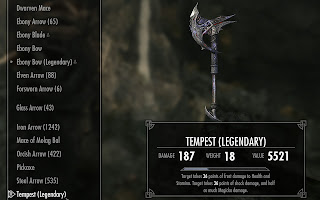
It's possible to enchant items to reduce the cost of destruction spells. These enchantments will stack across multiple items, potentially allowing you to decrease the cost of destruction spells (to unleash fire, ice or electricity upon your opponents) by 100%. That's right, with a high enchanting skill, you can cast offensive spells for no mana. Alternatively, maybe you'd like to increase your smithing abilities so you can create better weaponry. Well, if you get your smithing up to maximum level and improve items, you can end up with incredibly damaging weapons at your disposal that can dispatch any enemy in only a few hits.
Sure, the player can choose not to pursue these skills, but if they decide to, they don't necessarily realise how broken and overpowered these options are until it is too late. Then once the player has created and named their own custom set of enchanted armor and weapons, they can hardly be expected to just "give them up" simply because the designers failed to balance the game to cater for players who chose these pursuits.
Freak opponents
There are scaling issues for the opposition as well, though I wonder whether these might be bugs. A few times I faced an occasional quirks where one enemy would be vastly more powerful than its counterparts with exactly the same name (and hence theoretically should be the same level and roughly the same difficulty). In one case, a Falmer skulker (a low level archer) would kill me in a single hit if my health bar wasn't on absolute maximum. Not two enemies later, I found another Falmer skulker than did negligible damage and I could have taken about 8 arrows from him before I died. Even in my low 40s I encountered a random bandit that launched fireballs with utmost haste and I was dead before I even managed to get a bead on where he was shooting from. Fortunately in the latter case, a reload resulted in his replacement enemy being "normal", but the Falmer Skulker proved to be a very tough and annoying enemy to defeat.
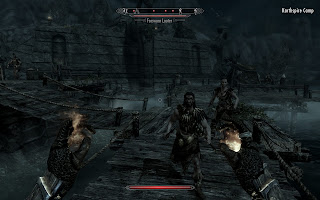
Even at a high level (52), I've faced a couple of opponents that killed me in one hit while decked out in full dragonscale armor, and I've got a bucketload of armor increasing perks. Now, while I appreciate the concept that there are still enemies out there who could potentially be a threat to me, it simply doesn't make sense for some random vagrant in a hideout presenting more danger than some of the named "epic foes" of the game.
The run around
The real joy of the game comes from exploration. When you reach the point where you want to just go around completing quests, the game becomes a little bit more tedious than the heights of excitement that it offers. Once you've explored vast amounts of the map and are just looking to complete some quests, it becomes a simple matter of "Pick up quest at point A", "Fast travel to point B to have conversation", "Fast travel to point C to kill a few enemies", "Fast travel to point A to complete quest". Without the exploration aspect, quest completion often becomes a very straightforward process that doesn't hold a whole lot of surprises or intrigue.
The Elder Scrolls games focus on a massive breadth of content, and that is their strength. You have the freedom to explore pretty much anywhere and choose to do (or not do) what you wish. The problem is that while every player ultimately has a different experience because of that freedom, that freedom means that there is very little or no "small scale" freedom in determining how each of the "mini-adventures" play out. For the majority of quests, everyone will have the same experience in how the interactions and results play out, with the differences coming from the style of combat that the player chooses or the route they travel to reach their destination. There's no real replay value for individual quests, but merely replay value on attempting different combat styles, which as I've mentioned, you can potentially explore entirely in a single playthrough anyway.

In same cases there are some minor choices which affect how things play out, but these are by far the exception rather than the rule. Even the dialogue roleplaying aspects are notably shallow, and your character is mostly a blank and shallow creation which has to follow many of the same lines regardless of personality. Given you are playing the voiceless dragonborn, it's up to you to inject personality into your character, because the game offers very little input into that aspect of roleplaying. You have a choice of what quests you will do in the world, but virtually no choice as to how you complete them.
World reactivity
One of the more notable problems relating to the immersion of the world is how it reacts to you. The problem here isn't that the characters don't react to you, because they do. It's that they don't react to you in a consistent manner. Town guards can notice me walking around with Azura's Star (a daedric artifact), yet Vigiliants of Stendarr (who hate daedra worshippers) won't bat an eyelid when I walk past them carrying the same daedric artifact, or even a daedric weapon from a daedra they consider to be (very) evil, even when I'm wearing armor from a different and also evil daedra. People from the other side of Skyrim will say "You're that made from College, heard about you", yet Farengar from Whiterun will keep telling me I should join the mages college if I have the aptitude, even though I've been the archmage for a couple of months. Or there's the guards that make fun of me being responsible fetching the mead for The Companions even though I've been their leader for even longer.
It's the inconsistency that gets to you in this regard, but also the fact that people seem to magically know things about you. The immersion breaker here is someone commenting: "so you're an alchemist then" or "I've always had respect for the school of restoration, Skyrim could do with more healers" even though they've never set eyes on me before, and I certainly haven't made a potion or cast a healing spell in front of them. By attempting to make the world react so much to you, it actually ends up feeling less realistic because the NPCs don't react to you in a believable manner. On the plus side, at least it does stop those guards talking incessantly about their old injuries...

These issues aren't entirely dealbreakers, but they are shortcomings of the game's design. Skyrim makes half-hearted attempts to address these issues, but as a result doesn't manage to satisfy the player in these areas. The balance is askew, choice is minimal at best, and the world has the bizarre situation of paying lip service to your actions without ever reacting to them properly.
Wait, you can get HOW powerful?
This has been a problem with Elder Scrolls (arguably Bethesda games in general) since Morrowind. As you get higher in levels, you can become obscenely powerful. It's not just that you become better as a player (which will arguably have some effect) or that you get better gear (which you will), it's the manner in which you can improve or create gear or your skills to the point where you become unfathomably powerful.
It's possible to enchant items to reduce the cost of destruction spells. These enchantments will stack across multiple items, potentially allowing you to decrease the cost of destruction spells (to unleash fire, ice or electricity upon your opponents) by 100%. That's right, with a high enchanting skill, you can cast offensive spells for no mana. Alternatively, maybe you'd like to increase your smithing abilities so you can create better weaponry. Well, if you get your smithing up to maximum level and improve items, you can end up with incredibly damaging weapons at your disposal that can dispatch any enemy in only a few hits.
Sure, the player can choose not to pursue these skills, but if they decide to, they don't necessarily realise how broken and overpowered these options are until it is too late. Then once the player has created and named their own custom set of enchanted armor and weapons, they can hardly be expected to just "give them up" simply because the designers failed to balance the game to cater for players who chose these pursuits.

Creating this was an exciting achievement, but it makes fighting a straightforward bore
Freak opponents
There are scaling issues for the opposition as well, though I wonder whether these might be bugs. A few times I faced an occasional quirks where one enemy would be vastly more powerful than its counterparts with exactly the same name (and hence theoretically should be the same level and roughly the same difficulty). In one case, a Falmer skulker (a low level archer) would kill me in a single hit if my health bar wasn't on absolute maximum. Not two enemies later, I found another Falmer skulker than did negligible damage and I could have taken about 8 arrows from him before I died. Even in my low 40s I encountered a random bandit that launched fireballs with utmost haste and I was dead before I even managed to get a bead on where he was shooting from. Fortunately in the latter case, a reload resulted in his replacement enemy being "normal", but the Falmer Skulker proved to be a very tough and annoying enemy to defeat.
Even at a high level (52), I've faced a couple of opponents that killed me in one hit while decked out in full dragonscale armor, and I've got a bucketload of armor increasing perks. Now, while I appreciate the concept that there are still enemies out there who could potentially be a threat to me, it simply doesn't make sense for some random vagrant in a hideout presenting more danger than some of the named "epic foes" of the game.

Is this Forsworn going to one-shot me? Who knows?
The run around
The real joy of the game comes from exploration. When you reach the point where you want to just go around completing quests, the game becomes a little bit more tedious than the heights of excitement that it offers. Once you've explored vast amounts of the map and are just looking to complete some quests, it becomes a simple matter of "Pick up quest at point A", "Fast travel to point B to have conversation", "Fast travel to point C to kill a few enemies", "Fast travel to point A to complete quest". Without the exploration aspect, quest completion often becomes a very straightforward process that doesn't hold a whole lot of surprises or intrigue.
The Elder Scrolls games focus on a massive breadth of content, and that is their strength. You have the freedom to explore pretty much anywhere and choose to do (or not do) what you wish. The problem is that while every player ultimately has a different experience because of that freedom, that freedom means that there is very little or no "small scale" freedom in determining how each of the "mini-adventures" play out. For the majority of quests, everyone will have the same experience in how the interactions and results play out, with the differences coming from the style of combat that the player chooses or the route they travel to reach their destination. There's no real replay value for individual quests, but merely replay value on attempting different combat styles, which as I've mentioned, you can potentially explore entirely in a single playthrough anyway.

I could go anywhere, but that is the only real choice
In same cases there are some minor choices which affect how things play out, but these are by far the exception rather than the rule. Even the dialogue roleplaying aspects are notably shallow, and your character is mostly a blank and shallow creation which has to follow many of the same lines regardless of personality. Given you are playing the voiceless dragonborn, it's up to you to inject personality into your character, because the game offers very little input into that aspect of roleplaying. You have a choice of what quests you will do in the world, but virtually no choice as to how you complete them.
World reactivity
One of the more notable problems relating to the immersion of the world is how it reacts to you. The problem here isn't that the characters don't react to you, because they do. It's that they don't react to you in a consistent manner. Town guards can notice me walking around with Azura's Star (a daedric artifact), yet Vigiliants of Stendarr (who hate daedra worshippers) won't bat an eyelid when I walk past them carrying the same daedric artifact, or even a daedric weapon from a daedra they consider to be (very) evil, even when I'm wearing armor from a different and also evil daedra. People from the other side of Skyrim will say "You're that made from College, heard about you", yet Farengar from Whiterun will keep telling me I should join the mages college if I have the aptitude, even though I've been the archmage for a couple of months. Or there's the guards that make fun of me being responsible fetching the mead for The Companions even though I've been their leader for even longer.
It's the inconsistency that gets to you in this regard, but also the fact that people seem to magically know things about you. The immersion breaker here is someone commenting: "so you're an alchemist then" or "I've always had respect for the school of restoration, Skyrim could do with more healers" even though they've never set eyes on me before, and I certainly haven't made a potion or cast a healing spell in front of them. By attempting to make the world react so much to you, it actually ends up feeling less realistic because the NPCs don't react to you in a believable manner. On the plus side, at least it does stop those guards talking incessantly about their old injuries...

I was going to do this post last week, then I took an arrow in the knee
These issues aren't entirely dealbreakers, but they are shortcomings of the game's design. Skyrim makes half-hearted attempts to address these issues, but as a result doesn't manage to satisfy the player in these areas. The balance is askew, choice is minimal at best, and the world has the bizarre situation of paying lip service to your actions without ever reacting to them properly.
Wednesday, December 7, 2011
Lessons from Skyrim
My apologies for being a little quiet on the blog front lately. I should reassure those eagerly awaiting the release of The Shattered War that I have actually been putting some time into modding. It is time, however, to take a closer look at some aspects of design of the recent success that is Skyrim, and look at those things that did and did not work. In this post, I'll examine some of the design issues that other games can learn from.
Art Design aka "It's not all about tech"
There is no denying that Skyrim is a beautiful game. People are taking time lapse "photography" of the game because it simply looks that good. Now, while many will attribute this to the "graphics", which is the technical wizardry behind the graphics, this isn't why the game is so jaw-dropping. Compare it to Crysis 2, which technically is a gorgeous game, but from a design point of view there weren't a lot of those moments where you just stopped and went "Wow, that's gorgeous." Skyrim, despite not having all the bells and whistles of the best Anti-aliasing, shader effects, glorious reflections and refractions, real-time realistic shadows, DX11 tesselation, or the myriad of other features offered in some technically superior games, simply looks attractive. It doesn't have the highest resolution textures or the best level of detail distance gradient handling, but it just downright looks good.
The reason Skyrim looks so good is because of the effort made to create a beautiful world where there are particular artistic styles and themes throughout. The terrain covers alpine forests, rolling hills, badlands, swamps, rivers cutting through chasms, ice floes... there are so many different types of terrain but each presents a cohesive visual style and this is supported by the flora, animals, weather and even enemies that you encounter in those areas. This applies to the interiors as well, each of which adhere to a consistent style, but have their own unique elements. The Dwemer ruins in particular have some absolutely spectacular scenery; it's likely that you've never seen dwarven ruins that look this good in any medium.

Level Design
The aesthetics of level design are not the only aspects that should be credited here, but also the functional aspects of levels. Interiors, in particular is an area where levels have typically been designed very well. Backtracking is a problem that results in tedious gameplay of passing over empty areas when you force the player into an area within one way in and out. The obvious means to solve this problem is to have an exit when the player reaches the end, though this the designers must mean that this cannot be an alternate entrance to the area that an adventurous player could potentially find and short-circuit the entire dungeon. Skyrim does manage to do this, and it is quite effective.
Perhaps even more impressive and interesting is the manner in which many dungeons are created with only a single entrance/exit, but are created as a closed loop. The player follows a set path to reach the final boss/treasure room, but continuing after this will result in the player looping back to a location very near to the entrance of the interior. Even more successful is that this is done in a variety of ways, so it doesn't ever feel particularly stale or overly contrived. The "exit path" joins is blocked off from the entrance path by a number of ways: sometimes a barred door or unopenable gate, sometimes a secret door, other times a high ledge that is impossible for the player to reach. This loop system, in conjunction with areas that do have a separate entrance and exit, means that design of interior levels is both interesting and functional.
Puzzles
Skyrim shows how puzzles in games can be done really well. These puzzles aren't minigames. They aren't alternative game mechanics. They're elements within the gameworld that are integrated in a fashion to present the player with a simple mental/visual challenge in order to proceed. Fairly early on in the game, you'll likely stumble across a door with three rings with symbols open them, which can apparently be opened by a claw. While this initially might seem like an issue of trial and error, you'll quickly learn that the claw holds the key to the correct sequence of symbols. This puzzle becomes trivial once you know the solution, but it's a near seamless way to include puzzles into the game.
Traps are visible and possible to avoid if you as the player are attentive, as opposed to a random die roll that determines whether your character can see them. While this isn't new, the traps are such that you actually do care about them because they can do a lot of damage or kill you outright, but also because you can quite easily use them to destroy unwitting enemies. This is a refreshing change from things like the paltry shotgun traps of Fallout 3 that were really of little consequence except for providing you with repair fodder/ammo.
There are symbol alignment/placement puzzles and lever switching puzzles that are also fairly easy to solve for the attentive and/or logical player, but the real joy is that you feel like you're interacting with the environment itself. There's no BioShock pipemania, no Mass Effect 1 Simon, no Alpha Protocol "findaword". It's simply a matter of observing the gameworld and interacting with it directly. It almost feels like a pity that the lockpicking mechanic is akin to those from Fallout, for this pulls you out of the gameworld in a way that the puzzles do not.

Now, while these are aspects of Skyrim that I thought deserve a positive mention, there are some places where Bethesda still come up a little short. I'll be looking at a few of those areas in my next post.
Art Design aka "It's not all about tech"
There is no denying that Skyrim is a beautiful game. People are taking time lapse "photography" of the game because it simply looks that good. Now, while many will attribute this to the "graphics", which is the technical wizardry behind the graphics, this isn't why the game is so jaw-dropping. Compare it to Crysis 2, which technically is a gorgeous game, but from a design point of view there weren't a lot of those moments where you just stopped and went "Wow, that's gorgeous." Skyrim, despite not having all the bells and whistles of the best Anti-aliasing, shader effects, glorious reflections and refractions, real-time realistic shadows, DX11 tesselation, or the myriad of other features offered in some technically superior games, simply looks attractive. It doesn't have the highest resolution textures or the best level of detail distance gradient handling, but it just downright looks good.
The reason Skyrim looks so good is because of the effort made to create a beautiful world where there are particular artistic styles and themes throughout. The terrain covers alpine forests, rolling hills, badlands, swamps, rivers cutting through chasms, ice floes... there are so many different types of terrain but each presents a cohesive visual style and this is supported by the flora, animals, weather and even enemies that you encounter in those areas. This applies to the interiors as well, each of which adhere to a consistent style, but have their own unique elements. The Dwemer ruins in particular have some absolutely spectacular scenery; it's likely that you've never seen dwarven ruins that look this good in any medium.

It's a long way down...
Level Design
The aesthetics of level design are not the only aspects that should be credited here, but also the functional aspects of levels. Interiors, in particular is an area where levels have typically been designed very well. Backtracking is a problem that results in tedious gameplay of passing over empty areas when you force the player into an area within one way in and out. The obvious means to solve this problem is to have an exit when the player reaches the end, though this the designers must mean that this cannot be an alternate entrance to the area that an adventurous player could potentially find and short-circuit the entire dungeon. Skyrim does manage to do this, and it is quite effective.
Perhaps even more impressive and interesting is the manner in which many dungeons are created with only a single entrance/exit, but are created as a closed loop. The player follows a set path to reach the final boss/treasure room, but continuing after this will result in the player looping back to a location very near to the entrance of the interior. Even more successful is that this is done in a variety of ways, so it doesn't ever feel particularly stale or overly contrived. The "exit path" joins is blocked off from the entrance path by a number of ways: sometimes a barred door or unopenable gate, sometimes a secret door, other times a high ledge that is impossible for the player to reach. This loop system, in conjunction with areas that do have a separate entrance and exit, means that design of interior levels is both interesting and functional.
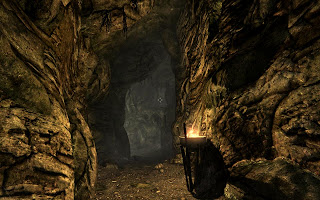
This is the entrance to a cave, and that ledge is shortly after the final room
Puzzles
Skyrim shows how puzzles in games can be done really well. These puzzles aren't minigames. They aren't alternative game mechanics. They're elements within the gameworld that are integrated in a fashion to present the player with a simple mental/visual challenge in order to proceed. Fairly early on in the game, you'll likely stumble across a door with three rings with symbols open them, which can apparently be opened by a claw. While this initially might seem like an issue of trial and error, you'll quickly learn that the claw holds the key to the correct sequence of symbols. This puzzle becomes trivial once you know the solution, but it's a near seamless way to include puzzles into the game.
Traps are visible and possible to avoid if you as the player are attentive, as opposed to a random die roll that determines whether your character can see them. While this isn't new, the traps are such that you actually do care about them because they can do a lot of damage or kill you outright, but also because you can quite easily use them to destroy unwitting enemies. This is a refreshing change from things like the paltry shotgun traps of Fallout 3 that were really of little consequence except for providing you with repair fodder/ammo.
There are symbol alignment/placement puzzles and lever switching puzzles that are also fairly easy to solve for the attentive and/or logical player, but the real joy is that you feel like you're interacting with the environment itself. There's no BioShock pipemania, no Mass Effect 1 Simon, no Alpha Protocol "findaword". It's simply a matter of observing the gameworld and interacting with it directly. It almost feels like a pity that the lockpicking mechanic is akin to those from Fallout, for this pulls you out of the gameworld in a way that the puzzles do not.

Symbols to align before I can pull the level to open the gate
Now, while these are aspects of Skyrim that I thought deserve a positive mention, there are some places where Bethesda still come up a little short. I'll be looking at a few of those areas in my next post.
Sunday, November 27, 2011
Star Wars: The Old Republic - Beta Review
There was a large scale beta stress test for SW:TOR on the weekend, and I was fortunate enough to be able to participate. Testers have been told they can "freely talk about their experiences this past weekend within the game, as well as post screenshots and gameplay videos of their testing experiences". So, with that in mind, let's just into an appraisal of my experience. This follows about a four hour journey of my testing.
After sitting through the excellent intro video that many people have already seen, I got presented with a server list... all of which were full. Picking one with the lowest wait time on the West Coast of the US, I did a few things while waiting to get a slot. Within a few minutes, I was logged on and ready to pick a side. After picking the Galactic Republic, I was treated to the "Hope" trailer before I got to select my class. Now, maybe it's just me, but I would have thought that anyone who is keen enough to participate in a beta will probably have already watched these videos, and even if they haven't they add little enough to the actual story of the game as it's presented to the player for them to actually matter. I might be nitpicking here over some nice eye candy, but as far as I was concerned, I didn't need to waste my time and download bandwidth on those videos.
Regardless, I fired up the character creator and got to select my class (Jedi Consular), race (Miralukan - like Visas Marr), and then the usual character appearance customisation. This defined body & face shape, skin tone, hair style/color, scars and my "mask" (seeing as Miralukans are physically blind). Unlike many MMOs it actually appeared as though this appearance would help individualise the character, as I didn't see anything items that I'd be wearing over my head or obscuring those choices completely. Now, of course, there is the potential that people will create identical looking characters, but there seemed to be enough variation that you wouldn't have everyone looking the same. With my character created, I was treated to the classic Star Wars rolling text over space before being presented with a cutscene of my character turning up on a Jedi homeworld.

First, let's talk about the visuals. It's not a mindbogglingly gorgeous game, and there were some texture issues like texture pop in dialogue/gameplay and generally low texture resolution. That said, it still looks okay, though I wouldn't be surprised if there are some improvements before the final release. The art design is clean and simple, going for a stylised appearance. To be honest, that's what I've come to expect of an MMO. Having to deal with high resolution graphics along with the overhead of an MMO is something that modern computers can do, but an MMO has to market to as many people as possible and targeting the enthusiast PC market doesn't mesh with that aim. I didn't really have any "wow, that looks awesome" moments in terms of scenery, but to be honest I don't think I've ever got that within the first four hours of an MMO.
On the plus side, the character animations are quite smooth, and it imparts some of the "yeah, I'm a real hero" feeling that is sometimes lacking from the regular "I throw a fireball", "I shoot a gun", "I hit the enemy with my fists" that feels flat and lifeless. It's no Ninja Gaiden or God of War, but it does feel a little more potent than contemporary MMOs. This is a little bit offset by the fact that it feels somewhat slow when you run, and the silly looking jump animation that looks like it's pulled straight from WoW. That said, my Jedi did do a nice looking tumble roll when he fell from a significant height, which was a very nice touch.

In general story-telling and quest flow, you can feel the "BioWare formula" coming through. It feels like a BioWare game, with the dialogue wheel, characters building you along the way, and leading you along the "individual journey" that their games typically manage well. This does come across a little strange I had people telling me "you're the most talented person we've seen in years" only to see other Jedi Consulars running along the exact same paths as me... this did shatter the illusion of my character being "special" as I was being told, knowing that all these other players were being given the same speech. Perhaps this problem was exacerbated by having so many beginners at the same time, but it felt as though it weakened the narrative a little. The writing still seemed quite reasonable, though I confess that once again I was put off the Jedi order by a "love is evil and leads to the dark side" sidequest.
That said, the voice acting is very good across the board, though I really do wonder how necessary it is. Some players were commenting how it drew them into the game a lot more and that they actually paid attention to the story, which is obviously what the designers were aiming for. I lost count of the number of times I was in a group in other MMOs were quest dialogue/overviews were skipped, and eventually I began ignoring them myself because trying to follow the story was already a lost cause. I briefly got to play in a group, which was a really nice touch, as each player got to say lines of dialogue (though I wasn't clear on how the game chose WHO would speak) within the conversation. This actually really made it feel like you were in a party and pushed that social aspect forward. The NPCs also emote and have the facial expression variance that has become a staple of BioWare's titles. While they're talking to you, the characters do a good job as virtual actors.

Now the big one: gameplay. Well... it's an MMO. If you hate MMOs, this probably isn't going to change your mind. Combat is not automatic - if you want to attack, you have to push a button and keep pushing them until your enemy is dead. Living in Australia, I thought this might be somewhat problematic given a beta stress test weekend and having to connect to a server on the US West coast. I was pleasantly surprised to find that lag was not a significant issue at all, and that I could quite comfortably manage to play with only a couple of lag spikes. I seemed to be getting better performance than some other US players. To start with it felt like the standard "mash button until enemy is dead" gameplay of MMOs, but I did pick up a few abilities near the end to perform stun and lift (crowd control), so it did seem as though the variety of skills and tactics to use would increase as I increased in level. There was a sense of "I've been here before" that I couldn't quite shake, but it seems like the so called "advanced classes" will allow players to pick different roles (tank, healer, support, DPS) based on what is necessary for the group they're travelling with. It's hard to tell whether this will lead to people trying to be a jack-of-all-trades or pursuing particular specialised roles as characters reach higher levels.
The usual MMO problem of backtracking is no less present in TOR than any other MMO, although they have tried to lessen the impact through liberal use of "quick transport" options - speeders that will get you from one location to another for a minimal fee. This does help alleviate the dull "run back to the quest giver" chore that plagues many MMOs, but without removing it entirely. Creatures spawn regularly and populate the map in large numbers, but in some cases it is possible to pass them by without fighting if you're just trying to do a return run. Side quests also become available when you're about to head to a new area for your class "main quest", meaning that you easily polish off a few quests in one trip, making it feel more productive and heroic. Additionally, the classic grind quests of "kill 65,340,285 boars" are mostly relegated to "additional objectives" as part of other quests. This is a nice touch in that the grind feels as though it's optional, and for the most part you'll likely end up killing the required number of creatures as a matter of course in trying to achieve the core objective of the quest.

As an overall experience, it seemed reasonably fun, though I do feel as though it would have been far more enjoyable with a group. It really did seem as though group play would feel a lot more rewarding, and going solo somehow made it feel as though you were missing out. I'd be interested to see how different the experience is in that case. The other issue is the concept of choice and the light-side/dark-side within the game. I didn't see any real consequences as a result of previous choices I'd made in my brief journey, but I'm not sure that I can necessarily expect that in such a short time frame. The light side points I kept gaining (yeah, yeah, I was playing a goody-two-shoes, deal with it) didn't really seem to have any great benefit. I was told by the in-game help that certain items would require me to have a certain level of light side points in order to equip, but if that's as far as the system goes, then it feels a little... "gamey".
So, Star Wars: The Old Republic - it's an MMORPG in the Star Wars universe with an increased focus on story. It had a feel similar to the Knights of the Old Republic games, and that's by no means a bad thing. How it will translate into a fully-fledged release will be interesting to watch, but it is definitely an MMO to keep your eye on.
After sitting through the excellent intro video that many people have already seen, I got presented with a server list... all of which were full. Picking one with the lowest wait time on the West Coast of the US, I did a few things while waiting to get a slot. Within a few minutes, I was logged on and ready to pick a side. After picking the Galactic Republic, I was treated to the "Hope" trailer before I got to select my class. Now, maybe it's just me, but I would have thought that anyone who is keen enough to participate in a beta will probably have already watched these videos, and even if they haven't they add little enough to the actual story of the game as it's presented to the player for them to actually matter. I might be nitpicking here over some nice eye candy, but as far as I was concerned, I didn't need to waste my time and download bandwidth on those videos.
Regardless, I fired up the character creator and got to select my class (Jedi Consular), race (Miralukan - like Visas Marr), and then the usual character appearance customisation. This defined body & face shape, skin tone, hair style/color, scars and my "mask" (seeing as Miralukans are physically blind). Unlike many MMOs it actually appeared as though this appearance would help individualise the character, as I didn't see anything items that I'd be wearing over my head or obscuring those choices completely. Now, of course, there is the potential that people will create identical looking characters, but there seemed to be enough variation that you wouldn't have everyone looking the same. With my character created, I was treated to the classic Star Wars rolling text over space before being presented with a cutscene of my character turning up on a Jedi homeworld.

In retrospect, I feel like I made a Jedi Guybrush Threepwood
First, let's talk about the visuals. It's not a mindbogglingly gorgeous game, and there were some texture issues like texture pop in dialogue/gameplay and generally low texture resolution. That said, it still looks okay, though I wouldn't be surprised if there are some improvements before the final release. The art design is clean and simple, going for a stylised appearance. To be honest, that's what I've come to expect of an MMO. Having to deal with high resolution graphics along with the overhead of an MMO is something that modern computers can do, but an MMO has to market to as many people as possible and targeting the enthusiast PC market doesn't mesh with that aim. I didn't really have any "wow, that looks awesome" moments in terms of scenery, but to be honest I don't think I've ever got that within the first four hours of an MMO.
On the plus side, the character animations are quite smooth, and it imparts some of the "yeah, I'm a real hero" feeling that is sometimes lacking from the regular "I throw a fireball", "I shoot a gun", "I hit the enemy with my fists" that feels flat and lifeless. It's no Ninja Gaiden or God of War, but it does feel a little more potent than contemporary MMOs. This is a little bit offset by the fact that it feels somewhat slow when you run, and the silly looking jump animation that looks like it's pulled straight from WoW. That said, my Jedi did do a nice looking tumble roll when he fell from a significant height, which was a very nice touch.

It's an MMO. Don't expect Crysis 2 tech here.
In general story-telling and quest flow, you can feel the "BioWare formula" coming through. It feels like a BioWare game, with the dialogue wheel, characters building you along the way, and leading you along the "individual journey" that their games typically manage well. This does come across a little strange I had people telling me "you're the most talented person we've seen in years" only to see other Jedi Consulars running along the exact same paths as me... this did shatter the illusion of my character being "special" as I was being told, knowing that all these other players were being given the same speech. Perhaps this problem was exacerbated by having so many beginners at the same time, but it felt as though it weakened the narrative a little. The writing still seemed quite reasonable, though I confess that once again I was put off the Jedi order by a "love is evil and leads to the dark side" sidequest.
That said, the voice acting is very good across the board, though I really do wonder how necessary it is. Some players were commenting how it drew them into the game a lot more and that they actually paid attention to the story, which is obviously what the designers were aiming for. I lost count of the number of times I was in a group in other MMOs were quest dialogue/overviews were skipped, and eventually I began ignoring them myself because trying to follow the story was already a lost cause. I briefly got to play in a group, which was a really nice touch, as each player got to say lines of dialogue (though I wasn't clear on how the game chose WHO would speak) within the conversation. This actually really made it feel like you were in a party and pushed that social aspect forward. The NPCs also emote and have the facial expression variance that has become a staple of BioWare's titles. While they're talking to you, the characters do a good job as virtual actors.

She looked and sounded concerned
Now the big one: gameplay. Well... it's an MMO. If you hate MMOs, this probably isn't going to change your mind. Combat is not automatic - if you want to attack, you have to push a button and keep pushing them until your enemy is dead. Living in Australia, I thought this might be somewhat problematic given a beta stress test weekend and having to connect to a server on the US West coast. I was pleasantly surprised to find that lag was not a significant issue at all, and that I could quite comfortably manage to play with only a couple of lag spikes. I seemed to be getting better performance than some other US players. To start with it felt like the standard "mash button until enemy is dead" gameplay of MMOs, but I did pick up a few abilities near the end to perform stun and lift (crowd control), so it did seem as though the variety of skills and tactics to use would increase as I increased in level. There was a sense of "I've been here before" that I couldn't quite shake, but it seems like the so called "advanced classes" will allow players to pick different roles (tank, healer, support, DPS) based on what is necessary for the group they're travelling with. It's hard to tell whether this will lead to people trying to be a jack-of-all-trades or pursuing particular specialised roles as characters reach higher levels.
The usual MMO problem of backtracking is no less present in TOR than any other MMO, although they have tried to lessen the impact through liberal use of "quick transport" options - speeders that will get you from one location to another for a minimal fee. This does help alleviate the dull "run back to the quest giver" chore that plagues many MMOs, but without removing it entirely. Creatures spawn regularly and populate the map in large numbers, but in some cases it is possible to pass them by without fighting if you're just trying to do a return run. Side quests also become available when you're about to head to a new area for your class "main quest", meaning that you easily polish off a few quests in one trip, making it feel more productive and heroic. Additionally, the classic grind quests of "kill 65,340,285 boars" are mostly relegated to "additional objectives" as part of other quests. This is a nice touch in that the grind feels as though it's optional, and for the most part you'll likely end up killing the required number of creatures as a matter of course in trying to achieve the core objective of the quest.

After adventuring in those mountains, I go to turn in three quests at once
As an overall experience, it seemed reasonably fun, though I do feel as though it would have been far more enjoyable with a group. It really did seem as though group play would feel a lot more rewarding, and going solo somehow made it feel as though you were missing out. I'd be interested to see how different the experience is in that case. The other issue is the concept of choice and the light-side/dark-side within the game. I didn't see any real consequences as a result of previous choices I'd made in my brief journey, but I'm not sure that I can necessarily expect that in such a short time frame. The light side points I kept gaining (yeah, yeah, I was playing a goody-two-shoes, deal with it) didn't really seem to have any great benefit. I was told by the in-game help that certain items would require me to have a certain level of light side points in order to equip, but if that's as far as the system goes, then it feels a little... "gamey".
So, Star Wars: The Old Republic - it's an MMORPG in the Star Wars universe with an increased focus on story. It had a feel similar to the Knights of the Old Republic games, and that's by no means a bad thing. How it will translate into a fully-fledged release will be interesting to watch, but it is definitely an MMO to keep your eye on.
Wednesday, November 23, 2011
Managing Difficulty Expectations
Game difficulty can be one of the more challenging aspects for designers. Make the game too easy and players will complain about it being too simple, short or dull, but a game that is too hard will likely be called stupid, imbalanced or poorly designed. While I've discussed aspects of managing difficulty previously, perhaps one of the most vital aspects is to make sure that the difficulty matches the expectations of the player. In this case, I'm going to pick on the somewhat older title of Need For Speed: Shift. I'll say upfront that I've mostly enjoyed playing the game and its sequel, but it would be remiss of me to not identify the issues that they have.
I'm sure I've complained about rubberband AI in driving games before, before Shift goes one step further. It has several mistakes when it comes to difficulty. Firstly, in order to unlock new "tiers" of racing (ie new cars and races) you have to gain a set number of "stars" by achieving certain placing, point total (which you earn through certain driving actions: mastering a corner, overtaking, trading paint, drifting, drafting, etc), or another bonus objective. However, if you complete all of the stars from tier 1 and a couple of the associated "invitational events" that you'll unlock by doing so, you'll not only unlock tier 2, but also tier 3. That's right, before you've even done your first race in the second tier, you'll have already unlocked the third. Now I'm all for rewarding players for being thorough, but this is just ridiculous. To unlock the third tier so early is like dangling a carrot in front of someone on a 100m long stick. If someone is going through and doing all the events (and let's be honest here, a lot of players are going to do just that), then awarding them the third level of racing before they've even done the second is just ridiculous.

If that's all the game did wrong in terms of difficulty, I'd be happy to leave it at that. Shift has mild rubberband AI, in that it is present, but it's not as blatant as exists in some other driving games, or even other outings in the NFS series. It instead falls into the trap of difficulty scaling. Having just gone through the process of winning every race in tier 1, I found myself with a substantial amount of cash. As such, I decided to put my money to work in buying a shiny new Porsche, top of tier 2, and invested in a few upgrades to put myself further on top of the newfound tier 2 heap. I jumped into a mixed (tier 1 & tier 2) event and expected this new wonderful car to breeze to victory. Couldn't be easier, right? Wrong.
Suddenly I was competing against people with equally fast and upgraded driving monsters, but I was the only one struggling to cope with the fact that this new car was a lot faster than the old one. Everyone else handled their new high horsepower beauties perfectly. Dismayed, I decided to shelve my new, shiny, uncontrollable Porsche in the garage for a spell, and spend a few thousand on some upgrades for my S2000 and see how it fared. At least if I lost to the competition, I could attribute it to their much faster and more powerful cars. So I jumped into the race with my old favourite... and found myself getting to the front of the pack with only a mild amount of difficulty.

I thought I'd positioned myself to destroy my opposition by spending my money on a top of the line vehicle with a whole lot of bells and whistles, but all I did was get the computer opponents to scale up with me. Any sense of accomplishment was lost when they came right along with me despite me feeling like I should have a superior car. Dropping back to a worse car and seeing my opponents scale down with me turned me off my new car even more. What should have been a triumph instead ended up feeling like a tribulation.
This does present a difficult problem specifically for the racing genre, in that each race should be challenging (for whatever definition that might have based on the player's chosen difficulty level), yet in a career mode, the player should be given an increasing difficulty curve with manageable spikes periodically. Of course, it could be argued that any particular sequence within a level of an FPS/RTS/RPG. Would it hurt to let the player of a racing game have a rare romp where they blitz the opposition by a vast margin like some firefights in an FPS are straightforward, or to have one really challenging race every now and then like an RPG boss fight? Racing games quite often manage the latter, but very rarely give a player the satisfaction of the first.
As a closing note, I should state that Shift 2 does make an attempt to address these issues, but isn't without its own shortcomings. The main issue retaining the concept of assigning cars a class based on an arbitrary point value based on various handling aspects of the car. While this makes sense, it's possible to have two cars with the same point value where one is vastly inferior in virtually all circumstances to the other. Admittedly given it's pitched more towards the sim end of the market, that's arguably fair enough, but it still sometimes misses being fun..
I'm sure I've complained about rubberband AI in driving games before, before Shift goes one step further. It has several mistakes when it comes to difficulty. Firstly, in order to unlock new "tiers" of racing (ie new cars and races) you have to gain a set number of "stars" by achieving certain placing, point total (which you earn through certain driving actions: mastering a corner, overtaking, trading paint, drifting, drafting, etc), or another bonus objective. However, if you complete all of the stars from tier 1 and a couple of the associated "invitational events" that you'll unlock by doing so, you'll not only unlock tier 2, but also tier 3. That's right, before you've even done your first race in the second tier, you'll have already unlocked the third. Now I'm all for rewarding players for being thorough, but this is just ridiculous. To unlock the third tier so early is like dangling a carrot in front of someone on a 100m long stick. If someone is going through and doing all the events (and let's be honest here, a lot of players are going to do just that), then awarding them the third level of racing before they've even done the second is just ridiculous.

I'm still almost two tiers behind this race...
If that's all the game did wrong in terms of difficulty, I'd be happy to leave it at that. Shift has mild rubberband AI, in that it is present, but it's not as blatant as exists in some other driving games, or even other outings in the NFS series. It instead falls into the trap of difficulty scaling. Having just gone through the process of winning every race in tier 1, I found myself with a substantial amount of cash. As such, I decided to put my money to work in buying a shiny new Porsche, top of tier 2, and invested in a few upgrades to put myself further on top of the newfound tier 2 heap. I jumped into a mixed (tier 1 & tier 2) event and expected this new wonderful car to breeze to victory. Couldn't be easier, right? Wrong.
Suddenly I was competing against people with equally fast and upgraded driving monsters, but I was the only one struggling to cope with the fact that this new car was a lot faster than the old one. Everyone else handled their new high horsepower beauties perfectly. Dismayed, I decided to shelve my new, shiny, uncontrollable Porsche in the garage for a spell, and spend a few thousand on some upgrades for my S2000 and see how it fared. At least if I lost to the competition, I could attribute it to their much faster and more powerful cars. So I jumped into the race with my old favourite... and found myself getting to the front of the pack with only a mild amount of difficulty.

Alas Porsche, back in the garage you go.
I thought I'd positioned myself to destroy my opposition by spending my money on a top of the line vehicle with a whole lot of bells and whistles, but all I did was get the computer opponents to scale up with me. Any sense of accomplishment was lost when they came right along with me despite me feeling like I should have a superior car. Dropping back to a worse car and seeing my opponents scale down with me turned me off my new car even more. What should have been a triumph instead ended up feeling like a tribulation.
This does present a difficult problem specifically for the racing genre, in that each race should be challenging (for whatever definition that might have based on the player's chosen difficulty level), yet in a career mode, the player should be given an increasing difficulty curve with manageable spikes periodically. Of course, it could be argued that any particular sequence within a level of an FPS/RTS/RPG. Would it hurt to let the player of a racing game have a rare romp where they blitz the opposition by a vast margin like some firefights in an FPS are straightforward, or to have one really challenging race every now and then like an RPG boss fight? Racing games quite often manage the latter, but very rarely give a player the satisfaction of the first.
As a closing note, I should state that Shift 2 does make an attempt to address these issues, but isn't without its own shortcomings. The main issue retaining the concept of assigning cars a class based on an arbitrary point value based on various handling aspects of the car. While this makes sense, it's possible to have two cars with the same point value where one is vastly inferior in virtually all circumstances to the other. Admittedly given it's pitched more towards the sim end of the market, that's arguably fair enough, but it still sometimes misses being fun..
Wednesday, November 16, 2011
A confession: Skryim review
Yes, I have a confession to make. From last Friday until tonight, my modding efforts were completed put on hold due to one main reason: Skyrim. The latest installment in The Elder Scrolls series is nothing short of spectacular, and this incredible game and gameworld make for a supremely engaging experience. After 40 hours of playtime and I still feel like I've only scratched the surface of the game.
The game starts off in typical Elder Scrolls style with you as a prisoner, but of course that doesn't last very long. You're soon thrust into the role of the unwitting hero, and find yourself at the centre of more than one conflict. As I started playing, I encountered two interface niggles that suggested that someone had been playing the PC version so long that these "seem normal":
1. How do I close the inventory of the chest I just looted using the letter "E"? Oh, "tab". Right, how obvious. It would have been handy to have something on the interface tell me that.
2. Why am I assigning something to my right hand with a left mouse click (which pops up a little "R" symbol) and to my left hand with a right mouse click (which pops up a little "L") symbol.
Small complaints, yes, but they were annoying to contend with in my first couple of hours of the game. Despite this initial confusion, you do quickly get used to these and the world of Tamriel is more engrossing and believable than ever.

One thing that Bethesda do very well is learn from past mistakes. Oblivion did away with Morrowind's horrible abomination of a journal, added fast travel ("purists" can complain all they want, but it does make the game more enjoyable) and overall reduced the inaccessibility of Morrowind by making it slightly easier to not get yourself killed with remarkable ease at lower levels. Of course, Oblivion wasn't without its own issues, but again Skyrim pushes the series forward. The levelling system is much improved, removing the asinine necessity to level up secondary skills in order to make sure you can increase your attributes. In fact, the only attributes you have to worry about are magicka, health and stamina. While this might seem like a simplification, the introduction of skill perk trees more than makes up for this change, and actually enables far greater depth of character development as you pick which skills you want to pick perks for. While the combat still feels a little clunky at times, it's definitely improved over Oblivion, and the ability dual wield weapons and/or spells is a nice touch. Also gone is Oblivion's creature levelling system - meaning you can encounter creatures that you can decimate... or those that can decimate you. There still appears to be some levelling in place, but the system is much more refined, and you won't suddenly find yourself beset by bandits decked out in full glass armor all the time.
There's nothing quite like the wandering and exploration aspect of an Elder Scrolls game, and in this aspect Skyrim delivers delivers in spades. It's hard to convey the sheer size and depth of content in this world, and you can quite literally spend hours wandering around getting sidetracked on one quest or another. As I was trekking towards a distant location, I happened across a pilgrim on his way to a shrine. He marked the location of this shrine on my map... despite that it was a significant distance away, I took the next turn on the path and decided to beat him to the shrine. The creatures also mean that the exploration is never dull, for you never know when you suddenly might be attacked by an angry bear, a troll, a group of mammoths and giants, or even a dragon. Better yet is that even if you're outmatched, you can still decide to run away and live to tell the tale. This only adds to the sense that the world is "real" and that while you might be a hero (or anti-hero), you don't have to try to stick it out against ridiculous odds... or load up that save in order to go somewhere else.

The individual stories and quests that you encounter are quite interesting, and there are plenty of them. You'll get dozens of miscellaneous tasks very quickly from just talking to strangers, and other sidequests are plentiful as well. There's 70 voice actors instead of the dozen in Oblivion, which is so overwhelmingly welcome. Though facial expressions are still lacking, characters come across as quite believable and you generally don't care too much when you're caught up in the act of exploring the world and the lives and troubles of everyone in it. The world feels so much more compelling than Oblivion, although it does feels as though it lacks the visual vibrancy and variety of Oblivion... though that might be in part because it snows so damn much, or at least is has for me. You won't, however, be trekking through dungeons and get that tedious feeling of "I've been here before" as you did with Oblivion. Other developers and games should take heed here - yes, Dragon Age 2, I'm looking at you.
Drawing another area where Skyrim excels (and Dragon Age 2 failed) is the continuity of the setting. This is something that the Elder Scrolls series and Bethesda are very good at delivering. Every previous game gets rolled into the collective history of the setting, with events sometimes set in motion due to previous games, or ideas and threats that are mentioned in previous games come to light in subsequent titles. The extensive library of books within the game carries over some titles that were present in past games, but there are still a joy for lore-loving players, old and new. You can read about the Nerevarine (Morrowind) or the Hero of Kvatch (Oblivion), and delve into the history of figures in those games or who have played roles in the history of Tamriel outside of the games. Despite the fact that hundreds of years have passed between Oblivion and Skyrim, the two games feel far more connected than the dozens of character cameos in Dragon Age 2 ever managed. Even a major character like Anders didn't provide continuity, and not just because Adam Howden wasn't as good as Greg Ellis. In Skyrim, you might be a hero, but you still get the sense that you're a hero in a vast and vibrant world. When a sandbox delivers that, you know it's done well.

If you've never played an Elder Scrolls game before, Skyrim is an incredible place to start, and if you've tried previous outings, it delivers more than you've faced before. If you're looking for the freedom to explore a fully realised fantasy setting, there's nothing else that comes close to delivering what it can. While there can be some bland visuals (or the occasional glitch) and there are some quest bugs, it's hard to imagine that a game this size could come without them. It doesn't seem to deliver an epic story-telling masterpiece (though I confess I haven't finished the main storyline yet), but that has never really been the highlight of Elder Scrolls games. There have been some really nice moments, but where the series excels is letting the player tell their own story. It's about the player's collective experiences and tales as they travel through the world, and this is where Skyrim is nothing short of sublime.
If you at all have an interest in this sort of game, do yourself a favour and go out and get a copy. You won't regret it. Skyrim is not only the best RPG of 2011, it's the best game of 2011.
The game starts off in typical Elder Scrolls style with you as a prisoner, but of course that doesn't last very long. You're soon thrust into the role of the unwitting hero, and find yourself at the centre of more than one conflict. As I started playing, I encountered two interface niggles that suggested that someone had been playing the PC version so long that these "seem normal":
1. How do I close the inventory of the chest I just looted using the letter "E"? Oh, "tab". Right, how obvious. It would have been handy to have something on the interface tell me that.
2. Why am I assigning something to my right hand with a left mouse click (which pops up a little "R" symbol) and to my left hand with a right mouse click (which pops up a little "L") symbol.
Small complaints, yes, but they were annoying to contend with in my first couple of hours of the game. Despite this initial confusion, you do quickly get used to these and the world of Tamriel is more engrossing and believable than ever.

I was complaining about something... oooo, that's pretty.
One thing that Bethesda do very well is learn from past mistakes. Oblivion did away with Morrowind's horrible abomination of a journal, added fast travel ("purists" can complain all they want, but it does make the game more enjoyable) and overall reduced the inaccessibility of Morrowind by making it slightly easier to not get yourself killed with remarkable ease at lower levels. Of course, Oblivion wasn't without its own issues, but again Skyrim pushes the series forward. The levelling system is much improved, removing the asinine necessity to level up secondary skills in order to make sure you can increase your attributes. In fact, the only attributes you have to worry about are magicka, health and stamina. While this might seem like a simplification, the introduction of skill perk trees more than makes up for this change, and actually enables far greater depth of character development as you pick which skills you want to pick perks for. While the combat still feels a little clunky at times, it's definitely improved over Oblivion, and the ability dual wield weapons and/or spells is a nice touch. Also gone is Oblivion's creature levelling system - meaning you can encounter creatures that you can decimate... or those that can decimate you. There still appears to be some levelling in place, but the system is much more refined, and you won't suddenly find yourself beset by bandits decked out in full glass armor all the time.
There's nothing quite like the wandering and exploration aspect of an Elder Scrolls game, and in this aspect Skyrim delivers delivers in spades. It's hard to convey the sheer size and depth of content in this world, and you can quite literally spend hours wandering around getting sidetracked on one quest or another. As I was trekking towards a distant location, I happened across a pilgrim on his way to a shrine. He marked the location of this shrine on my map... despite that it was a significant distance away, I took the next turn on the path and decided to beat him to the shrine. The creatures also mean that the exploration is never dull, for you never know when you suddenly might be attacked by an angry bear, a troll, a group of mammoths and giants, or even a dragon. Better yet is that even if you're outmatched, you can still decide to run away and live to tell the tale. This only adds to the sense that the world is "real" and that while you might be a hero (or anti-hero), you don't have to try to stick it out against ridiculous odds... or load up that save in order to go somewhere else.

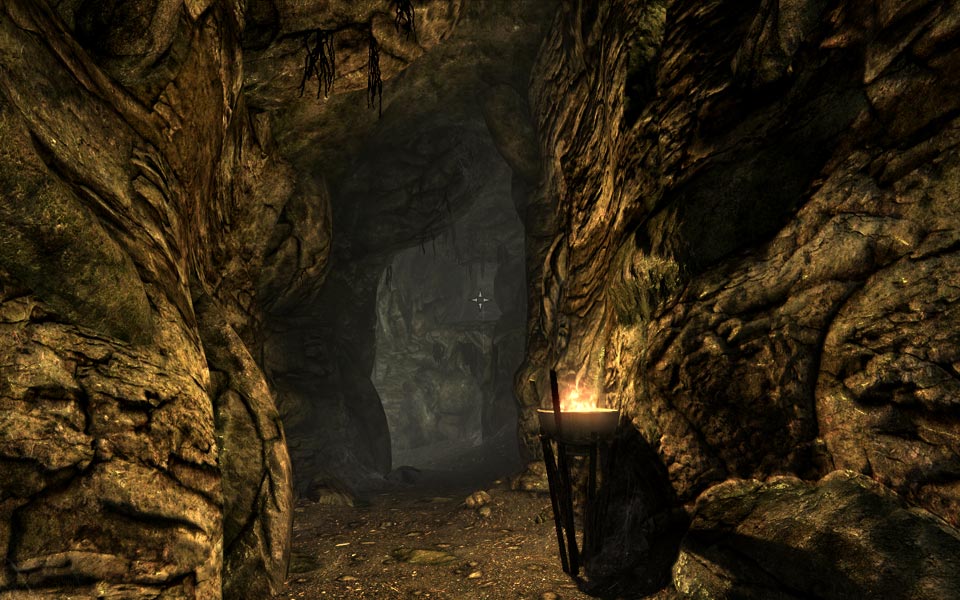
Why do I get the feeling that going into that cave is a very bad idea?
The individual stories and quests that you encounter are quite interesting, and there are plenty of them. You'll get dozens of miscellaneous tasks very quickly from just talking to strangers, and other sidequests are plentiful as well. There's 70 voice actors instead of the dozen in Oblivion, which is so overwhelmingly welcome. Though facial expressions are still lacking, characters come across as quite believable and you generally don't care too much when you're caught up in the act of exploring the world and the lives and troubles of everyone in it. The world feels so much more compelling than Oblivion, although it does feels as though it lacks the visual vibrancy and variety of Oblivion... though that might be in part because it snows so damn much, or at least is has for me. You won't, however, be trekking through dungeons and get that tedious feeling of "I've been here before" as you did with Oblivion. Other developers and games should take heed here - yes, Dragon Age 2, I'm looking at you.
Drawing another area where Skyrim excels (and Dragon Age 2 failed) is the continuity of the setting. This is something that the Elder Scrolls series and Bethesda are very good at delivering. Every previous game gets rolled into the collective history of the setting, with events sometimes set in motion due to previous games, or ideas and threats that are mentioned in previous games come to light in subsequent titles. The extensive library of books within the game carries over some titles that were present in past games, but there are still a joy for lore-loving players, old and new. You can read about the Nerevarine (Morrowind) or the Hero of Kvatch (Oblivion), and delve into the history of figures in those games or who have played roles in the history of Tamriel outside of the games. Despite the fact that hundreds of years have passed between Oblivion and Skyrim, the two games feel far more connected than the dozens of character cameos in Dragon Age 2 ever managed. Even a major character like Anders didn't provide continuity, and not just because Adam Howden wasn't as good as Greg Ellis. In Skyrim, you might be a hero, but you still get the sense that you're a hero in a vast and vibrant world. When a sandbox delivers that, you know it's done well.

The heroine Linaeryl contemplating her place in Skyrim and Tamriel
If you've never played an Elder Scrolls game before, Skyrim is an incredible place to start, and if you've tried previous outings, it delivers more than you've faced before. If you're looking for the freedom to explore a fully realised fantasy setting, there's nothing else that comes close to delivering what it can. While there can be some bland visuals (or the occasional glitch) and there are some quest bugs, it's hard to imagine that a game this size could come without them. It doesn't seem to deliver an epic story-telling masterpiece (though I confess I haven't finished the main storyline yet), but that has never really been the highlight of Elder Scrolls games. There have been some really nice moments, but where the series excels is letting the player tell their own story. It's about the player's collective experiences and tales as they travel through the world, and this is where Skyrim is nothing short of sublime.
If you at all have an interest in this sort of game, do yourself a favour and go out and get a copy. You won't regret it. Skyrim is not only the best RPG of 2011, it's the best game of 2011.
Sunday, November 13, 2011
Michael-Bay Warfare 3
With the final installment of the series, Modern Warfare has finally given up all pretenses and shown the true colours of its campaign "story-driven" experience. This explosion-packed ride doesn't let up for the few hours it'll take you to finish it, and ultimately still ends up falling short of the heights of the original game. It is an improvement over the utterly ridiculous MW2, and I think a little bit longer, as I polished off the campaign of Modern Warfare 3 on normal difficulty in a little over 6 hours.
I have to say that it was an enjoyable ride, but at the same time you love it in the same way that you love a trashy blockbuster action movie. It's lightweight, plot-negligible, with one-dimensional explosion after chase after fight continuity... but provided you're willing to switch off your brain and just enjoy the ride, it'll be a lot of fun reaching the end. As the post title implies, it's like a Michael Bay movie presented as a video game.
I found there were a few things that grated on my nerves, which is the reason for this blog post. There won't be any real spoilers here, but if you really want to make sure you don't spoil anything (you don't really need to worry though), then you may want to stop reading here.
Explosions!
When MW3 doesn't know what to do, it puts another big explosion on screen. When there's lots of action, people will overlook the absence of a plot, right? There never feels like there's any continuinity in the plot and that the loosely constructed story is merely a contrivance simply to provide a vague means to justify having explosions around famous cities. There's even a Team America moment where America levels the city that they're supposed to be saving. I'm not joking here. In what was most likely meant to be a serious "wow" moment or have some sort of impact on the player, I was laughing uncontrollably and found myself singing the movie's theme song.
The issue here is pacing. MW3 has a frenzied pace that barely lets up for even a couple of minutes, and even the most avid UT2K3/UT2K4 speed adrenaline junkie will potentially find themselves feeling overwhelmed by the constant action. Worse still is that fact that because of this pacing (or lack thereof) those moments that should feel like an amazing high end up just feeling like a regular part of the experience because the player is never given a reprieve from the guns, bombs, exploding buildings and dying protagonists. This isn't to say that it needs to attempt the "lull" sections that felt quite forced in Gears of War 1 & 2 to provide this necessary respite, but MW3 sorely needed something to break it up.

Another death... who cares?
As we've come to expect from Modern Warfare, characters die. Not just enemies or allies, but the characters that the player is playing. Just like with Modern Warfare 2, this happens on a fairly regular basis. There are fewer instances where you "almost die", which plagued the second installment in the series like a bad smell, but again the variety of characters means that you never care about any of the people you're playing. They're just as emotionless, faceless and lacking in character as the hundreds of enemies you slaughter on your way to victory.
There is only one death that actually matters, but even while I was lamenting that particular character's death, I realised that the only reason that I cared about them was because of their presence in previous outings of the game. That's right, MW3 does effectively does nothing to make you care about previous characters - it just expects you to come along with an attitude of: "you care about that person because they were in the previous games".
There's even one character who exists for only a single mission, and to make things worse...

Failing an objective as part of the story
You hit the button to complete an objective, and before anything else happens, "Objective failed" pops up at the top of the screen. Instead of showing you what is going wrong, you're immediately and definitively told "A Bad Thing Happened". The simple axiom of "show, don't tell" could not be more apposite here. Don't tell the player with a simple message that something went wrong, show them with the cutscene which is shown right after that message. Get rid of the message entirely, and not only would nothing be lost, but the scene would be a lot more effective. You still wouldn't care about the character's inevitable death, but at least the sequence would have some impact instead of none.
Contrast this with a later situation where you're trying to retrieve someone, and you see them taken away on enemy helicopter just as you arrive. There's no "objective failed" message here, just the sequence where you can fire at a few guards and then get maybe one or two rushed pot-shots at the captors before it flies off. That actually made you care about it and felt like it gave you some freedom, even though it didn't have any more than the previous example. It's not about what happens, it's about how it's presented to the player.
In closing...
As I said at the start, MW3 is by no means a bad game. I'm sure thousands of people are diving into the spec ops and multiplayer (though I must confess they don't quite hold exactly the same appeal to me), but given the campaign was being billed as a great adventure, I can't help but feel like the second and third games came up well short in trying to live up to the success of the first. The series is good for what it is, but you can't help but feeling that with a little more understanding about pacing, emotion and how to write a plot that makes sense, that the campaign across the three games could have been excellent instead of merely an enjoyable action outlet.
I must confess that since finishing it, I've sunk far more hours into Skyrim... which I might provide a few thoughts on in my next post.
I have to say that it was an enjoyable ride, but at the same time you love it in the same way that you love a trashy blockbuster action movie. It's lightweight, plot-negligible, with one-dimensional explosion after chase after fight continuity... but provided you're willing to switch off your brain and just enjoy the ride, it'll be a lot of fun reaching the end. As the post title implies, it's like a Michael Bay movie presented as a video game.
I found there were a few things that grated on my nerves, which is the reason for this blog post. There won't be any real spoilers here, but if you really want to make sure you don't spoil anything (you don't really need to worry though), then you may want to stop reading here.
Explosions!
When MW3 doesn't know what to do, it puts another big explosion on screen. When there's lots of action, people will overlook the absence of a plot, right? There never feels like there's any continuinity in the plot and that the loosely constructed story is merely a contrivance simply to provide a vague means to justify having explosions around famous cities. There's even a Team America moment where America levels the city that they're supposed to be saving. I'm not joking here. In what was most likely meant to be a serious "wow" moment or have some sort of impact on the player, I was laughing uncontrollably and found myself singing the movie's theme song.
The issue here is pacing. MW3 has a frenzied pace that barely lets up for even a couple of minutes, and even the most avid UT2K3/UT2K4 speed adrenaline junkie will potentially find themselves feeling overwhelmed by the constant action. Worse still is that fact that because of this pacing (or lack thereof) those moments that should feel like an amazing high end up just feeling like a regular part of the experience because the player is never given a reprieve from the guns, bombs, exploding buildings and dying protagonists. This isn't to say that it needs to attempt the "lull" sections that felt quite forced in Gears of War 1 & 2 to provide this necessary respite, but MW3 sorely needed something to break it up.

Not what I should be reminded of in a "realistic" video game
Another death... who cares?
As we've come to expect from Modern Warfare, characters die. Not just enemies or allies, but the characters that the player is playing. Just like with Modern Warfare 2, this happens on a fairly regular basis. There are fewer instances where you "almost die", which plagued the second installment in the series like a bad smell, but again the variety of characters means that you never care about any of the people you're playing. They're just as emotionless, faceless and lacking in character as the hundreds of enemies you slaughter on your way to victory.
There is only one death that actually matters, but even while I was lamenting that particular character's death, I realised that the only reason that I cared about them was because of their presence in previous outings of the game. That's right, MW3 does effectively does nothing to make you care about previous characters - it just expects you to come along with an attitude of: "you care about that person because they were in the previous games".
There's even one character who exists for only a single mission, and to make things worse...

Expect more pointless protagonist deaths like in MW2
Failing an objective as part of the story
You hit the button to complete an objective, and before anything else happens, "Objective failed" pops up at the top of the screen. Instead of showing you what is going wrong, you're immediately and definitively told "A Bad Thing Happened". The simple axiom of "show, don't tell" could not be more apposite here. Don't tell the player with a simple message that something went wrong, show them with the cutscene which is shown right after that message. Get rid of the message entirely, and not only would nothing be lost, but the scene would be a lot more effective. You still wouldn't care about the character's inevitable death, but at least the sequence would have some impact instead of none.
Contrast this with a later situation where you're trying to retrieve someone, and you see them taken away on enemy helicopter just as you arrive. There's no "objective failed" message here, just the sequence where you can fire at a few guards and then get maybe one or two rushed pot-shots at the captors before it flies off. That actually made you care about it and felt like it gave you some freedom, even though it didn't have any more than the previous example. It's not about what happens, it's about how it's presented to the player.
In closing...
As I said at the start, MW3 is by no means a bad game. I'm sure thousands of people are diving into the spec ops and multiplayer (though I must confess they don't quite hold exactly the same appeal to me), but given the campaign was being billed as a great adventure, I can't help but feel like the second and third games came up well short in trying to live up to the success of the first. The series is good for what it is, but you can't help but feeling that with a little more understanding about pacing, emotion and how to write a plot that makes sense, that the campaign across the three games could have been excellent instead of merely an enjoyable action outlet.
I must confess that since finishing it, I've sunk far more hours into Skyrim... which I might provide a few thoughts on in my next post.
Subscribe to:
Posts (Atom)

 Posts
Posts


