Monday, January 30, 2012

Level Design and Dragon Age 2

It's no secret that on the whole I found Dragon Age 2's (DA2) level design to be sorely lacking. From my perspsective, it's one of the areas where it really shows that DA2 was forced out of the door before it truly ready.

The first major flaw is Kirkwall itself. It's a remarkably tidy city by any standards. You barely see any litter in the streets or bits of trash as you wander around. It obviously is home to the most diligent cleaners in the history of Thedas - and probably even puts modern cities to shame in most cases. This is a lack of "trash detail" that pervades much of the game. Places get dirty unless they are cleaned, and this should occur to some degree even in the utopia that is a fantasy world in a computer game. It doesn't need to be brown and mucky everywhere (as would likely be realistic), but there needs to be some mess, otherwise it's simply not believable.

Obviously all mages are forced by the templars to master the "tidy floor" spell

Kirkwall's second problem is the fact that it doesn't change. DA2 takes place over 10 years, yet Kirkwall is almost static in appearance during that time. No new buildings are made, none fall into disrepair, the same tiles are missing in the stone walkways, the same cracks exist in building walls. While it would not be intelligent (or feasible) to redesign the city repeatedly each time a few years advance during the story, the fact that virtually nothing changes is utterly ridiculous. This is particularly the case after the second act, where the city is home to a full-blown conflict in the streets. Yet a few years later when the story resumes, the city has been rebuilt to an identical match of its former state. This is sheer laziness in terms of level design, and does not lend credibility to the narrative at all. Good level design should help tell the story of a location just as much as words should, so to flagrantly disregard this opportunity and to disrespect the storytelling of the game is a hideous shortcoming.

The poor quarter was rebuilt perfectly back the way it was? Seriously?

 The third, and most commented on issue by DA2's critics in terms of level design, is the gross amount of level reuse present within the game. There are a few stock areas that you travel maybe a dozen times in the game, perhaps with different sections blocked off here and there, maybe sometimes in the other direction, but most distinctly copied and pasted wholesale. When part of the critical plot of a game sees you go through and area you've already explored several times before as part of a random cave, the impact of the story and the sense of adventure are all but lost. This is without doubt one of the most telling indictments that DA2 simply wasn't given enough time to be developed. No, level design is not everything, but to come up short in such an obvious fashion that is terribly grating to the player is either a sign of a rushed product, or design staff who simply didn't understand the gravity of the problem for the player. I'd hope it was the former rather than the latter.

However, the news isn't all bad, so I do want to finish with one "good news story" that came out of DA2: Sundermount. This section of the game, or rather, the exterior areas (because the internals are part of the set levels used ad-nauseum) of it, are one of the highlights of the level design. Of course, there's the natural draw of "mountains are pretty", but while Sundermount does succeed aesthetically in providing good visuals, part of this is due to the technical design. Simply put, it reuses existing level design properly - it uses it as backdrop. The foothills of the mountain and the lower parts can all be seen as part of the vista that you can survey as you climb. This is intelligent area reuse, as it not only provides a sense of achievement (because you've climbed those bits before), but also helps to contextualise the player's position and current progress.

If you look carefully, you can even see people walking down below

So the news isn't all bad for Dragon Age 2 on the level design front, but unfortunately it tells us far more about level design through what it does wrong than by what it does right. If there's interest, I might try and put together a few points about when, where and how to reuse levels in a way that's less jarring to players.

Tuesday, January 17, 2012

Those little things

Sometimes life gets in the way of modding. Between work, social, musical and exercise commitments, not mention the daily routine of making sure I'm eating well and not living in a pig-sty, things have to fall off my to-do list.  Blogging tends to be the first cap off the rank there, hence why I've been a bit quiet of late. This is not to say that I haven't been thinking about game design or doing modding.

So when life gets in the way and I can't sit down for a long stint at the computer to mod for The Shattered War, I need small tasks that I can complete in short bursts.  So this is where it comes down to leaving "the little things" in a list to come back to when I have 15-30 minutes to spare rather than an hour or more.

First item on this list is processing VO lines that have been sent from voice actors. The first step here is to make sure the volume is consistent with all other lines in the mod. Sometimes this means decreasing the volume of the recording, other times increasing it, and other times I may need to do both to increase or decrease the overall volume range of the line. Once this is done, there's frequently a soft pop or tongue click that's not very audible by default, but would be in the final delivery. Then there's clipping or inserting silence at the beginning or end of each line to make sure that each line isn't just running into the next one.

Even fast talkers have to pause between sentences

The next item is codex entries, and this is an important one for me. I know some people will never check the codex once to check out the backstory of people, places or items, but for me this is a vital part of the modding process. Sure, I'm playing within the existing world of Thedas, but I'm exploring territory not really covered elsewhere, so I have a little freedom to provide background on the locations the player will visit. Every place has its own unique tales and pieces of folklore, and locations in The Shattered War are no different. The same applies to characters the players will meet, and the unique items they could acquire.

Add a couple of dozen codex entries for locations alone...

More recently, I've been looking at the various bits of text you read during load screens. Whether it's an area transition or loading a save, players deserve to see bits of information relevant to their current adventure rather than just generic bits of information recycled from the core campaign.  I want to make sure that players aren't disappointed when they are waiting on those loading screens and have something new and interesting to read.

Some of these are "little things" that many players (and modders) are often less fussed about, but I'm keen to make sure that these small touches of polish are present to make The Shattered War a more complete gaming experience. Are there any other things in this vein that players appreciate? If so, let me know those little things which really appeal to your sense of enjoyment and engagement.

Wednesday, January 11, 2012

Helping the player

One issue I constantly battle with in the design of The Shattered War is how much to help the player and hand-hold their experience. This struggle comes due to many of the modern conveniences of current video games and the way they make things just "that little bit easier" for the player.  While this might seem a somewhat trivial issue to ponder, the amount of help or assistance given to a player is a very important design consideration. A few simple tweaks can take a game that frustrates the player because they have no idea where to go or what to do, to one that annoys the player by telling them everything in minute detail. Striking a balance between these two extremes is very important for making an engaging game.

Firstly, we have things like that quest marker and quest helper. The exclamation mark to indicate a quest giver, and the question mark (or chevron in DAO, or equivalent symbol in other games) to indicate an objective or waypoint for a current quest. These are a great help for players and allow them to experience the game's content a lot more simply instead of having to talk to every single person with whom they can interact. Not every player wants to talk to a town's entire population, and sometimes players might have forgotten where a particular person is located in between play sessions. These markers assist the player in their journey, but for some they ruin the fun, removing the enjoyment they get from exploration and uncovering the gameworld on their own.

Skyrim encourages exploration, but Dragon Age could do so as well

In The Shattered War, I'm typically taking a middle road on this front.  Quest givers will have markers, and key individuals for quests will be marked, but I'll be leaving off assist markers in most cases for quests with an exploration or investigation focus. Admittedly in Dragon Age this still often simply means that the player just holds down the "highlight all interactive objects key" (default: tab), but this still gives a better sense of exploration than running from quest marker to quest marker.  Interactive objects typically warrant more interest than NPCs (the player might be able to loot them!), especially if the player has been instructed by an NPC/quest log to search items.  If I wanted to make things particularly difficult, it would be possible to only make the objects interactive (and thus able to be detected by tab) once the player got close enough to them, but this would be a sufficient break from the player's expectations that it would probably be unreasonable to do so from a design perspective.

The issue is making sure that the player is given sufficient information and encouragement. In the side quest "An Admirable Topsider" in Dragon Age, the player is told to search for three parts of a sword in the Deep Roads. However, once they have retrieved these items, they are simply told to return them to a grave, but are given no indication of where they should look for this grave. Furthermore, it is found in an area the player has already visited and cleared. In Dragon Age, a cleared area is typically exactly that - there is nothing new to be obtained or explored. The fact that this quest breaks that expectation as set by the majority of the rest of the game means that effectively the quest helper is required in order to provide the player the appropriate level of direction required to allow them to finish the quest. It's used as a lazy means to provide the player with direction that could have been provided in a written form, which would have encouraged the player to think and explore intelligently rather than trying to search the entire map, or just looking for the map marker. This would have provided the player with a much greater sense of involvement and enjoyment because they wouldn't just be simply running from point A to point B.

Surely we can give better directions than relying on these?

The next issue is how explicit to be in giving the player instructions, particularly via the quest log/journel.  Going back to games like Baldur's Gate and Morrowind, the player's journal was a lengthy and involved thing, including personal player character commentary, frequently with additional information. It was written more as prose rather than the modern equivalent, which tends to consist of simple and clear objectives. The modern school of thought on design is that when the player looks at their quest log, they want to see two things: what they have to do, and where they have to do it. "Meet Tolfdir at Sarthal" would be a quest log entry, as opposed to something like "Tolfdir gave me a lesson today on protective wards. In conclusion he decided that a practical test of my skills and that of the other students was necessary.  He suggested we travel to Sarthal to put our skills to the test, so I will need to travel there should I wish to continue my training." I'm tending towards the latter approach with my quest log entries, but still attempting to avoid unnecessary information. That said, often additional information may be accessible via additional informational codex entries rather than the quest log itself.

My aim is to give players a short and succinct description of what they need to do, but without explicitly hand-holding their way through the entire experience. Players are not stupid, so don't deserve to be treated as such.

Sunday, December 18, 2011

Testing and a Shout out

I've been feeling less than 100% over the past couple of days, but still tried to get in some modding.  I've been dealing with a swag of little issues as a result of playtesting:

A placeable not being interactive, companion attribute bonuses not appearing on the talent/skill (I think I may need to create entirely new custom abilities for this, however that is done), enemies not moving towards the player to attack (they spawn at a distance and are supposed to run towards the player), assorted scripting/tagging/plot logic errors, combat difficulty tweaking, fixing up codex entries for various items/areas/people, and a few other things besides.

The point here is to iron out all the issues in the opening few hours of the mod so I can potentially release a closed alpha/beta to a small group of willing testers in the near future. There's still lots of work to be done on the project as a whole (and there's still missing VO even in this prologue section), but I'd certainly love to here some independent opinion on the beginning of The Shattered War. Let me know if you're interested - an email to my gmail address (it's my "name" [the one in the graphic above] at gmail.com) would be fine - and I'll be in touch.

In closing, I thought I'd give a shout out to MiracleOfSound (aka Gavin Dunne) on the Escapist. Producing a new song every two weeks isn't a straightforward task, so when they're both pretty good, and game related, I can't help but love this work. Admittedly I was a fan ever since he told us we would never be better than Commander Shepard, but I really like his latest work, and like everything of late, it's all about Skyrim.

Tuesday, December 13, 2011

Lessons from Skyrim (Part 2)

In my last post, I talked about some of the areas where games could learn from Skyrim in terms of its successes. In this post, I'd like to discuss some of the game's shortcomings.

Wait, you can get HOW powerful?
This has been a problem with Elder Scrolls (arguably Bethesda games in general) since Morrowind. As you get higher in levels, you can become obscenely powerful. It's not just that you become better as a player (which will arguably have some effect) or that you get better gear (which you will), it's the manner in which you can improve or create gear or your skills to the point where you become unfathomably powerful.

It's possible to enchant items to reduce the cost of destruction spells. These enchantments will stack across multiple items, potentially allowing you to decrease the cost of destruction spells (to unleash fire, ice or electricity upon your opponents) by 100%. That's right, with a high enchanting skill, you can cast offensive spells for no mana. Alternatively, maybe you'd like to increase your smithing abilities so you can create better weaponry. Well, if you get your smithing up to maximum level and improve items, you can end up with incredibly damaging weapons at your disposal that can dispatch any enemy in only a few hits.

Sure, the player can choose not to pursue these skills, but if they decide to, they don't necessarily realise how broken and overpowered these options are until it is too late. Then once the player has created and named their own custom set of enchanted armor and weapons, they can hardly be expected to just "give them up" simply because the designers failed to balance the game to cater for players who chose these pursuits.

Creating this was an exciting achievement, but it makes fighting a straightforward bore

Freak opponents
There are scaling issues for the opposition as well, though I wonder whether these might be bugs. A few times I faced an occasional quirks where one enemy would be vastly more powerful than its counterparts with exactly the same name (and hence theoretically should be the same level and roughly the same difficulty). In one case, a Falmer skulker (a low level archer) would kill me in a single hit if my health bar wasn't on absolute maximum. Not two enemies later, I found another Falmer skulker than did negligible damage and I could have taken about 8 arrows from him before I died. Even in my low 40s I encountered a random bandit that launched fireballs with utmost haste and I was dead before I even managed to get a bead on where he was shooting from. Fortunately in the latter case, a reload resulted in his replacement enemy being "normal", but the Falmer Skulker proved to be a very tough and annoying enemy to defeat.

Even at a high level (52), I've faced a couple of opponents that killed me in one hit while decked out in full dragonscale armor, and I've got a bucketload of armor increasing perks. Now, while I appreciate the concept that there are still enemies out there who could potentially be a threat to me, it simply doesn't make sense for some random vagrant in a hideout presenting more danger than some of the named "epic foes" of the game.

Is this Forsworn going to one-shot me? Who knows?

The run around
The real joy of the game comes from exploration. When you reach the point where you want to just go around completing quests, the game becomes a little bit more tedious than the heights of excitement that it offers. Once you've explored vast amounts of the map and are just looking to complete some quests, it becomes a simple matter of "Pick up quest at point A", "Fast travel to point B to have conversation", "Fast travel to point C to kill a few enemies", "Fast travel to point A to complete quest". Without the exploration aspect, quest completion often becomes a very straightforward process that doesn't hold a whole lot of surprises or intrigue.

The Elder Scrolls games focus on a massive breadth of content, and that is their strength. You have the freedom to explore pretty much anywhere and choose to do (or not do) what you wish. The problem is that while every player ultimately has a different experience because of that freedom, that freedom means that there is very little or no "small scale" freedom in determining how each of the "mini-adventures" play out. For the majority of quests, everyone will have the same experience in how the interactions and results play out, with the differences coming from the style of combat that the player chooses or the route they travel to reach their destination. There's no real replay value for individual quests, but merely replay value on attempting different combat styles, which as I've mentioned, you can potentially explore entirely in a single playthrough anyway.

I could go anywhere, but that is the only real choice

In same cases there are some minor choices which affect how things play out, but these are by far the exception rather than the rule. Even the dialogue roleplaying aspects are notably shallow, and your character is mostly a blank and shallow creation which has to follow many of the same lines regardless of personality. Given you are playing the voiceless dragonborn, it's up to you to inject personality into your character, because the game offers very little input into that aspect of roleplaying. You have a choice of what quests you will do in the world, but virtually no choice as to how you complete them.

World reactivity
One of the more notable problems relating to the immersion of the world is how it reacts to you. The problem here isn't that the characters don't react to you, because they do. It's that they don't react to you in a consistent manner. Town guards can notice me walking around with Azura's Star (a daedric artifact), yet Vigiliants of Stendarr (who hate daedra worshippers) won't bat an eyelid when I walk past them carrying the same daedric artifact, or even a daedric weapon from a daedra they consider to be (very) evil, even when I'm wearing armor from a different and also evil daedra. People from the other side of Skyrim will say "You're that made from College, heard about you", yet Farengar from Whiterun will keep telling me I should join the mages college if I have the aptitude, even though I've been the archmage for a couple of months. Or there's the guards that make fun of me being responsible fetching the mead for The Companions even though I've been their leader for even longer.

It's the inconsistency that gets to you in this regard, but also the fact that people seem to magically know things about you. The immersion breaker here is someone commenting: "so you're an alchemist then" or "I've always had respect for the school of restoration, Skyrim could do with more healers" even though they've never set eyes on me before, and I certainly haven't made a potion or cast a healing spell in front of them. By attempting to make the world react so much to you, it actually ends up feeling less realistic because the NPCs don't react to you in a believable manner. On the plus side, at least it does stop those guards talking incessantly about their old injuries...

I was going to do this post last week, then I took an arrow in the knee

These issues aren't entirely dealbreakers, but they are shortcomings of the game's design. Skyrim makes half-hearted attempts to address these issues, but as a result doesn't manage to satisfy the player in these areas. The balance is askew, choice is minimal at best, and the world has the bizarre situation of paying lip service to your actions without ever reacting to them properly.

Wednesday, December 7, 2011

Lessons from Skyrim

My apologies for being a little quiet on the blog front lately. I should reassure those eagerly awaiting the release of The Shattered War that I have actually been putting some time into modding. It is time, however, to take a closer look at some aspects of design of the recent success that is Skyrim, and look at those things that did and did not work. In this post, I'll examine some of the design issues that other games can learn from.

Art Design aka "It's not all about tech"
There is no denying that Skyrim is a beautiful game. People are taking time lapse "photography" of the game because it simply looks that good. Now, while many will attribute this to the "graphics", which is the technical wizardry behind the graphics, this isn't why the game is so jaw-dropping. Compare it to Crysis 2, which technically is a gorgeous game, but from a design point of view there weren't a lot of those moments where you just stopped and went "Wow, that's gorgeous." Skyrim, despite not having all the bells and whistles of the best Anti-aliasing, shader effects, glorious reflections and refractions, real-time realistic shadows, DX11 tesselation, or the myriad of other features offered in some technically superior games, simply looks attractive. It doesn't have the highest resolution textures or the best level of detail distance gradient handling, but it just downright looks good.

The reason Skyrim looks so good is because of the effort made to create a beautiful world where there are particular artistic styles and themes throughout. The terrain covers alpine forests, rolling hills, badlands, swamps, rivers cutting through chasms, ice floes... there are so many different types of terrain but each presents a cohesive visual style and this is supported by the flora, animals, weather and even enemies that you encounter in those areas. This applies to the interiors as well, each of which adhere to a consistent style, but have their own unique elements. The Dwemer ruins in particular have some absolutely spectacular scenery; it's likely that you've never seen dwarven ruins that look this good in any medium.

It's a long way down...

Level Design
The aesthetics of level design are not the only aspects that should be credited here, but also the functional aspects of levels. Interiors, in particular is an area where levels have typically been designed very well. Backtracking is a problem that results in tedious gameplay of passing over empty areas when you force the player into an area within one way in and out. The obvious means to solve this problem is to have an exit when the player reaches the end, though this the designers must mean that this cannot be an alternate entrance to the area that an adventurous player could potentially find and short-circuit the entire dungeon. Skyrim does manage to do this, and it is quite effective.

Perhaps even more impressive and interesting is the manner in which many dungeons are created with only a single entrance/exit, but are created as a closed loop. The player follows a set path to reach the final boss/treasure room, but continuing after this will result in the player looping back to a location very near to the entrance of the interior. Even more successful is that this is done in a variety of ways, so it doesn't ever feel particularly stale or overly contrived. The "exit path" joins is blocked off from the entrance path by a number of ways: sometimes a barred door or unopenable gate, sometimes a secret door, other times a high ledge that is impossible for the player to reach. This loop system, in conjunction with areas that do have a separate entrance and exit, means that design of interior levels is both interesting and functional.

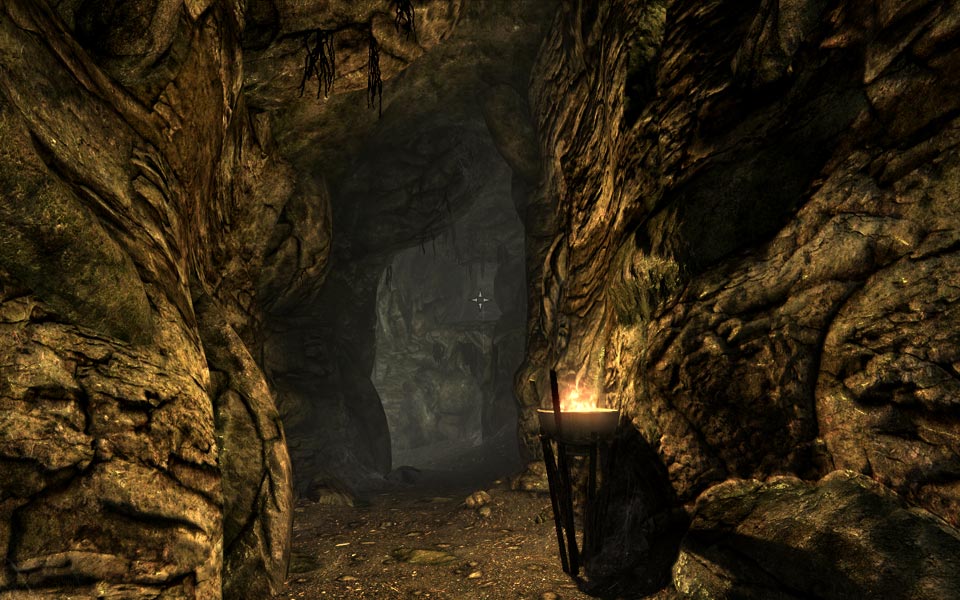
This is the entrance to a cave, and that ledge is shortly after the final room

Puzzles
Skyrim shows how puzzles in games can be done really well. These puzzles aren't minigames. They aren't alternative game mechanics. They're elements within the gameworld that are integrated in a fashion to present the player with a simple mental/visual challenge in order to proceed. Fairly early on in the game, you'll likely stumble across a door with three rings with symbols open them, which can apparently be opened by a claw. While this initially might seem like an issue of trial and error, you'll quickly learn that the claw holds the key to the correct sequence of symbols. This puzzle becomes trivial once you know the solution, but it's a near seamless way to include puzzles into the game.

Traps are visible and possible to avoid if you as the player are attentive, as opposed to a random die roll that determines whether your character can see them. While this isn't new, the traps are such that you actually do care about them because they can do a lot of damage or kill you outright, but also because you can quite easily use them to destroy unwitting enemies. This is a refreshing change from things like the paltry shotgun traps of Fallout 3 that were really of little consequence except for providing you with repair fodder/ammo.

There are symbol alignment/placement puzzles and lever switching puzzles that are also fairly easy to solve for the attentive and/or logical player, but the real joy is that you feel like you're interacting with the environment itself. There's no BioShock pipemania, no Mass Effect 1 Simon, no Alpha Protocol "findaword". It's simply a matter of observing the gameworld and interacting with it directly. It almost feels like a pity that the lockpicking mechanic is akin to those from Fallout, for this pulls you out of the gameworld in a way that the puzzles do not.

Symbols to align before I can pull the level to open the gate

Now, while these are aspects of Skyrim that I thought deserve a positive mention, there are some places where Bethesda still come up a little short. I'll be looking at a few of those areas in my next post.

Sunday, November 27, 2011

Star Wars: The Old Republic - Beta Review

There was a large scale beta stress test for SW:TOR on the weekend, and I was fortunate enough to be able to participate.  Testers have been told they can "freely talk about their experiences this past weekend within the game, as well as post screenshots and gameplay videos of their testing experiences". So, with that in mind, let's just into an appraisal of my experience. This follows about a four hour journey of my testing.

After sitting through the excellent intro video that many people have already seen, I got presented with a server list... all of which were full. Picking one with the lowest wait time on the West Coast of the US, I did a few things while waiting to get a slot.  Within a few minutes, I was logged on and ready to pick a side. After picking the Galactic Republic, I was treated to the "Hope" trailer before I got to select my class. Now, maybe it's just me, but I would have thought that anyone who is keen enough to participate in a beta will probably have already watched these videos, and even if they haven't they add little enough to the actual story of the game as it's presented to the player for them to actually matter. I might be nitpicking here over some nice eye candy, but as far as I was concerned, I didn't need to waste my time and download bandwidth on those videos.

Regardless, I fired up the character creator and got to select my class (Jedi Consular), race (Miralukan - like Visas Marr), and then the usual character appearance customisation. This defined body & face shape, skin tone, hair style/color, scars and my "mask" (seeing as Miralukans are physically blind). Unlike many MMOs it actually appeared as though this appearance would help individualise the character, as I didn't see anything items that I'd be wearing over my head or obscuring those choices completely. Now, of course, there is the potential that people will create identical looking characters, but there seemed to be enough variation that you wouldn't have everyone looking the same. With my character created, I was treated to the classic Star Wars rolling text over space before being presented with a cutscene of my character turning up on a Jedi homeworld.

In retrospect, I feel like I made a Jedi Guybrush Threepwood

First, let's talk about the visuals. It's not a mindbogglingly gorgeous game, and there were some texture issues like texture pop in dialogue/gameplay and generally low texture resolution. That said, it still looks okay, though I wouldn't be surprised if there are some improvements before the final release. The art design is clean and simple, going for a stylised appearance. To be honest, that's what I've come to expect of an MMO. Having to deal with high resolution graphics along with the overhead of an MMO is something that modern computers can do, but an MMO has to market to as many people as possible and targeting the enthusiast PC market doesn't mesh with that aim. I didn't really have any "wow, that looks awesome" moments in terms of scenery, but to be honest I don't think I've ever got that within the first four hours of an MMO.

On the plus side, the character animations are quite smooth, and it imparts some of the "yeah, I'm a real hero" feeling that is sometimes lacking from the regular "I throw a fireball", "I shoot a gun", "I hit the enemy with my fists" that feels flat and lifeless. It's no Ninja Gaiden or God of War, but it does feel a little more potent than contemporary MMOs. This is a little bit offset by the fact that it feels somewhat slow when you run, and the silly looking jump animation that looks like it's pulled straight from WoW. That said, my Jedi did do a nice looking tumble roll when he fell from a significant height, which was a very nice touch.

It's an MMO. Don't expect Crysis 2 tech here.

In general story-telling and quest flow, you can feel the "BioWare formula" coming through. It feels like a BioWare game, with the dialogue wheel, characters building you along the way, and leading you along the "individual journey" that their games typically manage well.  This does come across a little strange I had people telling me "you're the most talented person we've seen in years" only to see other Jedi Consulars running along the exact same paths as me... this did shatter the illusion of my character being "special" as I was being told, knowing that all these other players were being given the same speech. Perhaps this problem was exacerbated by having so many beginners at the same time, but it felt as though it weakened the narrative a little. The writing still seemed quite reasonable, though I confess that once again I was put off the Jedi order by a "love is evil and leads to the dark side" sidequest.

That said, the voice acting is very good across the board, though I really do wonder how necessary it is. Some players were commenting how it drew them into the game a lot more and that they actually paid attention to the story, which is obviously what the designers were aiming for. I lost count of the number of times I was in a group in other MMOs were quest dialogue/overviews were skipped, and eventually I began ignoring them myself because trying to follow the story was already a lost cause. I briefly got to play in a group, which was a really nice touch, as each player got to say lines of dialogue (though I wasn't clear on how the game chose WHO would speak) within the conversation. This actually really made it feel like you were in a party and pushed that social aspect forward. The NPCs also emote and have the facial expression variance that has become a staple of BioWare's titles. While they're talking to you, the characters do a good job as virtual actors.

She looked and sounded concerned

Now the big one: gameplay.  Well... it's an MMO. If you hate MMOs, this probably isn't going to change your mind. Combat is not automatic - if you want to attack, you have to push a button and keep pushing them until your enemy is dead. Living in Australia, I thought this might be somewhat problematic given a beta stress test weekend and having to connect to a server on the US West coast. I was pleasantly surprised to find that lag was not a significant issue at all, and that I could quite comfortably manage to play with only a couple of lag spikes. I seemed to be getting better performance than some other US players. To start with it felt like the standard "mash button until enemy is dead" gameplay of MMOs, but I did pick up a few abilities near the end to perform stun and lift (crowd control), so it did seem as though the variety of skills and tactics to use would increase as I increased in level. There was a sense of "I've been here before" that I couldn't quite shake, but it seems like the so called "advanced classes" will allow players to pick different roles (tank, healer, support, DPS) based on what is necessary for the group they're travelling with. It's hard to tell whether this will lead to people trying to be a jack-of-all-trades or pursuing particular specialised roles as characters reach higher levels.

The usual MMO problem of backtracking is no less present in TOR than any other MMO, although they have tried to lessen the impact through liberal use of "quick transport" options - speeders that will get you from one location to another for a minimal fee. This does help alleviate the dull "run back to the quest giver" chore that plagues many MMOs, but without removing it entirely. Creatures spawn regularly and populate the map in large numbers, but in some cases it is possible to pass them by without fighting if you're just trying to do a return run. Side quests also become available when you're about to head to a new area for your class "main quest", meaning that you easily polish off a few quests in one trip, making it feel more productive and heroic. Additionally, the classic grind quests of "kill 65,340,285 boars" are mostly relegated to "additional objectives" as part of other quests. This is a nice touch in that the grind feels as though it's optional, and for the most part you'll likely end up killing the required number of creatures as a matter of course in trying to achieve the core objective of the quest.

After adventuring in those mountains, I go to turn in three quests at once

As an overall experience, it seemed reasonably fun, though I do feel as though it would have been far more enjoyable with a group. It really did seem as though group play would feel a lot more rewarding, and going solo somehow made it feel as though you were missing out. I'd be interested to see how different the experience is in that case. The other issue is the concept of choice and the light-side/dark-side within the game. I didn't see any real consequences as a result of previous choices I'd made in my brief journey, but I'm not sure that I can necessarily expect that in such a short time frame.  The light side points I kept gaining (yeah, yeah, I was playing a goody-two-shoes, deal with it) didn't really seem to have any great benefit. I was told by the in-game help that certain items would require me to have a certain level of light side points in order to equip, but if that's as far as the system goes, then it feels a little... "gamey".

So, Star Wars: The Old Republic - it's an MMORPG in the Star Wars universe with an increased focus on story. It had a feel similar to the Knights of the Old Republic games, and that's by no means a bad thing. How it will translate into a fully-fledged release will be interesting to watch, but it is definitely an MMO to keep your eye on.