Monday, November 15, 2010

Level Design 101

Level design is crucial to a game in so many ways. It delivers the environment for the gameplay mechanics, helps storytelling, provides atmosphere, and it looks pretty. Now levels, do more than this, but I'll just focus on these aspects in order to limit the size of this post. There is a lot more to each of these subjects and I could go into a lot more detail on them, but let's just try and cover a few key points in broad brush strokes for now. If I get a lot of interest from people about one particular subject (or all of them), I might dedicate a post (or more) to it.

Looking Pretty
Let's start with the superficial (but important) value of the "wow! factor" when creating a level. Creating gorgeous looking levels is something that players will really appreciate, because they'll admire the scenery and look at the glorious vistas that you've created for them. As much as you get people complaining the "graphics aren't everything", big titles that don't look aesthetically appealing will get lambasted for their lack of visual quality. There is a reason that games advertise using the most gorgeous screenshots they can find: it's because those screenshots attract attention. Memorable landscapes (particularly near the beginning of the game) help to draw players into the the fictional reality created by the game.

Crysis. It's pretty.

Providing Atmosphere
Atmosphere increases player immersion and their engagement with the level. It's the surroundings, the lighting, the sound, the visual effects, all the things that combine to evoke an emotional state in the player or provoke an emotional reaction. If you've ever jumped because of a scary moment in a game, felt your heart racing because of the action or tension, or felt a sense of wonder and admiration, then you've experienced good atmosphere. Atmosphere reinforces the dramatic force of the level or the current actions of the player, their allies or enemies.

Helping Storytelling

As atmosphere reinforces the player's emotions, the levels can also help increase the player's cerebral engagement with the game and reinforce the setting. This can be signs that reiterate the setting, whether it be a billboard sign for a majestic location (which the player will visit later in the game), or a destroyed building to let the player know they arrived at their location too late. Clever level design can be used to push the plot forward without any dialogue or text. Let's make an example: A player is told that they will be able to receive help overcoming their adversary from a nearby village. Upon arriving at the village, the inhabitants are missing, but the player finds the corpse of one of their enemies. This is good because it helps tell the story, but also raises questions: Are the villagers dead? Were they captured? Are the enemies still nearby? I'm sure you can think of more questions, and each question and possibility can help make the player more interested in the level and the game.

You don't need Alyx to tell you something strange is happening.

Gameplay Mechanics
Overlook this aspect at your peril, as it really needs to be considered in order to keep a game engaging. Make sure your player has enough room to maneuver during any combat that might occur. Try to avoid situations where the player will face instant death if they make a wrong move, because that is a recipe for player frustration and hence anger. If the player is supposed to move about stealthily, give them plenty of hiding spots and shadows so they can. If the player is supposed to rush at the enemy all guns blazing, make the level open and provide "incentives" to keep them pushing forward. Make the level help the player to achieve their goal, or even better, actively encourage them to do so.

As I mentioned at the start of this post, I've kept all these of these comments very brief, because there's a lot that could be said on each of these subjects. But if you're making a level, try and at least give some thought to each of these aspects and how your design will help support each of them.

Sunday, November 14, 2010

Why the stigma?

Let's pose a hypothetical situation that you are meeting a person for the first time and they ask you about what you do in your spare time. If you state you are a hobbyist director, writer/poet/screenwriter, visual effects artist, or something similar, there is typically a moderate amount of respect commanded by such an admission.  However, stating that you are an amateur video game creator would likely result in a less than favorable perception by a large percentage of the population. Why?  What is it about video games that immediately elicits the reaction that it is a childish or wasteful past-time?  How is it that games have such a stigma associated with them?

This is perhaps even more strange that if you're a modder working with a modern game title, you actually cover all the names roles above. A modder directs cinematics, creates the levels and environments for the characters, and writes the plot, setting, and dialogue that make up the story that they wish to tell. So what is it about games that means they are viewed with a sense of derision when compared to movies, television, books or other artistic/storytelling mediums? Even when you're dealing with a poorly received movie compared to an extremely popular game from within the same franchise, in the general population, the game will receive more ridicule. And that's even the case when we're talking about a movie franchise known for its obsessive fans like Star Wars.

One of these has a horrible story. The other is a video game.

Computer games are an entirely new storytelling medium.  Scriptwriters and novelists have been asked to contribute to it, and have proven that they don't fully grasp the consequences of an interactive medium. This isn't to say they've done a bad job, but they don't have the necessary skills to excel at it because they don't appear to understand the subtleties required.  Creators of cinematics in video games are taking their cues from film directing, mapping the techniques directly from cinema into video game cutscenes to assist their storytelling capabilities. Games like Half-life pushed the interactive boundaries, having few real cutscenes that remove player input entirely, but instead using design tricks to coax the player into following the action that is presented on screen.

For example, take the opening sequence of Half-life 2.  At one point, the player is herded down a corridor with an interrogation room on their left.  The player has complete control over their actions, but the combination of lighting and sound mean that the vast majority of player stop and look through the small window slot in the door. There is nothing forcing the player to do this, yet because of the game design, they do. How can the skill required to create this sort of scenario not be considered worthy by the public at large? How can the skill of creating a situation that almost guarantees a certain response despite giving the player complete control over their actions be ignored?

Who didn't look inside the first door on the left?

So creating games takes a lot of skill, and draws on and even extends from media that are considered "acceptable" and the people that create them are considered talented.  Yet still many people are reluctant to admit that they play video games, and I don't even want to speculate on what the general opinion is of people who create video games. If someone suggests a party to play video games, responses will typically not be positive.  However, if at a party someone suggests playing games like Guitar Hero or something on the Wii, then generally people are more than happy to get involved.  There appears to be a definite stigma associated with the concept of playing video games as a past-time rather than something that simply happens. Yet very little is said of those people who visit the movies three times a week, or spend a dozen hours or so watching reality tv shows.

Isn't it time that the people who play and create games stood up and stated that they are creating a medium of entertainment every bit as worthy as books, art, music, television and film? Does the creation of video games not require people who have talents that could be applied to one more of these other mediums? Surely the people who enjoy video games can sensibly state that they enjoy an artform that has merit? We need not sit on an evangelical high horse and attempt to convert the populace en masse to the church of video gaming, but at the very least, we can declare that this thing that we enjoy takes great skill to create, and that it does not deserve to be treated with contempt.

Wednesday, November 10, 2010

Call of Duty, Black Ops and Sniper Design

Unless you've been living in a bubble separated from all video game related press, you've heard of the Call of Duty series. Modern Warfare and its sequel both sold phenomenal amounts of copies, and Black Ops, the latest in the series, had pre-orders in the millions. I'm not going to review the game and tell you it's good and bad points. The game delivers a game typical of the current style of the series: a short high-octane single player campaign supplement by its multiplayer component. However, there has been a significant amount of discussion regarding a particular design element of Modern Warfare and its change in Black Ops. That issue is quickscoping.

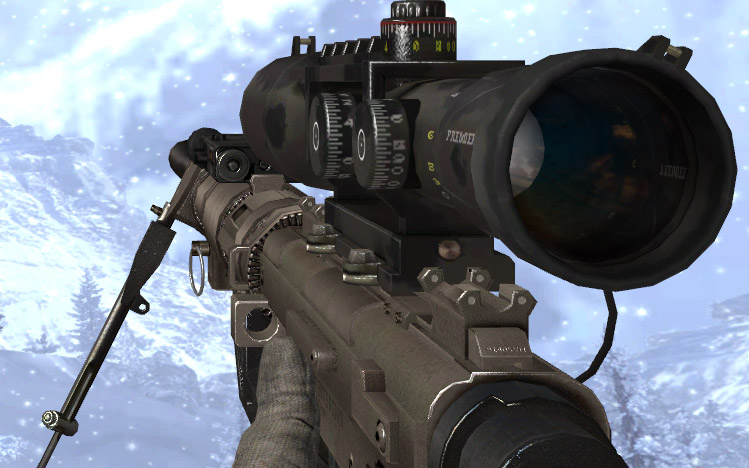
Quickscoping (also "quick scoping" or "quick scope sniping") is a mechanic in Modern Warfare 2, whereby using the "Sleight of Hand" perk and the aiming assist mechanism of guns with a sniper rifle, a player is able to pull off one shot kills on other players in medium to short range. There is some skill involved in terms of the aim and the timing, but it makes a sniper a dangerous proposition even at closer ranges. A quick search will turn up video demonstrating the mechanic and countless kills using it.

Why scope when you can quickscope?

In released Black Ops, Treyarch (that's the developer - they share the series with Infinity Ward, who were responsible for Modern Warfare 1 & 2) has taken steps to counter quickscoping by introducing error into the aiming assist mechanism, meaning that when you zoom in you won't lock directly onto exactly the location you were looking at before you zoomed in. In this way, quickscoping is not really possibly, because you'll need to correct your aim before being able to fire a killing shot. As a result, proponents of quickscoping have decreed that snipers are worthless in Black Ops.

I'm sorry to anyone who believes that, because it is a truly ridiculous argument. Snipers have instead been switched to the role that they are meant to fit: a long range combatant. Funnily enough, this is what they do in real life. Of course, the immediate counterargument to realism is "but this is a game and it is meant to be fun". I wholeheartedly agree, but because it is also a game it should therefore be balanced. Take a leaf out of the book of MMOs, or heck, even Team Fortress 2.

The scout: fast, agile and squishy

Balance implies that there are multiple roles within a game, and there is no one class or player can perform all roles well. This is where quickscoping completely fails the test of good game design. Snipers are the only class that can perform effectively at long range. Other classes can score hits, but it comes down to luck more than skill. Therefore they have a distinct advantage over other classes in that role, and game design dictates that if you had an exclusive ability (or at far better at it than anyone else) then you should have an equivalent shortcoming. But quickscoping means that snipers are almost as effective as people equipped with assault rifles in medium range, and even at close range, they've still got a reasonable chance of pulling off a single shot kill against someone using a shotgun or sub-machine guns. This completely breaks all rules of balance by allowing a quickscoping sniper to excel in virtually any situation, which is the epitome of bad game design.

There might be those that argue the quickscoping made sniper rifles more viable by allowing them be used at more ranges, and thus reducing the likelihood of camping. This is an even worse argument, because this overlooks the fact that generous killstreaks in Modern Warfare 2 made a defensive camping style of play more attractive than sniper rifles ever could.  Even ignoring this, making sniper rifles more useful in close combat does not make camping less attractive, it just makes a different style of play more lucrative rather than solving the initial problem.

Modern Warfare's Wetwork. Hello snipers.

The truth of the matter is that campers and the act of camping isn't the problem. After all, we've been told it's a legitimate strategy. The problem that we're dealing with here isn't the fault of the designers of the gameplay mechanics, nor the players. In this case we actually have to lay the blame on the level designers. It's level designers that create layouts that allow snipers to have highly defensible positions that are extremely difficult for people to reach. It's level designers that create sniper hideouts with an extremely large field of view to allow them to pick off people with ease. It's level designers that don't create balanced maps to set each style of play on a relatively even playing field.

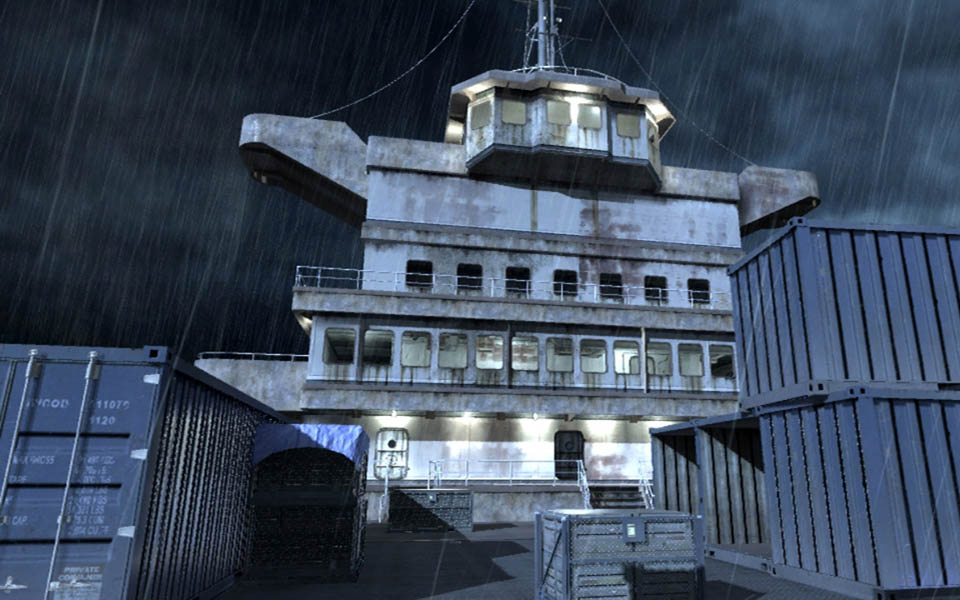
That said, I know they have their work cut out for them in creating such levels. It's not an easy task, but I can't help but feel that the level designers for the series need to improve their tradecraft in this regard. The realism and aesthetics are usually fairly good, but the mechanics of some of the levels simply don't work. I found that Wetwork degenerated into a combination of sniping and countersniping, or explosive spam in the centre of the ship. I'm sure you can think of other levels that suffered similar weaknesses in terms of repetitive gameplay, although it's certainly not a problem exclusive to Call of Duty.

Of course, I could mention other design issues in like combining Danger Close and One Man Army or elaborate on how killstreaks promote camping, but I imagine I might attractive enough hatred from FPS players with this post without covering that ground as well. Maybe I'm not "pro" or "semi-pro" when it comes to FPS games, but I understand game balance. In that regard, quickscoping does nothing to support game balance thus getting rid of it can only be a good thing.

Tuesday, November 9, 2010

Voice Acting and Games (Part 2)

Let's take yesterday's discussion about voice acting and constrain it to the voice acting of characters that the player meets and talks to during the game.

If we've got a character with a small portrait and text without VO, then it's up to the player to infuse that NPC with personality as they see fit based upon one small portrait and their interactions. There is generally a lot of leeway for different players to have a different mental image of that character. This relates to the point I was making in my Nostalgia Reviewing post some time ago.

When we compare portrait & text to a fully voiced and animated character, we're dealing with two entirely different means to engage the player. The former style was all that could be used in older games due to the technical limitations of the time. This meant characters were left more as a blank slate for players to read their own thoughts into the personality of a character based on a single image and the dialogue within the game.  In some cases, I imagine that the personality of those character did not match the personality as it was envisioned by the writers/developers. But no doubt the same is true of books.  And in this way, comparing portrait & text to fully voiced and animated characters is like comparing the difference between a character in a book and a character in a movie.

Is this exactly how you imagined Aragorn from reading Lord of the Rings?

Compare and contrast characters from old RPGs like Ultima Underworld or Infinity Engine games against something like Dragon Age. If you asked players to describe the personality of specific characters, I imagine you would get significantly more variance in the description of characters from the older games. In newer games the characters that players meet have more tightly defined personalities because of the extra details we get in appearance, gestures, expression and voice. The older games allowed us to fill all those details in because it wasn't possible to show them to us.

So with all this extra information that we are being provided, surely we are getting a richer experience from interacting with these characters? We get to see and experience every nuance of our interaction with them on a level that is beginning to approach exchanges that we experience in movies or real-life, all within the context of a video game. All the extra information that the designers can convey to players is phenomenal, allowing them to emotionally manipulate players through cinematic visuals and audio. We can hear the fear and sorrow in the voice of Alyx Vance (Half-life), the indignation of Loghain (Dragon Age), and the snarky exchanges between the Prince and Princess (take your pick of the Prince of Persia games). These give us a real sense of the personality of the characters in these games, allowing us a greater ability to truly understand and hence empathise with these characters.

This scene would not pack as much emotional punch without voice acting

However, while we might be getting an impression of the character that is more closely aligned with that of the people responsible for creating it, does this really help us become engaged with the game in the best possible way?  In a way, while we can become more emotionally engaged with the characters that have been created for us, we become less engaged with our own personal perception of the characters and environment. If everything is shown to the player in minute detail, then a game risks that every player will have exactly the same experience because they are not engaged with the game through their imagination.

For older games, players were almost forced to use their imagination to give characters extra depth simply because it was not possible to give that complete picture of a character. The experience arguably was more personal for older games, because it was up to the player to infuse the game they were playing with the extra personality that was lacking. Just like reading a book, everyone's image of the individual settings and characters was slightly different, providing an individual experience for each person within the set boundaries of its plot.

Have players become lazy and simply demand that they be shown every single thing in games nowadays? Are players losing their imagination as a result of the increasingly cinematic approach to AAA games? Or has the desire to have believable gaming environments created a gaming market in which pure text is no longer acceptable in order to maintain the illusion of reality?

Monday, November 8, 2010

Voice Acting and Games

The addition of voice acting into games is pretty much standard nowadays for big titles. Players expect characters to be voiced, and moreover, they expect the people delivering those voiced lines not to deliver hackneyed performances. The gaming community is no longer content to put up with overacting or flat line delivery. And beware the collective opinion of your game's audience should it have a small number of voice actors like Oblivion.

We can safely say that voiced games are not going to disappear any time soon, and if anything, they are going to become more popular and prevalent.  Now that games are attracting famous actors to provide VO work for titles, acting seems set to be increasingly important.  Keeping in mind my gaming preference towards RPGs, this post could easily head towards the topic of Dragon Age 2 and the effect that a voiced protagonist will have on the game compared to Origins. However, that raises a whole different can of worms that I don't want to play with right now.

Hawke, Dragon Age 2's voiced protagonist

Instead, let's focus on why voiced characters have become so popular and what they add to games. With the realistic graphics of modern games modelling characters, their movements and facial expressions accurately, it is only natural that a player will want to hear these characters speak as well. Compare the impact of a static character portrait with a line of text next to it against the scenario of watching a character's face close up as they deliver every word with matching facial and tonal emotion. Games are giving us a cinematic experience almost parallel to movies at times, so the impact of those visual scenes would fall flat if characters were not voiced.

It has been suggested that when communicating with people in person, 55% of communication is non-verbal (facial cues, body language, gestures, etc), 38% voice quality (tone, speed, etc), and 7% the actual words. If a game only gives us text for dialogue of characters, then we are potentially missing around 93% of the content associated with those words to give context to them in real life. If we are able to see characters within a game in full 3D, complete with animations, facial expressions and the tone of their voice, then the experience of our interaction with that character more closely mimics our real-life expectations and increases the player's level of engagement. Anything that brings characters to life makes the interactive experience of a game more engrossing, which is the designer's ultimate aim.

A face can speak a thousand words

While the benefits of voicing are clear, is it always necessary? Can games get away without voice over work and use other methods to convey their story? Would a game's budget in terms of money and disk space be better spent providing additional playable content for the player to experience rather than voice over work for a reduced amount of material? There is something to be said for games who decide to ditch VO for the sake of additional content, reserving communication entirely via written text. The potential increase would be significant once the cost of hiring a studio, recording, re-recording, mastering, lip-syncing, facial animation/capture, animations, etc, are all taken into account.  Providing voice content is not cheap. Moreover, if dialogue is delivered badly, it can actually be more grating then were we just to read the lines as text. Bad voice acting or continually repeated voice cues or lines can quickly aggravate the player. Virtually all players of S.T.A.L.K.E.R. quickly became annoyed by the line "Get out of here, stalker."

The question that remains to be asked is simple: Is it commercially viable to create games with large amounts of text? Planescape Torment did not achieve significant commercial success despite critical acclaim and its transition into RPG "cult classic" status. Games are not books, and to remove the audio-visual cues that games borrow from cinematic presentation greatly reduces their potential impact. A game could describe a scene with text on a black screen, or simply present the scene and deliver it in a matter of seconds.


Is it easier to describe or see this scene?

This is not to say that text cannot be used effectively in games, but if it is, then a balance must be struck. Anything that the player has to interact with arguably must be seen, because they will have to see it while playing the game. Pure text can be used to deliver other information, whether observations to augment the visuals, backstory delivered through the game's user interface (as opposed to in-game elements) or any in-game elements that would not be voiced. If a player find a book or paper in the game world, then allow them to read it. Plain text can be used to enhance the believability of the game environment every bit as much as voice acting can.

Saturday, November 6, 2010

Area Preview: Patren's Wood

Level design is something that I want to be a highlight of The Shattered War, and for that reason, a lot of effort goes into creating each area.  Aside from being able to support the story and the gameplay, the levels must also be unique and have their own individual feel. This is one thing I believe will help make it an enjoyable and original experience for players.  Recently I've been working on a new level, and I thought I'd have a brief showcase of it in this post.

Patren's Wood

Patren's Wood is a forest high in the Frostback Mountains, and is both beautiful and dangerous.  In winter it is blanketed in white, but in spring and autumn merely flecked with snow among its rocky gullies. Its lush surroundings often fool travelers into thinking that they are in tranquil surroundings, but bitingly cold evenings have been the death of more than one unwary visitor to the area. The creatures of the forest are no less benign and aggressive bears are commonplace, at least according to those who are fortunate enough to leave the forest alive.

Walls of Stone and Wood

The level is still in the early stages of development, currently standing at around 20% complete. As such, there will still probably be changes to the sections of the level shown in these two screenshots.  The level creation process is time consuming, but it will be worth it when players finally get to play The Shattered War.

Here's something I forgot earlier...

After my last post regarding Dark Times, I realised that I failed to mention another significant modding release for Dragon Age that occurred recently.

The mod in question is none other than Baldur's Gate Redux, a project designed to re-imagine Baldur's Gate 2 within Dragon Age. This release of the mod covers the beginning of the game, allowing the player to explore and escape from Irenicus' Dungeon. I believe they have plans to try and do the entire game, which will be a mammoth undertaking!

The team have put in a lot of effort to recreate the experience of BG2 and to bring some of the benefits of Dragon Age's engine as well.  I was lucky enough to try it out as part of beta testing, and I was definitely impressed.  So if you're looking for a bit of nostalgia-inducing gaming, or want to get a feel for what the fuss over BG2 is all about, then go check it out now!