Tuesday, August 31, 2010

Character backstory: How much is enough?

Following on from my last post on character development, I thought it might actually be good to discuss how much effort to put into creating characters within a game. Yes, as per usual, I'm going to focus specifically on the RPG genre, but only because it typically has more characters and relies more on characterisation than other gaming genres. You might have to adapt the (RPG) specific roles to different roles within other genres, but some of these basic principles will remain the same, because in truth they are simply adapted from basic elements of characterisation that exist across narrative forms like poetry, prose, plays and cinema.

So at the lower end of the scale, we have "extras". These are characters who don't interact with the player in any meaningful way, for example, simply giving one line responses when the player clicks on them. These people don't really need any individual characterisation, as all that is needed here is a basic archetype: soldier, beggar, drunk, servant, etc. We don't need to know anything about the character themselves, just the group that they belong to, and some of the events or circumstances that individuals from that particular group might comment on. Here we're less concerned with characterisation and more concerned with the reality of the game world. These characters simply provide "flavour content" for those who want to take the time to talk or listen to them. Take Mass Effect 1's "refund guy" as a memorable example of this kind of character. (Can you believe I could not find a screenshot of him? And I don't have the PC version, so I can't take one him either!)
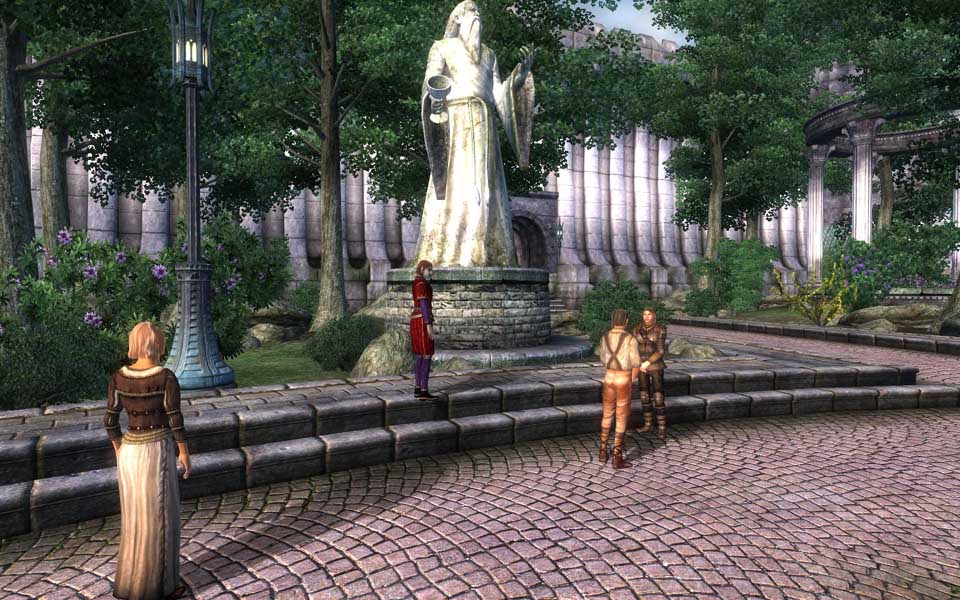
Nameless citizens: the unimportant cast of their own reality

Taking a step up from extras, we have minor characters. These ultimately play very little role in the story, but in an RPG, this character may provide a brief introduction to a situation or offer the player a small sidequest. From this level of character upward, my basic litmus test for a character is fairly simple, and involves looking at the character's desires or primary goal. Ask yourself two questions: What does this character want? Why do they want it?

If you can't answer those two questions, then your character is probably in need of more design. Now, obviously for more complex or prominent characters, you're going to need more details, like behaviour, upbringing, personal morals, and much more. But for a basic character to act coherently within a game, you need to know the answer those two questions. If you can't then they probably can't interact with the character in any meaningful way. If you can, then that's potentially all you need for a simple quest-giver NPC. Do you really need a full backstory for the mother who wants you to look for their child? Or for the bartender who wants you to get rid of the thugs from his bar? These characters have simple desires and simple goals, and there's really no need to develop them further than their role in the game requires.

Please kill the monster, I'm too scared to do it.

On the other hand, we have major NPCs. Characters crucial to the plot, antagonists and party members. These characters should have some really solid development behind them, including history/backstory, personality traits, speech patterns, like and dislikes... basically a full biography and profile. If these characters are meant to grow, develop and shine as three dimensional characters, they have to have conflicting elements to their personality, individual components that come together to form a cohesive individual who has the potential to mature throughout the game's narrative.

Now, this isn't to say that characters have to change their personality during a game, even though I love that as a concept. But a character should grow and develop into a fully formed creation as the adventure progresses. The player should gradually learn more about important characters as the game progresses, as new information and experiences present their character in a new light or expose different facets of their personality or background. This applies equally to all major characters, be they allies, companions or adversaries. Companions don't immediately divulge all their secrets to you upon meeting them, and there is no mystery in the enemy whom you fully understand from a single encounter.
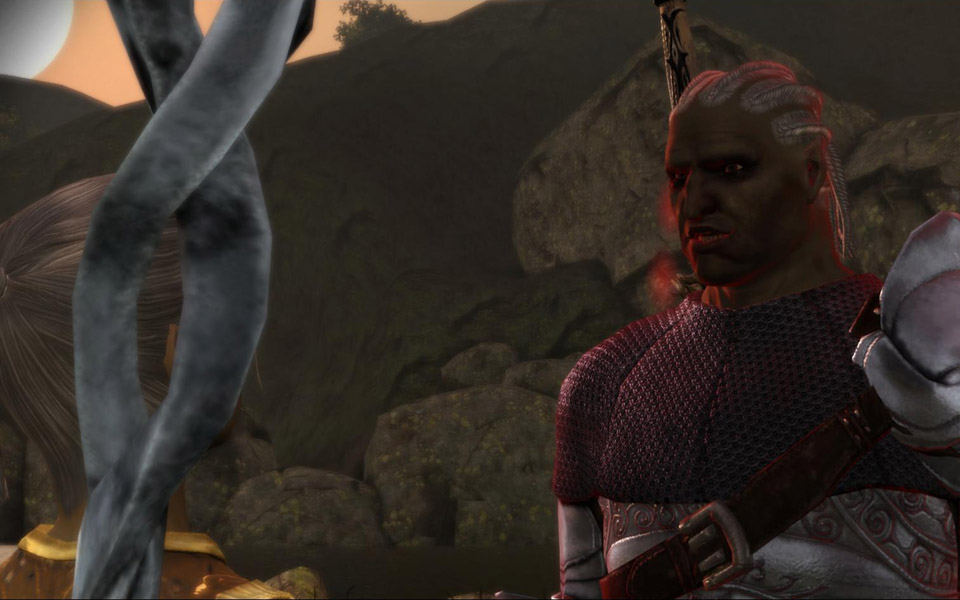
Where's the fun in Sten telling you everything at once?

Of course, there will be plenty of characters that fall in-between the extreme of "major character" and "side quest NPC". At what point do we cross the line and require more details for those characters? How far do you go developing a backstory for someone who is a catalyst for some events but will ultimately fall by the wayside? This is when I go back to my litmus test. For each significant action that a character is taking, you need to know why they are making that action. The small time villain serving the player's ultimate enemy needs to have a reason to support his master, but they may also need their own motivation to want to kill the player character. Now, this could be as simple as wanting to please their master and assume a higher rank in the Nebulous Evil Organisation, or it could be something a lot more complex.

Deciding what makes characters the way they are is part of the fun of writing. For the player, finding out about those characters helps to make the journey fun. It can be a lot more fun to defeat a game's villain if you're doing it with people who feel like they are your friends. If players have insight into the personality of the characters they are dealing with (whether on friendly or unfriendly terms), it makes for a much more enjoyable narrative, which consequently should deliver a better game.

Saturday, August 28, 2010

Variable Characterisation

A post by TimelordDC on his development blog got me thinking (again) about the amount of detail required to be put in a game in terms of the small details and backstory.

As for small details, that's relevant to what I was trying to do for over an hour today, which was to get guards to stand at attention or salute as you walked past.  I thought this would be a relatively simple process of overriding ambient behaviour (and a scripting command exists for this), but as I posted in this thread, I couldn't get it to work. Hopefully someone will be able to figure out what I'm doing wrong - I've already spent a significant amount of time on something that in all honesty won't add a lot to the experience of most players. Yet it's those small details I love seeing in games.

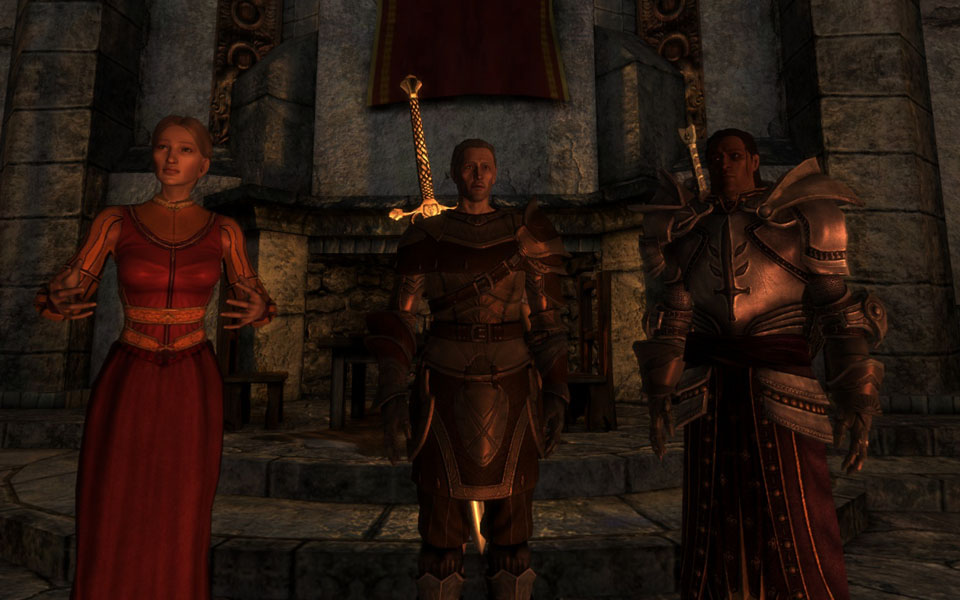
When it comes to backstory, I find myself putting in a lot of effort for characters, particularly major characters within a story.  There is a lot of work that is going into creating the backstories for the party members and the major NPCs within The Shattered War, and I can almost guarantee that not all that information will make it into the final set of dialogue.  Additionally, just like in the main campaign, there are likely to be some bits of information that you find out in mutually exclusive choices.  As an example, a point in the main campaign of Dragon Age where you question Alistair about the Grey Wardens comes to mind - you can potentially ask him if there were any elves or women with the Grey Wardens. You can only ask one of these questions before he'll start relating a story about another character, making a small and subtle difference possible in your interaction.

Alistair reminisces about getting drunk

Now, the funny thing is that this doesn't really add much in terms of the character's development, but merely provides a more natural flow of conversation and a small variance in your experience. But having a large number of these throughout a game make for a more organic interactions and individualise the experience for players.  I know I've discussed this before, but what if designers divulge different aspects of a character's past or experiences based on the choices a player makes? It's not a matter of withholding information, but merely making a more "realistic" representation of the interactions between two people.

Let's take a hypothetical real-world situation as an analogy. Say you have a group of three friends. It is unlikely that two of the friends will know exactly the same information about the third, though there will be some key information to which both will be privy to. However, the might be some secrets that one will know and the other will not, and vice versa.  Who is to say that NPCs in a game should not react in the same way? Perhaps based on a player's choices, they will see different facets of a character than if they had chosen differently, offering an individualised experience for each player.  Moreover, it could offer significantly different experiences on repeat playthroughs. This isn't about changing a character's persona, merely exposing the player to different facets of it based on their choices.

Three... let's go with "acquaintances"

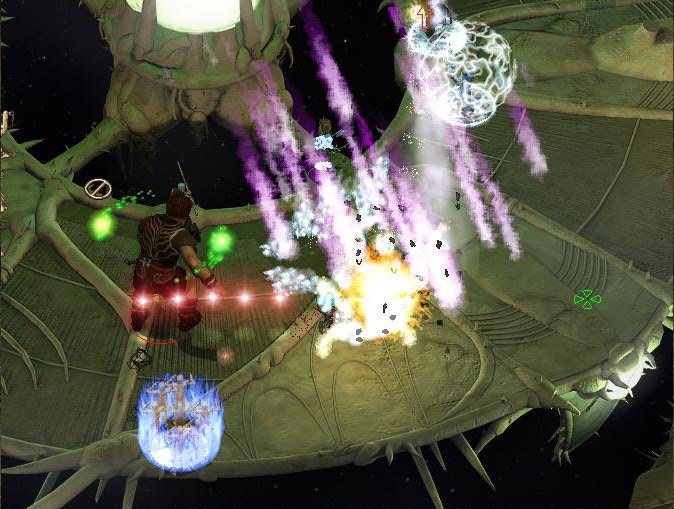
However, what if we did take this a step further and allowed the player to influence a character's personality? I'm not simply talking about the ability to make someone a jedi like in Knights of the Old Republic 2. Or going a little bigger, something like David Gaider's Ascension modification for Baldur's Gate 2: Throne of Bhaal. This allowed you to get the monk Balthazar to support you in the climactic battle against the final boss(es) provided certain criteria were met. Actually, Alpha Protocol is probably one of the best examples of this idea, as you can have some greatly different experiences based on many decisions, and can potentially end the game with a great number of allies, or simply a massive body count. There are also several boss fights which can pit you against different opponents (or change their abilities) based on your choices. The idea that through your actions you can turn an adversary into an ally (or vice versa), is something that definitely appeals to me.

Death by spell barrage in Throne of Bhaal

Imagine a short game that is a murder mystery that plays out different based on your actions throughout the game. Everyone has a motive for murder, but through your actions and prodding, one of the characters finally decides to take that plunge into the darker side of nature. I'm reminded of a quest in Oblivion which was a "reverse murder mystery" where you could prod the entire house into murdering one another through your actions. But imagine if instead of being a sidequest, that level of control was woven through the major plot of the game. Maybe I like to meddle too much in the affairs on NPCs in a game, but I'd love to be able to affect the development of major NPCs in a game.

Wednesday, August 25, 2010

Small details

Today will be another short post, as I've been spending quite a bit of time doing some polish on previous quests and content.  It's the small things like making sure that a shot looks exactly how you want it, that all the quest entries are laid out nicely and clearly explain the plot and so on that make a big difference in my book. That attention to detail is something that I really feel makes a difference between an engrossing adventure and one that has you cringing at its technical or artistic aspects.

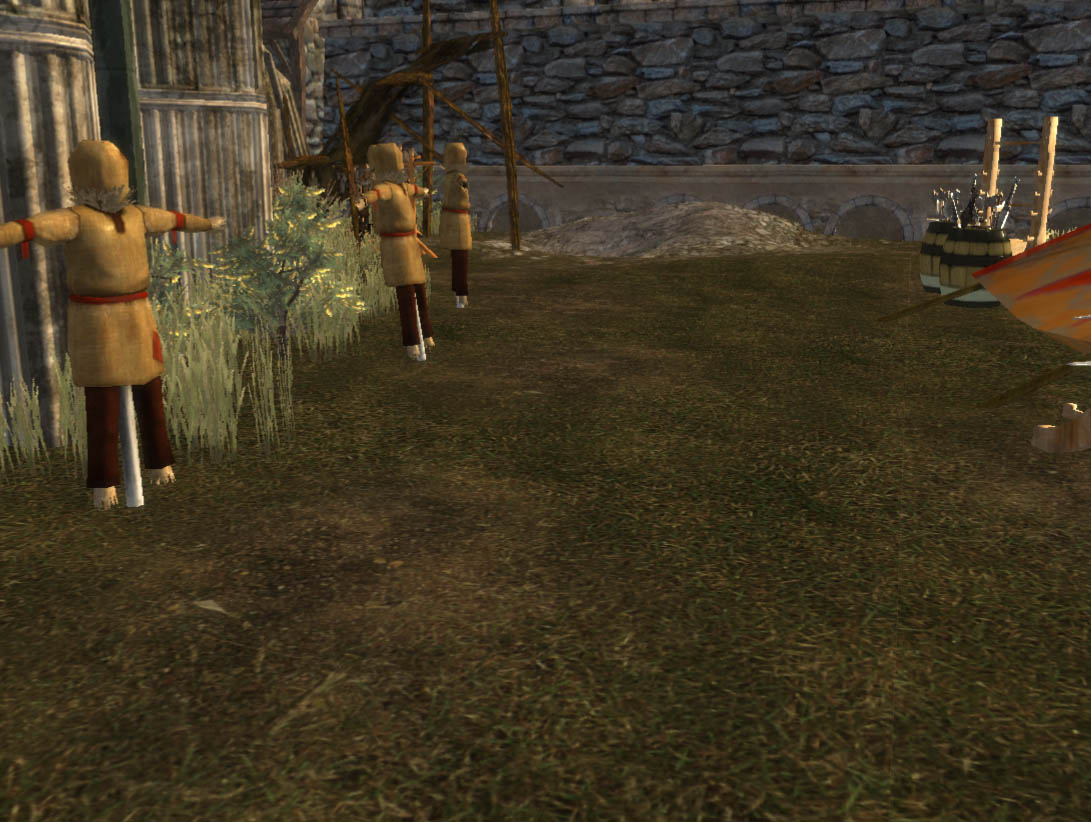
In order to demonstrate the kind of small details I'm talking about, I'm going to show two screenshots of a small area within Fort Velen. The first shot, which is the "bad" or unrefined shot is below. (You may want to open up both images full size so you can compare them properly)

Initial terrain

This is a fairly narrow area we're looking at here, so it would potentially be feasible to not pay any attention to it. There are small patches of dirt in front of the training dummies, which are there because people practicing on the dummy would likely wear away the grass in front of it with constant steps. However, I still wasn't happy with it.

"Better" terrain

Now I've added some height variance into the ground, with divots in front of the dummies and small mounds between them. This wouldn't typically be because of the training dummies, but such small bumps would have helped dictate the initial placement of them. The main thing to take away from this is to avoid having sections of uniform terrain.

Flat terrain is unnatural and looks out of place, especially if you're dealing with a natural surface like grass or dirt. Large sections of stone might be flat, but they quickly become monotonous and boring for the player to look out. The same applies to texturing, in that having large swathes of ground covered in exactly the same texture with no interruption looks boring, and usually exposes the tiling of the texture quite clearly.

Now, you might be thinking that the difference between the two shots doesn't look that big, and I agree that it's not, but it will be noticeable. As the player walks along, they'll note their hero going over the small bumps. It will also be more visible because when you're viewing it in game, you'll have proper lighting rather than having everything full lit like you do when you're working in the toolset. (Or at least as I am here) This means that you'll have shadows to further accentuate the height differences.

This might seem like a picky and trivial thing, but trust me, even a small amount of height variation can make all the difference in making a level feel more interesting and more organic. It's a principle applicable to any terrain editing you might do.

Monday, August 23, 2010

Frustration Warning!

Tonight will be a short update because of a bug I found in the Dragon Age toolset that has caused numerous problems that I couldn't track down. This one is for modders.

Do not duplicate plots!

If you duplicate a plot, the toolset does not create a new GUID for the duplicated plot. For those who aren't tech savvy, this means that setting plot flags is not reliable.  You might end up setting a plot flag on a different plot to the one you thought you had selected. It also causes havoc for any codex plots you might have created.

This issue has caused me several headaches... I had a quest that was miraculously being finished for no apparent reason even though the requirements had not been met, I had the codex entry appear for a character the player had not met, and was missing codex entries as well.

I've still got a bit of repairing to do in order to rectify this problem. Something that should have saved me a significant amount of time has actually cost me many hours of productive modding.

Saturday, August 21, 2010

Surprise!

So after a lot of work over the past couple of weeks, I've got something to share with you all... No, The Shattered War isn't finished. But I do have a shiny new video to show! This is a video walkthrough of one of the major areas within the module: Fort Velen.


In addition, I've also added three new hi-res screenshots to my slideshow that's on the left of this blog. The source images are 1680 by 1050 - I don't have a 24" monitor so I can't go up to 1920 by 1200. (If you want them that big, then you'll have to donate to the "buy AmstradHero a new monitor" fund) To give you a closer look, I've posted one of them below, and as per usual, click for a larger image.

Running urgently to Fort Velen's keep

You can also access the Picasa album these images are in by following this link. Happy viewing!

Wednesday, August 18, 2010

I will not argue on the Internet...

Recently I've wasted too much time on the BioWare Social Network, typically getting drawn into discussions that initially appear interesting but quickly devolve into... well, something that isn't. However, I don't get out early enough and on several occasions have fallen prey to the madness that is arguing on the Internet.

I could highlight some of the less sensible posts I encountered, but I'd rather not spark an argument here. I'm interested in discussing game design, but unfortunately many threads tend to quickly turn to mudslinging matches with terms like "console kiddie", "PC elitist", "dumbing down", "selling out" and other terms that equally add nothing meaningful to debates.  That's not to say that the debates are entirely like this, and there are some really good points (including ones that I disagree with) raised by some people. Unfortunately, they tend to get lost amongst the noise.

As such, I'm going to try to avoid getting sucked into these debates. However, I love seeing, reading and getting comments from the developers, so it's a tough thing to do. For now, it's back to level editing and waiting for lightmaps to render...

Tuesday, August 17, 2010

Don't forget the basics...

After my earlier post, I put what I think are the final touches on the basic layout of the level. So I decided to render lightmaps for the first time and get a basic idea of what the lighting looks like. I then use this to inform my lighting decisions to figure out how many lights I need to place and their intensity. I've started using this approach to Dragon Age because the light-mapper is so finicky. When I'm using the Unreal Engine editor, I'll go crazy with lights and put lots of them in because I know it can and will do the job effectively and efficiently. (Plus that's what the professionals do, so I take my lead from them)

However, since this is only really the third level I've done from scratch in the Dragon Age toolset, and it's been a while since I did the other two, I forgot something basic...

Did somebody turn out the lights?

When you're making a level in Dragon Age, before you render your lightmaps, always put in an Ambient baked light to avoid pitch black shadows.

You don't want to know how long it took for the lighting calculation. Or rather, I don't want to think about it.