Sunday, November 28, 2010

It's time for your input...

A quick post to tell everyone that I'm calling up readers to give their opinion in my latest poll.

I want to know how much people use cosmetic mods like Pineappletree's Vibrant Colors (I hate spelling that without a "u") or Don't worry, be hairy. So far I've stuck with the default options for hair styles and eye/hair colouring, but I want to know if players have these mods installed by default and won't stand for the small selection available in default.

The reason I ask is because these mods have the potential to modify the appearance of existing faces from the default or as I have created them...

Those eyes suddenly look a little different...

This might be a minor thing, but I don't want a character to suddenly look out of place because of an external mod. So I want to do the right thing by players and if they are using one (or multiple) appearance changing mods, I'll install those mods during the creation process for The Shattered War and make sure that all the characters have the appearance that they are "supposed" to have.

If people could go one step further and identify the specific mods that they use, I would definitely appreciate it.

Saturday, November 27, 2010

Shattered War: Character Interaction

In my last post I promised I'd give some information about characters in the Shattered War, so that's exactly what I'm going to do today.

In The Shattered War, you take upon the role of a soldier investigating darkspawn in the Frostback Mountains. Set after the events of Dragon Age: Origins, the adventure sees you acting as part of a larger force to deal with the problems in the region. As a result, you will be called upon to talk to those who live in the area, as well as allies and enemies seeking to help or hinder your cause.

It will come as no surprise to any regular reader that choice will be a key consideration in The Shattered War. There will be many situations where you will be called upon to make difficult decisions, and in some cases there will not be an option that allows you to save the day without consequence. Before the player reaches the end of the adventure, there will be deaths on their conscience, no matter the path that they choose.

You will be called upon to take sides

Party members will react differently depending on how you treat them, but there will not be undue penalties simply because you do not agree with a particular party member. Leadership can take on many forms, and you will see the effects of your relationship with party members, be it one of friendship or enmity. The worst thing you can do as a leader is to inspire indifference, for in The Shattered War your party members will perform better if they like you or hate you.

Of course, there are other characters you will have cause to talk to repeatedly during your campaign, and your behaviour with them will affect future interactions. If you mistreat a particular individual or otherwise anger them, you might find yourself at odds with them later in the game. There are a number of characters that can go from ally to adversary or vice versa, so carefully consider any decision to grant or withhold your assistance.

Be prepared for some frosty receptions

The Shattered War will present you with characters you will love, and some that you will love to hate. Your interactions with them will help define the outcome of your adventure, and even have wider implications for the region. Choose your words wisely.

Thursday, November 25, 2010

Interesting Characters

Interesting characters are vital for any sort of narrative, and video games are no exception.  I've always tried to make characters that are a bit different from normal, and The Shattered War is no exception.  The means for making characters interesting are many and varied, and I couldn't try to list all the possible ways that you might try to do this. But here are a couple of general pointers that I like to think of when going through the initial process of creating a character:

Introduce Quickly
Give your character's name, position and emotional reaction to the protagonist as quickly as possible. Ideally you'd give all three within the first line or two, but you might choose to withhold an identity for dramatic tension or plot reasons. Players generally shouldn't be left wondering who they are talking to.

Cameras have establishing shots, dialogue should have establishing lines

Purpose
What does this character add to the game? Why have you added them? If you can't answer this question, then you've got a problem. Are they for background flavour, to allow the player to overhear a conversation, give the player a quest, or are they an ally or adversary?

Uniqueness

Resist the temptation to fall into stereotypes (the typical tough guy) or counter-stereotypes (but he's really a softie on the inside), or if you do, give them a quirk that gives their personality some additional depth. If you've got an established lore, see what roles this character can play within that, and how they might buck some of the trends set by it.

Emotion
People have an emotional reaction to situations, especially when there is something at stake. If there's nothing at stake... well, you're doing something wrong with your game's plot! How does a character react to their current problems or predicament. This should come through in their attitude, expressions, movement, tone of voice and vocabulary.

He doesn't look particularly happy...

Desired Reaction
What do you want the player to feel when interacting with this character? Are you trying to get the player to sympathise with them, dislike them, want to show them up? Not all allies have to be likable, and not all enemies have to be completely hate inducing. Imagine if you can make the player empathise with a villain and then be forced to decide whether to kill them or spare them despite probably future danger and/or betrayal.

Don't be afraid to try and manipulate your player. Some of the best characters are those that people love to hate. If you can inspire an emotional reaction in a player such that all they want to do is see a character brought undone, then you've achieved the goal of making your NPC memorable.

In my next post, I'll give a few hints about The Shattered War and what players can expect from interactions with characters during the adventure.

Tuesday, November 23, 2010

The 180 Degree Rule

Sometimes when reading or watching something, you can identify that something isn't "right", but you're not exactly sure what that thing is. I recently did a small amount of reading about cinematic techniques which demonstrated something I was doing completely "wrong".

In one particular sequence for The Shattered War, I was breaking a film-making guideline known as the "180 degree rule". This states that two characters in the same scene should always have the same left/right relationship to each other, unless there's a specific camera movement "crossing the line" and presenting the subjects from the other side.  If this is done, it can be disorienting and jarring.

This is one of those funny rules that is totally obvious, yet I couldn't work out why a particular scene just did not work. Maybe I'm just not observant enough when it comes to cinematography, but as soon as I read about the 180 rule, I immediately knew what was wrong. As a result of this realisation, I made a new generic stage to use for conversations, where the cameras are positioned on "the other side" of the line. By default, Dragon Age always has the player on the camera's right, but now I have a stage with the player on the camera's left...


Now for something completely different...

As a result the transition from my cutscene to dialogue isn't jarring any more. This might be a minor thing, but it made the whole sequence a lot more pleasant to watch. Film techniques and film editing are the means for making good movies, and as such, they are also essential for making good in-game cinematic sequences. Now I know I must do research into film-making and directing techniques to make my cutscenes more engaging - yet another vital skill that must be added to a modder's repertoire. Any recommendations for source reading/watching material would be gladly welcomed!

Sunday, November 21, 2010

Standalone Complex

A continuing trend across many games genres is a tendency towards every combat encounter within a game being its own discrete entity, and with no real continuity in terms of resource management across these encounters.  Okay, I used big words there that make this sound more confusing than it actually is, but I'm trying to be specific. But let's quickly make it simple and take the example of a first person shooter...

This has resource management continuity

Health was a finite resource in Doom. You started off with 100 health, and every bit of damage you took subtracted from that total, but you could restore health (and even exceed your starting "maximum") by picking up items. If you did badly on a particular section or particular group of enemies, you began desperately searching for medkits to get your health back up to a safer level.

Jump forward to modern titles like Modern Warfare, Gears of War, Mass Effect or Uncharted 2, and you don't have a health number. When you get injured, your screen goes red (to varying degrees) indicating you've taken damage and need to bunker down to recover. When you finish one encounter, you're effectively at full health again and ready for whatever might come your way.

Dragon Age attempts to introduce a small middle ground, by penalising characters who fall in battle with "injuries" that hinder their performance in combat until the player uses an "injury kit" or returns to camp to heal. But for the most part, these injuries don't make a big difference upon a character's ability in combat. Maybe people who play on nightmare difficult might notice a more significant penalty, but I never really noticed any appreciable difference in fighting prowess as a result of injuries.

So a party member is injured. Do I really care?

Each system has it's own strengths and weaknesses, so let's take a look at them. For Doom, it's possible for one bad encounter to turn the tide for the entire level. A player gets through the first few fights and finds them really difficult and so has very low health as a result.  The remaining fights in the level might be significantly easier, but the player can't get past them because they can't avoid being hit entirely, and they simply don't have the health to survive.  This is bound to lead to frustration for the player, as they might try dozens of times to get past the level before realising they'll had to load up an earlier save (providing they actually have one) to do the first bit of the level again. It's generally considered poor design to get the player into a situation where they can't win, and that's effectively what this kind of system does.

On the flip side, this kind of system actually makes the player care about each individual combat scenario more. They know they have a limited amount of resources/health available to them, and hence will be more invested in every encounter with the enemy, because they know it will have an impact as they progress through the level. Some could argue that ammunition provides a degree of resource management for a game, but unless the designers are being unfathomably stingy with ammunition, this isn't really much of an argument. I'd also contend that if as a designer you're being that stingy with ammunition, you're probably making a game that many players are not going to find fun.

We don't play First Person Shooters to go ammo hunting

Now let's look the game without resource management. As a designer, it is easier to make every encounter more balanced and achievable for the player, because you know exactly how durable they are coming into the fight. You know they will have full health and how much damage they can take before dying. There's no need to consider the effects of previous encounters within the level on their current state, and thus it's easier to precisely manage the difficulty curve for the player. This is great in terms of pacing, as it allows the designer to do things like giving the player some easy encounters to make them feel good about themselves before throwing them in the deep end by putting them in a really tight spot. It's easier to provide a balanced game experience, and reduces the possibility of players getting stuck in a situation in which they can't possibly prevail.

However, the main weakness of the system stems from the lack of continuity, in that each individual combat scenario can feel different. If you're simply gunning down enemies with little resistance and the combat feels like a procedure rather than exciting gameplay because the player is never in any danger, then the game has become dull. Because the player's performance in one battle doesn't affect what comes after it, the player can become somewhat nonchalant about the encounter, because once the enemies are dead, they don't matter. The player simply walks along and is quickly 100% ready for the next bit of combat, thus somewhat trivialising "ordinary" encounters that quickly come to feel like "filler" to pad out the game's playtime.

More fighting. Yay.

I touched on Dragon Age's attempt to take something from both styles. Health and stamina/mana (used for special abilities or spells) regenerate very quickly outside of combat, effectively meaning characters fully recover between individual sections of combat. However, anyone that falls in battle "comes back" (I guess they got better) once the fight is over, but with a small penalty to their statistics, making them less effective in subsequent fights. This is perhaps an interesting step in trying to get more continuity across encounters, but it fell somewhat flat from my experience. Besides, as long as a character isn't "killed" completely, even if they survive on the smallest sliver of health, there is absolutely no "penalty" given to them at all.

I'm not sure I like this trend for everything to be standalone. From a design perspective I understand the desire for it, but it reduces the tension for "ordinary" encounters with enemies, and makes them somewhat tedious. In a strange conundrum, resource continuity might allow designers to be lazier by adding more "filler" encounters with generic enemies, but at the same time, makes every such encounter more meaningful and interesting for the player because they provide actual consequences should the player perform badly. This is why the "random encounters" with creatures in older RPGs actually meant something, because you were potentially already low on health and mana and forced to fight for your life against a paltry band of goblins (okay, three half-ogres in this case)...

You have been waylaid by enemies and must defend yourself

If you restore a player to full fitness between each encounter, it might be easier to create balanced "special" encounters, but it is actually more demanding of the game/combat designer, because more sections of combat must be "special" in order to keep the player interested. Standard combat against generic enemies quickly becomes as bland as it sounds, because it simply doesn't matter to you as a player.

In trying to simplify their work by removing ongoing health meters, game designers have actually made their job (and that of the rest of their development team) harder because there have to be more "standout" sequences that are made unique by the mechanics, enemy AI, scripted events, the level design, or any other of a number of factors that combine to make a combat encounter. Without any sort of ongoing consequences, there has to be variety in most encounters in order to keep the player engaged and give them something to care and think about.
Thursday, November 18, 2010

What has story cost us?

I frequently laud the power of story in video games and how they are an amazing medium for interactive storytelling.  However, there's a flipside to this argument that deserves analysis. What are we losing by having an increased focus on story in video games?  What negative impact is storytelling having on games as a medium for pure fun and entertainment?

Firstly, let's get address that by raising an issue like this, some might argue that I'm calling into question the whole "video games can be art" argument and proving that "video games are just for children/entertainment". But in that case, every "action blockbuster movie" that requires you to check your brain at the door does the same thing for films. Not every book or movie can be considered "art" nor does anything spectacular for their medium as a whole besides pure entertainment. There is nothing to say that an artform can't also purely provide entertainment at times.

Just turn off your brain and enjoy the ride

So with that aside, let's look at how storytelling has modified games. Games now frequently feature a narrative, albeit of greatly varying coherence and quality depending on the particular game. As a result, we also get characterisation and cinematic presentation to help facilitate that story. Good level design dictates that events within a level will help communicate the story and force the player towards their goal.

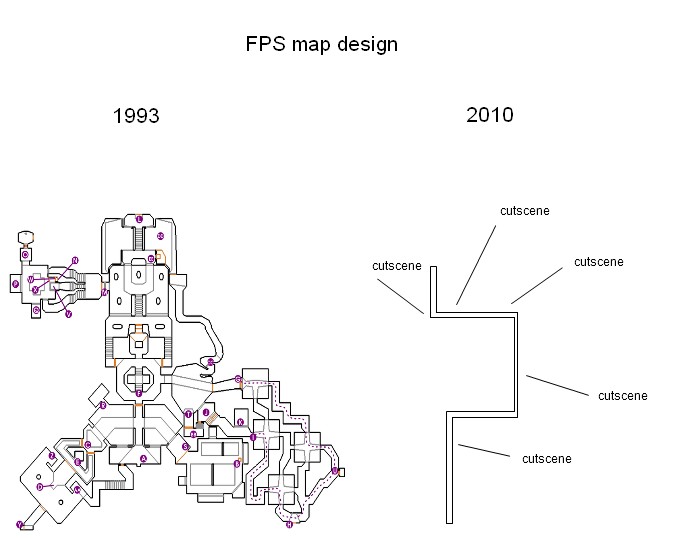
So what do we get when we combine all these factors to make a game? We have to have a plot that makes sense and motivates the player, and we need to amazing set pieces, either gameplay or non-interactive cinematics that progress the game's narrative. And if we're talking AAA titles, everything has to be pretty and the characters probably need voice acting, and our cinematics need good camera work, and the player shouldn't miss any of them, because then they're missing out on content that took lots of time and money to create, and we don't want to waste it because many players will only play the game through once, if that. So when we combine all these things... well, let's compare the map for an old FPS to a new FPS...

So... which one is supposed to be better, again?

I can't take credit for this picture (though I had seen it before pigeon's comment the other day), but it's somewhat brutally accurate. As much as we can applaud Half-Life for the effect it had FPS gaming, its success and critical acclaim have in no small part led to the situation where players are effectively being herded down a narrow corridor that does its best to not look like a narrow corridor. We've been forced to sacrifice freedom for the increasingly cinematic presentation of our gaming experience. Yes, we get incredibly moving and gripping cinematics or scripted sequences that we experience as the player because of this enforced non-linearity, and each of these has more potential impact because there's a steady pacing of narrative to keep the player engrossed and attached to the story. But we're on rails.

Compare this to something like The Bank Job in Thief 2: The Metal Age, where there were about half a dozen different ways just to get inside the building. The player could freely run around the building and thus "experience" the entire level, but they wouldn't necessarily work out all the different ways they could enter the bank. Even this very start of the level, where the player is merely trying to get inside the building helps reinforce the setting, the aim of the level and the character of Garrett as a master thief. He's so good that there isn't just one way into the building, there's several, and he has the ability to pick whichever one he wants!

Is this time spent creating wasted content? I'd argue not, because in providing a wider level, you give the player a real feeling of choice and empowerment, because not only are they choosing how to break into the building, they can visibly identify other ways to get in that present different level of challenge and risk. In the Half-life series, as well created as it may be, as a player you see one way to reach your goal, and you can easily identify that it is the only means to reach your goal.

I can just go in the front door?

I might be starting to sound like a bit of a broken record to regular readers, but I'd like more non-linearity in modern games. In Doom a player could explore side tunnels on most levels, but they'd eventually end up flicking the relevant switch or grabbing one of the three necessary coloured key/skull to get through the relevant door. If we applied that to modern gaming, we could easily have three sections that every player would be guaranteed to experience within the game, but the exact path they used to get there could be slightly different. We do run the risk of creating content that players may not necessarily see (which is an ongoing argument in itself between big-name game designers), but I feel increasingly constrained by being forced down "the one true path" in many modern games.

I imagine some people will stand up and say: "But we have non-linear games! They are sandbox games like Morrowind, Fallout 3 and Red Dead Redemption!" These games definitely have non-linearity, but they introduce this non-linearity by adding a lot of (dead) "transit time" getting from one location to another. I love exploration, but I'm not personally so much a fan when exploration (or traveling) turns into one of the primary mechanics of the game, at least not without a massive variety of landscapes or some other driving force (preferably a narrative force) to push me to explore. Games should "skip the boring bits"... commuting is one of those "boring bits".


Commuting is not fun

Where is the balance between these two extremes? Why does it seem like we've mostly fallen into games/levels with linear paths (albeit with attempts to disguise their linearity) driven by story, or completely non-linear games with very little story to drive us? More importantly, where is the happy medium that allow players choice while still keeping them driven by engrossing narrative? No one appears to have quite nailed this balance yet. It does appear that some developers are attempting to do so on a macro-level, i.e. across the entire game, but the idea of doing it within a level appears to have fallen somewhat out of favour, which I would argue is something of a loss for games when it comes to creating engaging levels.

Wednesday, November 17, 2010

How to improve your levels

Today I'm going to talk about how budding level designers can help improve their level design. If you're not interested in making your own levels, you may not find this terribly useful, but it may cast some light on why the process of level creation is so incredibly time consuming.

Analyse
This part is easy, and your homework for this is to go play some games. Really, it's that simple.  However, you need to be paying attention and you need to look at games from more than just your chosen genre. If you want to learn about how level design can and should support gameplay mechanics, go play some multiplayer-centric first person shooters. Look at maps from Counterstrike, Unreal Tournament 3, or Team Fortress 2. There are some great examples from these three games, but feel free to look at other maps as well. Moreover, consider maps that both work and don't work, and then take the time to decide why. Why do particular maps result in stalemates or levels that are mostly empty apart from one frenetic killzone? If you're not as experienced in level design, make sure you consider the use of height differences in the level, as this is an area that is frequently overlooked and/or misunderstood by beginners. Breaking down level design is an interesting but very complex subject, so for the sake of brevity, I'll leave it as a topic for future discussion.

Plan
Don't fire up your level without putting pen/pencil to paper first. Sketch out your level design! In professional game studios, concept artists create draft images of particular "shots"  that they believe should be the game to help convey the setting or instill players with that "wow!" feeling they get from looking at an amazing level. Even if you can't draw well (and I am terrible at sketching images), you should at the very least have an overhead map of the functional aspects of your level. Where are the trees/buildings/rocks/stairs/etc? You don't have to fill in every detail, but you do need a basic idea of how the level is going to play out.  An overhead map should allow you to concentrate on how the level is going to support and enhance gameplay mechanics, and should help you quickly help identify areas that could annoy the player because of repeated backtracking or a sense of being railroaded.

It doesn't have to be complex. But do it.

Prototyping
Do it. It's that simple. Make up a mock of your level in bare terms as quickly as possibly. There's no need to fill in the space, or even necessarily have the space exactly how you will in the final level. The main idea is to get an idea of level flow, size, and spatial considerations. Ask questions like: Is a hallway too long, too narrow, too straight, or too steep?  Is the level too linear or too non-linear? Does the player have enough space to move around? Can they see or work out where they are supposed to be going?  When doing a prototype, focus entirely on function, not on form. Don't even bother texturing, and only add lighting so you can see what is going on in your level. Make sure the level "works", then start creating in earnest.

I'll make a Dragon Age specific note here and say that you should make sure that you include at least one model in your level before trying to do the process of building lightmaps and using "Post to Local". I had a protoype level without a single mesh model that appeared to cause an infinite loop during the post process.

Playtest
This goes hand in hand with prototyping and revising your levels, but you need to make sure that they are fun. You want your players to have fun, right? Then you should make sure that when you're playing a level you've made, you're having fun. If you're building for a multiplayer game, try and get a few friends to help test as well, even if the levels unfinished. If you can't do that, put in bot-pathing and test if yourself. It's not perfect, but it's better than nothing.


Good multiplayer maps require lots of testing

Throw Away
At some point, you'll end up creating something that doesn't work. It's that simple. Every level designer has done it. Any level designer that claims they haven't, isn't really a good level designer. IT might be a long section where the player feels unnecessarily herded down a linear path, it might be a level where 50% of the mapis never visited by players, or it might just plain suck. Don't get disheartened, but instead realise what is wrong with the design and then ditch it to create your next level. Do not fall into the temptation to try to continually patch up a level whose core design doesn't work. You'll end up with a level that feels like it has been patched up, at least not without likely spending more hours to fix it than it would have done to create a new, better level from scratch.

Budding writers are told that their first few books are always terrible, and they need to get the first few out of the way before they can actually write something good. As a level designer, take that same approach. Prepare to throw away your first few levels, particularly if you're new to level designing or the particular toolset you're using for level creation. On that note, if you're working on a new mod or game, do not start by creating the first area that the player will enter. The first level (or at least one of the first levels) should be very visually appealing to grab the player's attention. Delivering them your first attempts in level creation for the game is not a good means of doing this.

These are a few small tips for improving your level design, but there are plenty more ways to get better. Still, all the theory in the world means nothing if you don't practice. So get stuck into that level editor!