Wednesday, November 10, 2010

Call of Duty, Black Ops and Sniper Design

Unless you've been living in a bubble separated from all video game related press, you've heard of the Call of Duty series. Modern Warfare and its sequel both sold phenomenal amounts of copies, and Black Ops, the latest in the series, had pre-orders in the millions. I'm not going to review the game and tell you it's good and bad points. The game delivers a game typical of the current style of the series: a short high-octane single player campaign supplement by its multiplayer component. However, there has been a significant amount of discussion regarding a particular design element of Modern Warfare and its change in Black Ops. That issue is quickscoping.

Quickscoping (also "quick scoping" or "quick scope sniping") is a mechanic in Modern Warfare 2, whereby using the "Sleight of Hand" perk and the aiming assist mechanism of guns with a sniper rifle, a player is able to pull off one shot kills on other players in medium to short range. There is some skill involved in terms of the aim and the timing, but it makes a sniper a dangerous proposition even at closer ranges. A quick search will turn up video demonstrating the mechanic and countless kills using it.
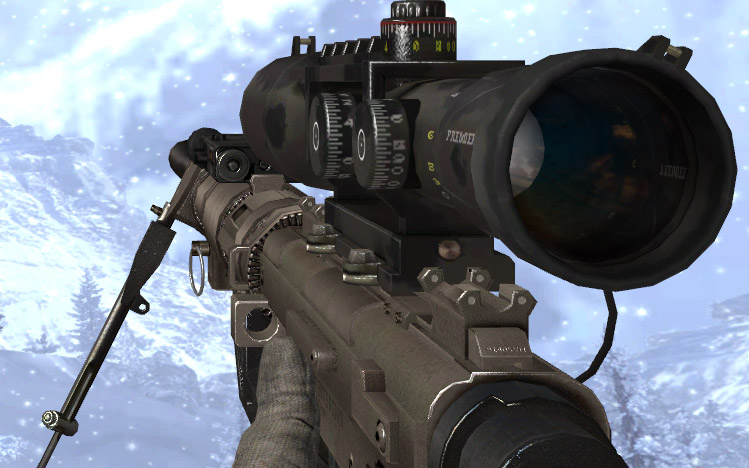
Why scope when you can quickscope?

In released Black Ops, Treyarch (that's the developer - they share the series with Infinity Ward, who were responsible for Modern Warfare 1 & 2) has taken steps to counter quickscoping by introducing error into the aiming assist mechanism, meaning that when you zoom in you won't lock directly onto exactly the location you were looking at before you zoomed in. In this way, quickscoping is not really possibly, because you'll need to correct your aim before being able to fire a killing shot. As a result, proponents of quickscoping have decreed that snipers are worthless in Black Ops.

I'm sorry to anyone who believes that, because it is a truly ridiculous argument. Snipers have instead been switched to the role that they are meant to fit: a long range combatant. Funnily enough, this is what they do in real life. Of course, the immediate counterargument to realism is "but this is a game and it is meant to be fun". I wholeheartedly agree, but because it is also a game it should therefore be balanced. Take a leaf out of the book of MMOs, or heck, even Team Fortress 2.

The scout: fast, agile and squishy

Balance implies that there are multiple roles within a game, and there is no one class or player can perform all roles well. This is where quickscoping completely fails the test of good game design. Snipers are the only class that can perform effectively at long range. Other classes can score hits, but it comes down to luck more than skill. Therefore they have a distinct advantage over other classes in that role, and game design dictates that if you had an exclusive ability (or at far better at it than anyone else) then you should have an equivalent shortcoming. But quickscoping means that snipers are almost as effective as people equipped with assault rifles in medium range, and even at close range, they've still got a reasonable chance of pulling off a single shot kill against someone using a shotgun or sub-machine guns. This completely breaks all rules of balance by allowing a quickscoping sniper to excel in virtually any situation, which is the epitome of bad game design.

There might be those that argue the quickscoping made sniper rifles more viable by allowing them be used at more ranges, and thus reducing the likelihood of camping. This is an even worse argument, because this overlooks the fact that generous killstreaks in Modern Warfare 2 made a defensive camping style of play more attractive than sniper rifles ever could.  Even ignoring this, making sniper rifles more useful in close combat does not make camping less attractive, it just makes a different style of play more lucrative rather than solving the initial problem.
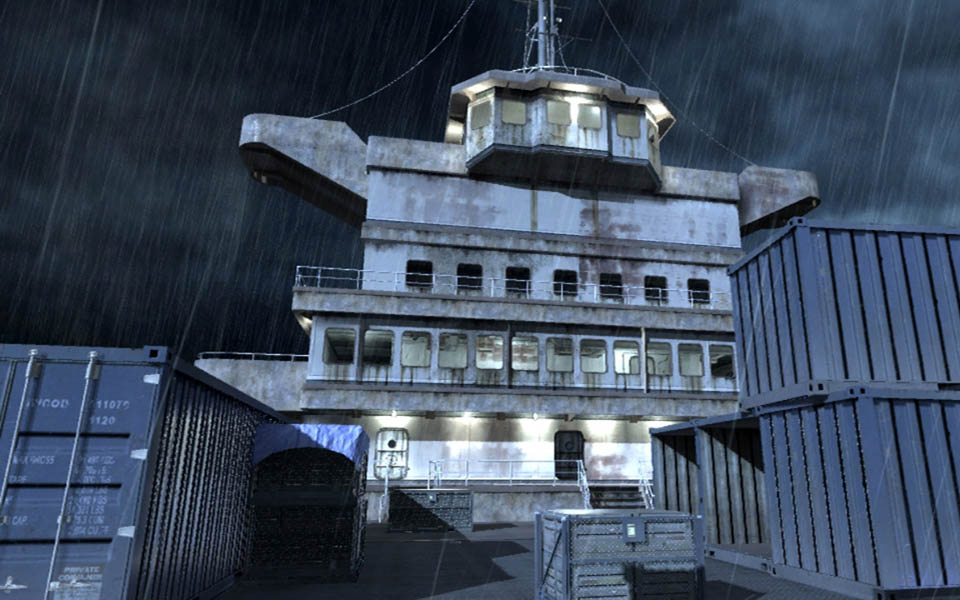
Modern Warfare's Wetwork. Hello snipers.

The truth of the matter is that campers and the act of camping isn't the problem. After all, we've been told it's a legitimate strategy. The problem that we're dealing with here isn't the fault of the designers of the gameplay mechanics, nor the players. In this case we actually have to lay the blame on the level designers. It's level designers that create layouts that allow snipers to have highly defensible positions that are extremely difficult for people to reach. It's level designers that create sniper hideouts with an extremely large field of view to allow them to pick off people with ease. It's level designers that don't create balanced maps to set each style of play on a relatively even playing field.

That said, I know they have their work cut out for them in creating such levels. It's not an easy task, but I can't help but feel that the level designers for the series need to improve their tradecraft in this regard. The realism and aesthetics are usually fairly good, but the mechanics of some of the levels simply don't work. I found that Wetwork degenerated into a combination of sniping and countersniping, or explosive spam in the centre of the ship. I'm sure you can think of other levels that suffered similar weaknesses in terms of repetitive gameplay, although it's certainly not a problem exclusive to Call of Duty.

Of course, I could mention other design issues in like combining Danger Close and One Man Army or elaborate on how killstreaks promote camping, but I imagine I might attractive enough hatred from FPS players with this post without covering that ground as well. Maybe I'm not "pro" or "semi-pro" when it comes to FPS games, but I understand game balance. In that regard, quickscoping does nothing to support game balance thus getting rid of it can only be a good thing.

Tuesday, November 9, 2010

Voice Acting and Games (Part 2)

Let's take yesterday's discussion about voice acting and constrain it to the voice acting of characters that the player meets and talks to during the game.

If we've got a character with a small portrait and text without VO, then it's up to the player to infuse that NPC with personality as they see fit based upon one small portrait and their interactions. There is generally a lot of leeway for different players to have a different mental image of that character. This relates to the point I was making in my Nostalgia Reviewing post some time ago.

When we compare portrait & text to a fully voiced and animated character, we're dealing with two entirely different means to engage the player. The former style was all that could be used in older games due to the technical limitations of the time. This meant characters were left more as a blank slate for players to read their own thoughts into the personality of a character based on a single image and the dialogue within the game.  In some cases, I imagine that the personality of those character did not match the personality as it was envisioned by the writers/developers. But no doubt the same is true of books.  And in this way, comparing portrait & text to fully voiced and animated characters is like comparing the difference between a character in a book and a character in a movie.

Is this exactly how you imagined Aragorn from reading Lord of the Rings?

Compare and contrast characters from old RPGs like Ultima Underworld or Infinity Engine games against something like Dragon Age. If you asked players to describe the personality of specific characters, I imagine you would get significantly more variance in the description of characters from the older games. In newer games the characters that players meet have more tightly defined personalities because of the extra details we get in appearance, gestures, expression and voice. The older games allowed us to fill all those details in because it wasn't possible to show them to us.

So with all this extra information that we are being provided, surely we are getting a richer experience from interacting with these characters? We get to see and experience every nuance of our interaction with them on a level that is beginning to approach exchanges that we experience in movies or real-life, all within the context of a video game. All the extra information that the designers can convey to players is phenomenal, allowing them to emotionally manipulate players through cinematic visuals and audio. We can hear the fear and sorrow in the voice of Alyx Vance (Half-life), the indignation of Loghain (Dragon Age), and the snarky exchanges between the Prince and Princess (take your pick of the Prince of Persia games). These give us a real sense of the personality of the characters in these games, allowing us a greater ability to truly understand and hence empathise with these characters.

This scene would not pack as much emotional punch without voice acting

However, while we might be getting an impression of the character that is more closely aligned with that of the people responsible for creating it, does this really help us become engaged with the game in the best possible way?  In a way, while we can become more emotionally engaged with the characters that have been created for us, we become less engaged with our own personal perception of the characters and environment. If everything is shown to the player in minute detail, then a game risks that every player will have exactly the same experience because they are not engaged with the game through their imagination.

For older games, players were almost forced to use their imagination to give characters extra depth simply because it was not possible to give that complete picture of a character. The experience arguably was more personal for older games, because it was up to the player to infuse the game they were playing with the extra personality that was lacking. Just like reading a book, everyone's image of the individual settings and characters was slightly different, providing an individual experience for each person within the set boundaries of its plot.

Have players become lazy and simply demand that they be shown every single thing in games nowadays? Are players losing their imagination as a result of the increasingly cinematic approach to AAA games? Or has the desire to have believable gaming environments created a gaming market in which pure text is no longer acceptable in order to maintain the illusion of reality?

Monday, November 8, 2010

Voice Acting and Games

The addition of voice acting into games is pretty much standard nowadays for big titles. Players expect characters to be voiced, and moreover, they expect the people delivering those voiced lines not to deliver hackneyed performances. The gaming community is no longer content to put up with overacting or flat line delivery. And beware the collective opinion of your game's audience should it have a small number of voice actors like Oblivion.

We can safely say that voiced games are not going to disappear any time soon, and if anything, they are going to become more popular and prevalent.  Now that games are attracting famous actors to provide VO work for titles, acting seems set to be increasingly important.  Keeping in mind my gaming preference towards RPGs, this post could easily head towards the topic of Dragon Age 2 and the effect that a voiced protagonist will have on the game compared to Origins. However, that raises a whole different can of worms that I don't want to play with right now.

Hawke, Dragon Age 2's voiced protagonist

Instead, let's focus on why voiced characters have become so popular and what they add to games. With the realistic graphics of modern games modelling characters, their movements and facial expressions accurately, it is only natural that a player will want to hear these characters speak as well. Compare the impact of a static character portrait with a line of text next to it against the scenario of watching a character's face close up as they deliver every word with matching facial and tonal emotion. Games are giving us a cinematic experience almost parallel to movies at times, so the impact of those visual scenes would fall flat if characters were not voiced.

It has been suggested that when communicating with people in person, 55% of communication is non-verbal (facial cues, body language, gestures, etc), 38% voice quality (tone, speed, etc), and 7% the actual words. If a game only gives us text for dialogue of characters, then we are potentially missing around 93% of the content associated with those words to give context to them in real life. If we are able to see characters within a game in full 3D, complete with animations, facial expressions and the tone of their voice, then the experience of our interaction with that character more closely mimics our real-life expectations and increases the player's level of engagement. Anything that brings characters to life makes the interactive experience of a game more engrossing, which is the designer's ultimate aim.

A face can speak a thousand words

While the benefits of voicing are clear, is it always necessary? Can games get away without voice over work and use other methods to convey their story? Would a game's budget in terms of money and disk space be better spent providing additional playable content for the player to experience rather than voice over work for a reduced amount of material? There is something to be said for games who decide to ditch VO for the sake of additional content, reserving communication entirely via written text. The potential increase would be significant once the cost of hiring a studio, recording, re-recording, mastering, lip-syncing, facial animation/capture, animations, etc, are all taken into account.  Providing voice content is not cheap. Moreover, if dialogue is delivered badly, it can actually be more grating then were we just to read the lines as text. Bad voice acting or continually repeated voice cues or lines can quickly aggravate the player. Virtually all players of S.T.A.L.K.E.R. quickly became annoyed by the line "Get out of here, stalker."

The question that remains to be asked is simple: Is it commercially viable to create games with large amounts of text? Planescape Torment did not achieve significant commercial success despite critical acclaim and its transition into RPG "cult classic" status. Games are not books, and to remove the audio-visual cues that games borrow from cinematic presentation greatly reduces their potential impact. A game could describe a scene with text on a black screen, or simply present the scene and deliver it in a matter of seconds.


Is it easier to describe or see this scene?

This is not to say that text cannot be used effectively in games, but if it is, then a balance must be struck. Anything that the player has to interact with arguably must be seen, because they will have to see it while playing the game. Pure text can be used to deliver other information, whether observations to augment the visuals, backstory delivered through the game's user interface (as opposed to in-game elements) or any in-game elements that would not be voiced. If a player find a book or paper in the game world, then allow them to read it. Plain text can be used to enhance the believability of the game environment every bit as much as voice acting can.

Saturday, November 6, 2010

Area Preview: Patren's Wood

Level design is something that I want to be a highlight of The Shattered War, and for that reason, a lot of effort goes into creating each area.  Aside from being able to support the story and the gameplay, the levels must also be unique and have their own individual feel. This is one thing I believe will help make it an enjoyable and original experience for players.  Recently I've been working on a new level, and I thought I'd have a brief showcase of it in this post.

Patren's Wood

Patren's Wood is a forest high in the Frostback Mountains, and is both beautiful and dangerous.  In winter it is blanketed in white, but in spring and autumn merely flecked with snow among its rocky gullies. Its lush surroundings often fool travelers into thinking that they are in tranquil surroundings, but bitingly cold evenings have been the death of more than one unwary visitor to the area. The creatures of the forest are no less benign and aggressive bears are commonplace, at least according to those who are fortunate enough to leave the forest alive.

Walls of Stone and Wood

The level is still in the early stages of development, currently standing at around 20% complete. As such, there will still probably be changes to the sections of the level shown in these two screenshots.  The level creation process is time consuming, but it will be worth it when players finally get to play The Shattered War.

Here's something I forgot earlier...

After my last post regarding Dark Times, I realised that I failed to mention another significant modding release for Dragon Age that occurred recently.

The mod in question is none other than Baldur's Gate Redux, a project designed to re-imagine Baldur's Gate 2 within Dragon Age. This release of the mod covers the beginning of the game, allowing the player to explore and escape from Irenicus' Dungeon. I believe they have plans to try and do the entire game, which will be a mammoth undertaking!

The team have put in a lot of effort to recreate the experience of BG2 and to bring some of the benefits of Dragon Age's engine as well.  I was lucky enough to try it out as part of beta testing, and I was definitely impressed.  So if you're looking for a bit of nostalgia-inducing gaming, or want to get a feel for what the fuss over BG2 is all about, then go check it out now!

Thursday, November 4, 2010

The Long Road (Dark Times Released!)

A quick post today to point readers and Dragon Age players in the direction of Dark Times: The Confederacy of Malkuth if they aren't already aware of it. This has been in development for quite some time, and it's good to see another gameplay mod released.

This is a fairly large add-on to the single player campaign of Dragon Age, and can provide a good many hours of additional gameplay to the game.  It's been a substantial undertaking of numerous modders from the Dragon Age community, and at the moment it's the largest and longest module available (probably by a fair margin, too).  I did some beta testing for the project, so I've had hands-on experience with the mod, and I even contributed my voice to one of the characters. That's right, the mod is also fully voiced.

So I know this mod has been in development for some time, and it has reminded me of how much work I still need to do in order to get The Shattered War done. Short answer? A lot. Anyway, based on recent feedback, it appears there are still some bugs being ironed out of Dark Times, but given that it's a very large module, that's not entirely surprising. Regardless, if you haven't looked at it already, I'd recommend that you go grab it!

Wednesday, November 3, 2010

Remake the old games I like!

As much as I decry nostalgia regarding old games as a bit of a curse because of its tendency to let players sugar-coat their past experience without the context of modern games, I still have a soft spot for some of my old time favourite games.  So this post is dedicated to two game series for which I want to see a fourth installment.

The first is a game that has actually been announced: Thief 4.  Thief was a superb game and I still possess the CDs for all three games in the series, which follow the exploits of the master thief Garrett.  The thrill and tension of working out the perfect way to break into somewhere, steal the valuables inside and then get out again is something that Thief did amazingly well. The atmosphere instilled by various levels throughout the series is nothing short of spectacular, including highlights like a haunted cathedral, a highly secure bank and the scariest orphanage of all time. To top it off, no other game has really managed to pull off a working stealth mechanic as successfully as the series.

The deliciously scary Shalebridge Cradle

While the AI is relatively simplistic and quite visible to the player, this actually serves to make the stealth system work. Guards were either unaware of Garrett's presence, suspicious, alarmed or aware, and each state was associated with various audio cues and animations, allowing the player to discern their level of danger almost immediately. While this might not be the most believable mechanic in terms of character behaviour, it was a happily accepted mechanic in that it made the game enjoyable and gave the player immediate feedback in a fashion that still felt part of the game world rather than some arbitrary mechanism:

A flashing indicator is not immersive stealth

Since Thief: Deadly Shadows was released in 2004 there's really been nothing else significant in the "stealth-em-up" genre.  Splinter Cell let you play stealthily for the most part, but would then force you into action sequences despite that it really wasn't suited to that style of gameplay. It was also a little too linear compared to Thief's open level design. Alpha Protocol allowed stealth to some degree, but for the most part simply was unable to deliver stealth with the same appeal and style.  There were a few levels where you could complete the mission without killing a single person (the G22 hideout being the most enjoyable of these), but other times you were forced into fights even if you were a master of stealth. In one case, I broke out of a mansion without firing a bullet, yet the level-ending cutscene showed me leaving its grounds as I tossed out explosives and walked out without a modicum of subtlety.  For me, I'm hoping Thief 4 will be a breath of fresh air into this genre that I love so much.

The other thing that I'd love to see is a shooter that sets itself apart from Call of Duty, Medal of Honor, and the countless generic first/third person shooters that inundate the game industry. I don't have a wanton dislike of them, and I remember the excitement of playing titles like Wolfenstein 3D, Ken's Labyrinth, Doom, Half-life and Unreal Tournament when they all came out. However, as much as I loved all these games, there's one shooter that many didn't play or found too difficult. And it's the one that I would love to see brought back. That series is Descent.

Descent turned up the heat for shooters

Descent was a First Person Shooter with a difference - you were piloting in a ship in space, or more accurately, in zero-gravity mines filled with psychotic excavation drones. This meant that you had full 360 degree movement and you weren't stuck to the floor for the whole game. There would be loops in the level that would result in you re-entering a room you'd previously visited... only this time you would enter through the roof. Navigating could become a challenge, and many players gave up due to being disoriented or feeling plain nauseous from the curving tunnels combined with fast movement and the potential need to rotate the ship to get your bearings.

The sequel introduced a guidebot to help players navigate more easily, which solved the most significant problem for many players.  The level design was also far improved, which assisted player navigation further as well as making the levels more interesting and aesthetically pleasing. The new robots, including the highly aggravating "thief robot" that would use hit and run tactics to try and steal your weaponry helped to make the experience more varied as well. Descent 3 featured greatly improved graphics and the ability to go outside rather than being constrained by mines, which changed the feel and dynamic of the game somewhat. However, there were still plenty of enclosed sections to maintain the "original Descent feel", and the game definitely lived up to the bar set by its predecessors.

Did this set Descent free?

Now while I thought Descent was pretty much dead, apparently Interplay re-registered the Descent trademark in October 2008 (which that had let lapse in 2002), so maybe there is a faint hope that there will be a fourth installment. Though I do foresee one small problem... how do you map the controls of a true 3D game to a console controller? Would it have to be a PC only release?

I'm being selfish here, but these are the games that I want brought back. Isn't it time someone tried to breathe life into these games given the advancement in technology since the last outings in these two series were released? I'd love to see what can be done for Thief and Descent with the current generation of hardware.