Wednesday, September 15, 2010

Antagonists: Dragon Age Origins

I'll happily admit that I'm a huge fan of Dragon Age Origins (DAO), but I'm not afraid to point out that it does have weaknesses. Unfortunately, one of those weaknesses is its antagonist.  Perhaps I should say antagonists, as the game almost has two. Plot spoilers ahead...

The game begins with an "origin story" of your choosing - a backstory you play that details how you come to join the Grey Wardens, a famous order of warriors. Regardless of your choice of origin, you end up at Ostagar to prepare for a great battle. Hideous creatures known as darkspawn threaten to spill out into the land of Ferelden, consuming it in an event that has happened four times previously, called a "blight". This is marked by the appearance of a fearsome beast known as an archdemon, a dragon corrupted by the "taint" that makes darkspawn monstrosities. However, this creature has not been seen yet, and in an attempt to stem the tide of these creatures in its absence, the King, his chief tactician (Teryn Loghain), and the Grey Wardens make a stand to stop the blight before it starts. The Grey Wardens are famed for ending the blights whenever they have occurred and bravely face off against darkspawn wherever they are found. However, the battle goes badly, and is lost as Loghain retreats from the field instead of marshaling his forces to save the King.

You and a junior Grey Warden named Alistair are the only survivors of the Grey Wardens from the nation of Ferelden, and the order is blamed by Loghain for the defeat and declared traitors to the crown. Thus it falls to you to gather armies to help defeat the blight and eventually confront Loghain over his betrayal at Ostagar. Yet Loghain and his ally, Arl Howe, dog your efforts along the way by attempting to kill and capture you. They even send a deadly assassin after you... but you defeat him and can even have him join your party.

Zevran. Not quite as ridiculously awesome as you.

Eventually, with the assistance of another noble named Arl Eamon you call for a Landsmeet - a meeting of all the important nobles in Ferelden. Here you unmask Alistair as the bastard brother of the former King, someone with a claim to the throne. You argue to either place him or the Queen (who also happens to be Teryn Loghain's daughter) on the throne... or both.  However, in order to do so, you must defeat Loghain in combat and take control of Ferelden away from him.

With this done, the blight is truly upon the country as the Archdemon appears. While you have seen it only in visions in your sleep (due to the Grey Wardens possessing a small amount of the darkspawn "taint"), you must fight your way to the top of the tallest tower in Ferelden's capital and defeat it in order to end the blight.
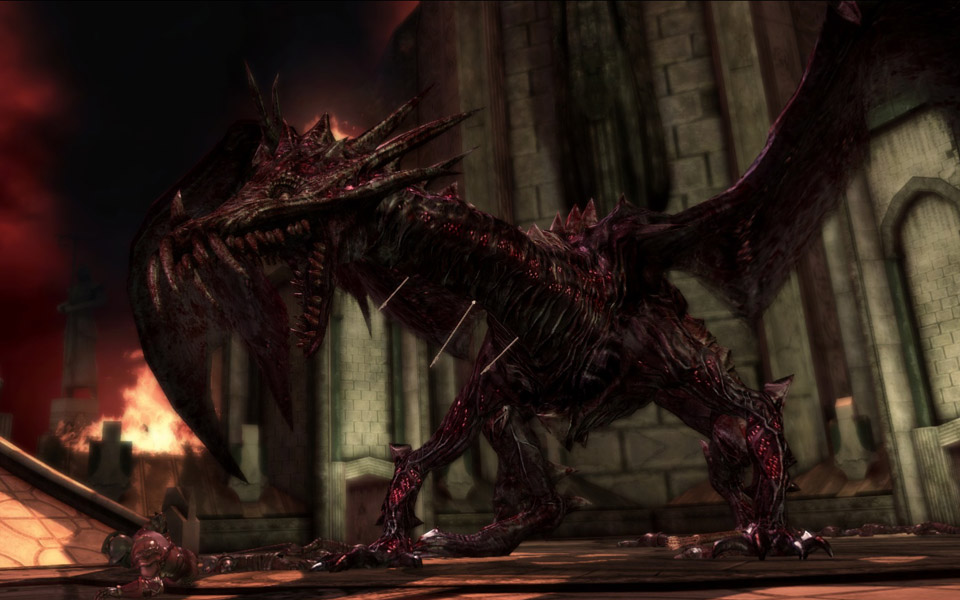
It's a dragon. Only uglier.

As I said at the start of this post, DAO has weak antagonists.  It is almost a sad fact that the game's secondary antagonist, Loghain, is a more powerful force in the game's narrative. Loghain's betrayal and his actions divide players, for the player is given the chance to kill him or have him join the Grey Wardens after the events of the Landsmeet. Some consider he deserves death for his crimes and ambition, whereas others argue that he did what he thought was necessary to preserve Ferelden in a time of great strife.  This makes Loghain an excellent character, but unfortunately he still doesn't quite manage to become a strong antagonist.

Loghain considers the Warden a pest, but does little to act directly against them, preferring to let others deal with the issue. He is more concerned with ensuring that he is able to rule Ferelden effectively than killing the Warden, and therefore does not draw a great deal of ire from the player. He has you declared traitor and attempts to kill you, but from his perspective this is done to secure his position rather than out of direct malice. The player is left to rely on these indirect attempts on their life, Loghain's complicity in slavery and Alistair's personal grudge to provide the impetus for disliking Loghain. Unfortunately, none of them really feel so strong that they provide a true drive to dispatch him.

This said, in a way Loghain's failing as a direct antagonist to the player is actually a good thing. His attempt to bring the player undone is not what defines his character, as his desire to dispatch the Warden pales in insignificance compared with his desire to see Ferelden prosper. It makes him an excellent and complex character, but not entirely the grand enemy you might expect.
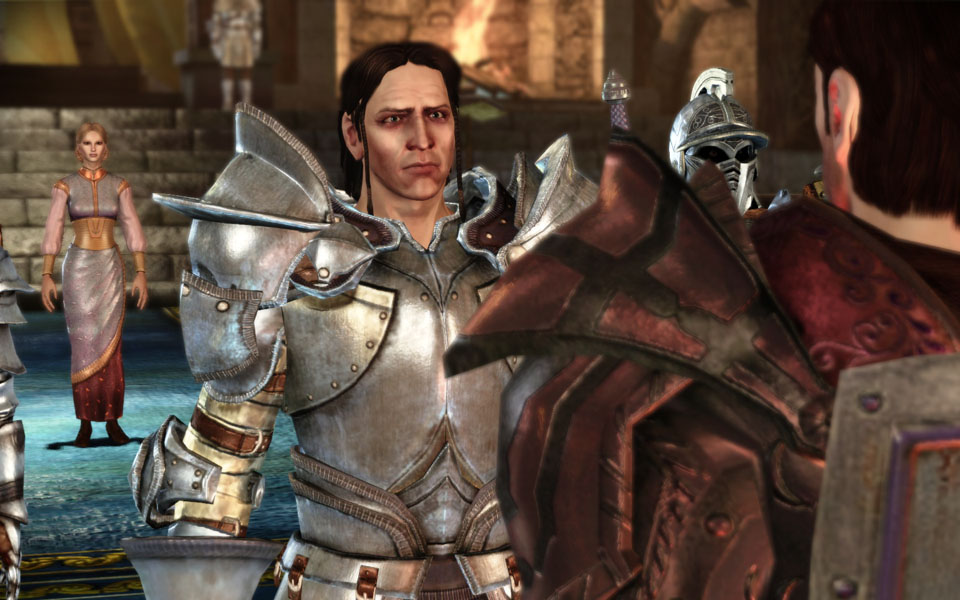
Loghain: villain or misguided hero? You be the judge.

The main problem with Loghain not playing a strong antagonist role is that DAO's final battle with the archdemon is against an antagonist that has no character. The archdemon is little more than a faceless creature that you must defeat simply because it is evil and its continued existence will destroy Ferelden. This is not to say that all antagonists need to have a personal relationship with the protagonist, but the archdemon's greatest failing is that it is a "classic" nemesis with no morals, no purpose, and no goals except to be "evil" and destroy. Even worse, it does not really appear in the game until the game's final few hours apart from a few discussions about the archdemon and the aforemention dream sequence. 

As such, the player has nothing directly invested in the archdemon's defeat except for the moral duty of being the hero to save Ferelden. The player has incentive for this noble cause and the self-serving desire to not die in the blight, but there is very little else to make the fight more personal for the player, meaning that the final fight of the game lacks the punch that the gripping and forceful climax of a game so desperately calls for. The player still gets a great sense of victory from the fight, but far less than if the archdemon had been more than a simple beast.

With a complex character who does not act as a true antagonist and a faceless evil creature, DAO almost manages to tick a lot of boxes when it comes to the checklist of creating a great antagonist. Its problem is that those ticks are spread across two characters rather than one, and split in such a way that you don't quite ever get that feeling of overcoming a truly great and memorable adversary.

Monday, September 13, 2010

Sorry, what?!?

It was brought to my attention today that I should no longer pay any heed to "professional" review sites whatsoever. Why, you ask? Because of IGN UK's 10/10 review and rating of Halo: Reach. As an admission of bias, I must confess that I have disliked Halo ever since I played it through on a PC. So you may want to take my opinions on the game itself with a fair amount of salt. I could explain at length why I think the Halo series as a whole is horrendously overrated and the only valuable thing it did was make FPS games accessible for the console. However, I won't get sidetracked by that argument.

My complaint is not with the series itself, but the disgraceful (and increasing) trend of "professional" review sites dishing out high scores to games even while identifying significant weaknesses. This trend is why I now feel forced to resort to Zero Punctuation for a decent review. His acidic tone along with his crass language and imagery may not be to everyone's tastes, but at least when I'm watching one of his reviews, I know that the flaws in a game will be clearly (and usually brutally) identified. His review of Halo 3 (very strong language alert) pointed out many of the things that I thought were rather prominent flaws in the game.

At least Halo gave us Red vs Blue

Hrm, it seems I accidentally got sidetracked on an anti-Halo rant despite my assertions that I wasn't going to do so. I'd apologise, but I'll instead tell you to hold onto your seats as we get onto the meat on IGN's "review" and focus on some key quotes. Note that I've not played the game, I'm just going on what has been explicitly stated in the review.

Regarding the "campaign that stands as one of Halo's best": "it's certainly more direct than the incoherent tangle of lore that was Halo 3 it's no more engaging."  And, "the rest of Noble team [apart from the player] are little better than a grab-bag of cliches". This is waved away because "if you're playing Halo for a well-told story you're frankly in the wrong place". Sorry, I know I rate story more highly than most people, but if you're presenting a campaign that is supposed to have a story, then it had better not be "sci-fi pulp that takes itself too seriously".

Then the review mentions the "nine or so hours that it'll take to crack the campaign on Heroic". So playing on the second hardest difficulty, the game is about at long as Call of Duty: Modern Warfare, a game that despite its brilliance was also criticised for being too short.

Next up we have "an amazing array of set-pieces, and if Bungie is perhaps a little too keen on aping the highlights of its last nine years it does at least seem determined to bring its experience to make them shine like never before". Wait... what? We're being given recycled and touched-up set pieces from the previous games in the series?

But it gets worse, because "the level design is Bungie's best, and while the blend of open battlefields and labyrinth interiors may be superficially familiar it's never been as well executed as Reach's set. If you've a favourite moment from Halos gone it's likely to be referenced here". So not only does Reach copy set-pieces, but levels as well? Exactly what is the game doing that is original?

Let's jump the warthog. Again.

So keeping all the above in mind, exactly as what point did Halo Reach demonstrate that it was worthy of a score like 10/10? I know that the Australian review scored it 9/10 and the US review gave 9.5/10, but based on these few quotes, it hasn't demonstrated it's worthy of those scores either. Maybe it's a cultural thing, but I actually like the Australian review more for its more candid take on the game, despite the somewhat casual delivery of the review.

What is the point of having review sites if they do not accurately and impartially address the faults within games and then mark them down in the rating scores that are delivered? More importantly, if review sites cannot provide an adequate assessment of the strengths and weaknesses of games, then why should gamers bother reading them?

Saturday, September 11, 2010

Consoles != Dumbing Down

There was a time back in the days of the PS2 and the original XBox that I might have accepted the argument that consoles weren't played by "real gamers". But not any more. The technical increases in the power of consoles and the popularity of console gaming means that PC gamers can no longer get on their high horse of superiority and declare that console gamers are "kids" or don't want games with any depth.

I can't provide a definitive reason for the rise in popularity in console gaming compared to PC gaming, as there are many factors that have potentially contributed to this: PC piracy, gaming becoming "mainstream", affordability of consoles, and many more besides. Regardless of the reason, consoles have truly become a proper gaming system in their own right, and the superiority espoused by PC gamers needs to come to an end. For me personally, there are some games I'll get on PC, but others I'll buy on console. Console gamers are not necessarily after a "simpler" gaming experience.


It doesn't have to be one or the other

But don't take my word for it... compare the recent statistics that have been gathered on Mass Effect 2 playthroughs on both PC and XBox360. Now, I could write a whole post on how these results are interesting and the insights that these could provide for design issues, but that's been discussed elsewhere. This is a massive trove of information on player choice and preference (more people play soldier than all the other classes combined and 80% of Shepards are male?!?), but I was interested in the differences between console and PC gamers.

Across millions of playthrough, PC gamers spent about an hour longer to finish the game (not much considering the average playtime was around 30 hours), whereas XBox players did about 10% more loyalty missions on average (which pretty much amounts to 1 more). However, most PC players did Miranda's (touchy-feely plot) quest, whereas console players tended not to, but console players favoured the combat-focused mission for Grunt's loyalty.

It's hard to draw conclusions based on a simple loyalty mission choice. Do console players like Miranda's character less and Grunt's character more? Or was it the emotionally charged story of finding Miranda's sister that they didn't care for?  Perhaps PC players didn't particularly like Grunt's personality or maybe thought an unstable Krogan might be more dangerous for their enemies? Maybe less PC players didn't even let him out of his tank?  There are plenty of reasons why either of these decisions could have been made, so I'm not sure it would be responsible to try and draw conclusion on the rationale behind the differences in these choices.

Grunt: Krogan extraordinaire and console gamer favourite

While these differences are interesting, there's no clear difference in choice that indicates a "bored" audience on the console market. Some gamers who decry ME2 as "not being an RPG" would probably argue that is because the game is already "dumbed down" to suit the console audience, but I'd argue that these statistics but a bullet right to the head of that argument. Mass Effect 2 still has a lot of dialogue in it, and only 15% of that dialogue was skipped by players (unfortunately there's no PC/console breakdown of that statistic). It appears from this information that console players are every bit as dedicated to experiencing a good story as the PC gamers.

In short, if you ever feel the urge to insult a proponent of your non-favoured system, please reconsider. There are advantages and disadvantages of both platforms, and people should recognise that. There's no reason that there has to be an "us" and "them" mentality among gamers playing a multi-platform game on different systems. After all, we're all gamers, right? The games themselves should be the important thing, and not the choice of hardware on which we play them.

Friday, September 10, 2010

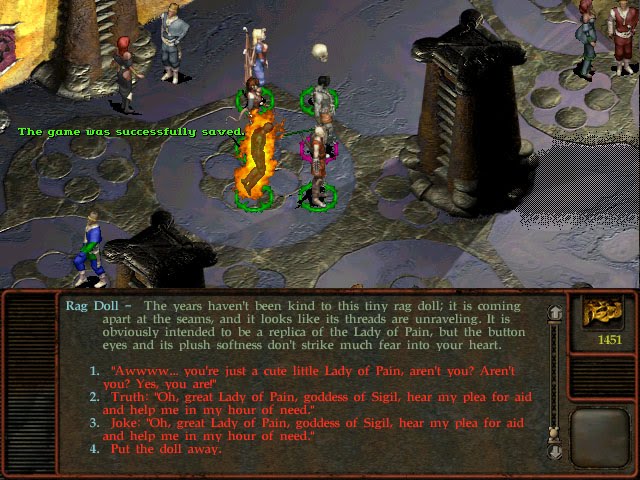
Antagonists: Planescape Torment

Planescape: Torment was a game that wanted to be a novel. The amount of words in this game is huge by any standard, and anyone who isn't keen on reading will never finish it. Created by Black Isle using BioWare's Infinity Engine, the game now looks very dated, but this doesn't actually detract from the game in a huge way. Perhaps this is because in no small part because there is so much that happens within the game that is described in text rather than shown, constantly reinforcing that it is the writing that makes this game special. It also features one magnificent antagonist... so heed the spoiler warning and tune out now if you ever want to play this game!  I'll give a quick disclaimer that this is one of the longest posts I've done, but there is a lot to discuss here.

The game starts off with you getting over a small illness: death. That's right, you're immortal, and in fact, the game hinges around this characteristic. You are "The Nameless One", waking up in a morgue, without any memory of how you got here, what you were doing, or anything about your former life. Your only assistance is in the form of a talking, floating skull named Morte. If this sounds a little bizarre, that's because it is. The Planescape D&D setting is perhaps one of the more confusing creations you might come across, for it is a place where your very thoughts and actions can cause things to come into being. As an example, throughout the game, you can tell people that your name is "Adahn". If you do so enough, then a person actually named Adahn magically pops into existence.

Starting off dead... Well, that's... different.

Searching for answers on how you came to be in the morgue, you find you were dumped there by a man named Pharod. Lacking any other leads, you decide to seek him out. After a series of events including an encounter with a collective entity of sentient rats, you discover Pharod, who gives you a few precious clues to follow. After leaving, the player is privy to a short cutscene where Pharod is beset and killed by creatures called Shadows. These soon begin to attack The Nameless One as well, seemingly acting as an agent for a more sinister enemy.

You eventually discover that your immortality may have been caused by a night hag named Ravel Puzzlewell, who is currently imprisoned in a magical maze by the ruler of the city, a mysterious being known as the Lady of Pain. After a series of trials, The Nameless One finds his way to Ravel, to find that she was indeed the one who made him immortal. It turns out that his mortality was separated from him so he could never die permanently (see, I told you Planescape was weird), but that with each death, he loses some of his memory. She send him to the fallen angel Trias to try and find his mortality.

A being introduced as "The Transcendent One" kills Ravel after the player leaves Ravel's maze, and appears to be the greater evil commanding the Shadows to kill The Nameless One. The player frees Trias who claims to not be able to not know the answer, but instead directs The Nameless One to other planes, where they eventually discover that their mortality is in a place called "The Fortress of Regrets". It is revealed that Trias lied and has betrayed The Nameless One in a past life as well as this one. After defeating Trias, The Nameless One discovers that the entrance to this Fortress is in The Mortuary, where the player began the game.

Shadows, the dangerous allies of your enemy

Once there, the player encounters three of his past incarnations: one practical, one good, and one paranoid. The "good" incarnation is the original, who made himself immortal after committing terrible deeds and wishing to avoid retribution after death and correct the evil he had wrought. These previous incarnations have left the clues that have allowed him to travel his current path and learn about his past and reach this place. However, upon reaching his mortality, the player finds that it is in fact the mysterious being known as The Transcedent One that has been trying to kill him all this time. His mortality has come to enjoy freedom and wishes to erase all of The Nameless One's memories to live in peace. The Nameless One can kill or convince his mortality to rejoin with him, finally allowing the him to "defeat" his enemy - ultimately dying and receiving the retribution he tried so hard to avoid.

Yes, that is honestly the condensed version of the story, and even that leaves out a lot of points.  There are around 800,000 words of text in the game, so trying to distill it down to key aspects is no simple task. Due to this massive amount of text (and a few other reasons) Torment is a unique proposition in that it doesn't obey lots of standard conventions. For one, it is extremely hard to die permanently - in most cases death will simply cause you to be reincarnated not far from where you died, with everything else pretty much as it was. This alone means the "challenge" of the game is unusual, forcing the game to rely on its narrative more than a game where your death means a reload. So how does this affect the game's antagonist?

Yes, the game has a lot of dialogue

For one, defining the game's antagonist is a curious prospect, because in reality, the main character is the protagonist and the antagonists. Yes, I said antagonists, because it's not just the Transcendent One that stands in the player's way. The previous incarnations of The Nameless One both assist and hinder the player, feeding misinformation and outright lies as well as truths; setting traps as well as laying the trail of breadcrumbs for them to follow. The clues left behind are mysterious and reveal the truth of the situation in disjointed fragments, constantly leaving the player trying to find out more. The player quickly deduces that The Nameless One left some clues for himself in a Momento style scenario, but just as in the movie, it's unclear as to exactly how accurate those clues are.

From the moment the player sees Pharod murdered by Shadows, the game takes a darker turn. There is very obviously something or someone trying to kill The Nameless One, but the player isn't exactly sure why. There is a sense of constant malice, and there is still an essence of danger despite the Nameless One being immortal. Oddly enough, it is the lack of information about your antagonist that makes him such a great "villain". The game is more a journey of discovery where the pieces of a puzzle eventually fall into place than a traditional adventure with a villain you are striving to defeat. After all, the eventual aim of the protagonist is to find a means to die, an aim that requires some fairly serious motivation on the part of the player.

Closing the book on the game and The Nameless One's life

It is this nature of the game's narrative that makes The Transcendent One an effective villain. The story revolves around the fact that you're trying to find out what happened to you, to discover who did the terrible thing of giving you immortality that causes you to lose your memory and to harm the lives of those people whose fates have become inextricably (or in one case, quite intentionally and deviously) linked to your own. The villain initially appears to be attempting to kill you for its own inscrutable means rather than directly opposing you, and all your instincts and the advice you receive indicate that you should run rather than attempting to attack what appears to be an incredibly powerful being. The plot twist that eventually reveals that you must instead face that opponent, and that opponent is in fact part of you makes it all the more powerful a reveal.

The fact that the player is pushed towards avoiding confrontation makes the antagonist an interesting proposition. The player is somewhat fearful of The Transcendent One despite being immortal, and doesn't have any direct reason to hate it except for basic self-preservation. But given The Transcendent One seems content to not act directly against The Nameless One, it almost raises the tension further, raising the question "Why?" Why is The Transcendent One, who is shown to be extremely powerful, not attempting to kill the player, when it seemingly possesses the power to do so? The actions, or rather, the lack thereof, of the antagonist serve to provoke the player's curiosity rather than ire. In an excellent example of writing helping shape the design of a game, this means that they wish to find out about their enemy rather than simply kill them, which is exactly the tone of the entire game and precisely what the plot requires.

Planescape: Torment features an unusual antagonist befitting an unusual game. It revolves around the main character and the reconciliation of their past, which due to the fantastical nature of the setting provides an exposition of what would otherwise be an internal struggle. The desire of the protagonist to avoid responsibility for past actions is what placed the player in their initial predicament, giving them the sombre task of facing up to the required judgment for the countless lives that have been destroyed as a result of the both selfish and noble goal of trying to cheat death and correct those mistakes. All of these aspects combine to make Planescape: Torment interesting and thought provoking, not to mention a great game.

Tuesday, September 7, 2010

Why mod?

I was recently asked the following question: "What is that makes you want to do modding?" Surprisingly, this isn't an easy question to answer, as there are many reasons to do so.  In today's slightly narcissistic post, I'd like to discuss some of the things that keep me coming back to my game-related projects.

Creativity
I've always the artistic process of creation in many forms. Be it writing, drawing, digital art or music, the desire to create something new and interesting was always a great appeal to me.  The process of game creation allows many of those aspects to be combined into an interactive format for players.

Writing
While this is arguably a subset of my first point, it's a major factor behind my interest in RPGs. The attraction of an intricate tale and interesting characters is a very powerful drawcard for me, so the narrative strength of an RPG is a natural choice. It's like creating a choose-your-own adventure novel as well as a game. 

A Love of Gaming
I have had a passion for games ever since I was a child, playing games many people wouldn't recognise (has anyone ever heard of Repton or Citadel?) and have embraced the massive improvements in technology that has allowed for increasingly amazing games.

Pride
This might seem like an odd reason, but I take a great deal of joy in creating something that I feel is well-crafted. There is a reason I'll spend hours putting the finishing touches on a level, proofreading and editing dialogue, playtesting, and all the other little touches to make it "just right". 

Delivering to Gamers
There's something special about making a gamer happy and hearing how much they enjoyed playing something you've made. The enjoyment of creation and subsequently seeing your efforts played by people is a great reward.

The Industry
Lastly, I love working on creating games, and I'd love to be able to get paid to do it. I treat my modding work as somewhat of an on-going resume towards this goal, in the hope that it will demonstrate my skills and dedication to a prospective employer.

So, there are some of the key reasons that keep me coming back to create levels, adventures and gaming experiences for players. I imagine some of my reasons would be common, but I'd be interested to know the driving force behind others who create games. But for me, the above are why I keep trying to improve my work and look for ways to perfect scenes like the work in progress below...

 A small rural village

Saturday, September 4, 2010

Roll Credits

You defeat the Big Bad at the of the game, sit through the stirring epilogue recounting your triumph, and then kick back as the credits roll. Then suddenly... the music playing in the credits jolts you out of your reverie. Why? Because it doesn't fit.

I recently saw a complaint about the "30 Seconds to Mars" track "War" which plays in the credits of Dragon Age. Now, I'm not going to get into an argument over the merits of the song or the band itself, because that gets into personal taste over music, and that's not the point of this post. Now, there are those who will say "it's in the credits, you can just skip it". That is entirely correct, but some people don't want to skip the credits. There's the desire to see the names roll past on the off chance you might have interacted with one of them, to watch concept art while thematic music plays, and I'm sure there are other reasons people have.  Unfortunately, this 30 Seconds to Mars song makes watching the credits a jarring experience.

I know you probably don't watch these. I frequently do.

The problem is that it doesn't fit musically with the rest of the game. Arguably, the lyrics fit from a thematic standpoint, but the song itself feels almost as out of place as if they'd had Marilyn Manson, just like they did in the promotional trailers. Now, I'm not saying that all credits music has to be exactly the same, and it doesn't necessarily need to be the same orchestral sound as throughout the rest of the game, although I'd probably argue that would have been the best fit for Dragon Age.

Other games have had songs in their credits that didn't feature in the game, but still match the overall tone of the game. M4 Part 2 by Faunts (Mass Effect) had a definite synth/sci-fi feel that meshed with the songs that were part of the game, Late Goodbye by Poets of the Fall (Max Payne 2) had a dark melancholy tone befitting the film noir style, Time Only Knows (Sands of Time) and I Still Love You (The Two Thrones) both had strong musical influences matching the rest of the soundtracks from their respective games.

The impact that can be made by something as seemingly trivial as the music used in the credits of a game is rather surprising. First and last impressions are curious things.

Friday, September 3, 2010

Public Service Announcement

For anyone who hasn't seen it, check out this video. It discusses a court case in the US relating to gaming, and attempts to heavily restrict game content. The future of gaming in America has a huge effect on the gaming industry around the world, so even though I'm not from America, the ramifications if gaming loses are massive. I can't possibly see how games could ever get stomped, but the fact that it's even become this much of an issue concerns me.

I cannot comprehend how anyone could consider games to not have artistic merit. Such people obviously have no concept of the creativity required to develop a game. Design, art style, narrative, characters, game mechanics, environments, cinematics, and so many more things combine to make a game. The art required to create a game is varied, meaningful and requires great dedication, and if more people could realise that, there would be a greater understanding of video games by players and the general population.