I must confess to having a great soft spot for old video game soundtracks. I've still got a selection of old MIDI files from games including: Ultima Underworld 1 & 2, Doom 1 & 2, Hexen 1 & 2, Descent 1 & 2, Warcraft 1 & 2... Hey, what's with all these old sequels?!?
The problem with old MIDI soundtracks is that they sound horribly dated when you compare them to the wonderful orchestrated pieces of game music we get from modern titles. There's no denying that MIDI files sound hideous, and every year makes them sound even worse. Unfortunately my lack of knowledge and skill when it comes to music creation and mastering means that I lack the necessary skills to turn these files into modern sounding masterpieces. I don't even know where to begin, nor do I have any idea as to what software I could use to do so.
So today, while listening to this terrible quality music made palatable purely by nostalgia, I decided to search to see if anyone had recreated/updated some of these tracks with modern technology. I was pleasantly surprised to find a link to a website featuring redone versions of the old midi files from Doom, Heretic and Hexen.
These might not be to everyone's tastes, but for me, these recordings breathed new life into old melodies that I've listened to on many occasions.
Sunday, October 31, 2010

Saturday, October 30, 2010
What's in a face?
The human brain is fantastic at recognising similarities when it comes to things like human faces. Which means when we're dealing with computer games that show people and faces in any sort of detail, designers have to be somewhat particular about the creation of individual characters. Faces can assist in portraying age, personality and even give information about a character's life, so should be created with some thought.
When people are walking down a crowded street, it's easy to pick out the faces of people they know, and this translates to the interactions a player has with characters in a game. Individuality must be a major factor when creating faces and characters because people are so good at recognising faces, so multiple characters that all have the same generic face will immediately break the illusion of reality for the player. That said, if a player never sees these "generic faces" up close, then the problem is not that significant.
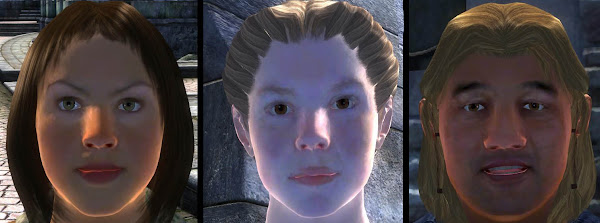
In Dragon Age, like many non-first person games, you don't get a particularly close look at the faces of many individuals unless you talk to them and subsequently get a close-up camera during conversation. In first-person games there's frequently the chance to get a close look at people's faces, which will translate into requiring a few extra faces needed for the "extras" within the game. However, the most effort should be invested in a game's major characters to make them memorable and distinctive. So how should designers work on creating NPCs and facial appearances that will help to create individual and unique characters?
In computer games, designers have many tools at their disposal to communicate to the player, and portraying the personality of characters is something that can be done in numerous ways. There's overall appearance and body shape, facial apperance, their speech (both in terms of vocabulary and VO delivery), and things like their ambient behaviour when they're not interacting with the player. A designer should be abke to use all these tools to help convey and reinforce the personality of characters, particularly when it comes to major NPCs like crucial plot characters or allies. Some characters might pace incessantly, sit and meditate, read a book, and so on. This helps convey their character before the player even talks to them.

When it comes to appearance it is ideal if a character's face can help reinforce their personality, even if in a stereotypical manner. People will associate certain facial types and structures with particular personalities, so the gaunt faced character will serve better as an older or more world-weary person, whereas the character with a larger or rounder face is more likely to be jovial or amicable. This isn't to say that characters should conform entirely to stereotypes, but designers should utilise these to help convey key aspects of character personality when create overall appearances and faces.
So if we're dealing specifically Dragon Age head morphs, there are a lot of things to consider. Skin, eye and hair colour, hair style, skin complexion, then various tattoos and makeup considerations are the basic superficial features that can help convey a character's background. As an example, a particularly flamboyant of flirty female might have strong makeup, perhaps bright red lipstick to attract attention. A character who spends all their time outside might have skin type with more wrinkles but less not an aged facial texture. Consider the shape of the character's brow and whether the corners of their lips are naturally raised or lowered as these could suggest a basic friendly or unfriendly disposition for the character.
Facial structure itself is a little more difficult to define in terms of how it relates to someone's personality, but there are some general sort of rules you might be able to follow. A squarer and more prominent jaw will help suggest a bulkier and stronger character, whereas a more narrow and pointy jaw will tend to make players think the characters is perhaps more dainty or lithe. Consider other facial features: high cheekbones may indicate a more confident or authoritative figure, thin nosed characters might tend to be fussy or annoying, small button noses might be used for more happy or shy people... I'm sure there are many other stereotypes that you can think of to help support character traits.
Ideally a face should just be another means that help support and convey character personality and history. Thus for important characters that have a personal involvement with the player, a designer should try to make those faces as individual as their dialogue and personality.
When people are walking down a crowded street, it's easy to pick out the faces of people they know, and this translates to the interactions a player has with characters in a game. Individuality must be a major factor when creating faces and characters because people are so good at recognising faces, so multiple characters that all have the same generic face will immediately break the illusion of reality for the player. That said, if a player never sees these "generic faces" up close, then the problem is not that significant.

Oblivion suffered partially from "generic face syndrome"
In Dragon Age, like many non-first person games, you don't get a particularly close look at the faces of many individuals unless you talk to them and subsequently get a close-up camera during conversation. In first-person games there's frequently the chance to get a close look at people's faces, which will translate into requiring a few extra faces needed for the "extras" within the game. However, the most effort should be invested in a game's major characters to make them memorable and distinctive. So how should designers work on creating NPCs and facial appearances that will help to create individual and unique characters?
In computer games, designers have many tools at their disposal to communicate to the player, and portraying the personality of characters is something that can be done in numerous ways. There's overall appearance and body shape, facial apperance, their speech (both in terms of vocabulary and VO delivery), and things like their ambient behaviour when they're not interacting with the player. A designer should be abke to use all these tools to help convey and reinforce the personality of characters, particularly when it comes to major NPCs like crucial plot characters or allies. Some characters might pace incessantly, sit and meditate, read a book, and so on. This helps convey their character before the player even talks to them.

You know this character's profession from a single glance
When it comes to appearance it is ideal if a character's face can help reinforce their personality, even if in a stereotypical manner. People will associate certain facial types and structures with particular personalities, so the gaunt faced character will serve better as an older or more world-weary person, whereas the character with a larger or rounder face is more likely to be jovial or amicable. This isn't to say that characters should conform entirely to stereotypes, but designers should utilise these to help convey key aspects of character personality when create overall appearances and faces.
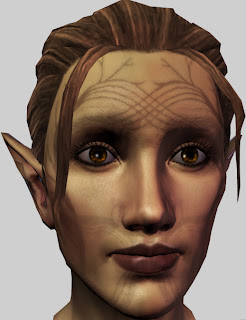
So if we're dealing specifically Dragon Age head morphs, there are a lot of things to consider. Skin, eye and hair colour, hair style, skin complexion, then various tattoos and makeup considerations are the basic superficial features that can help convey a character's background. As an example, a particularly flamboyant of flirty female might have strong makeup, perhaps bright red lipstick to attract attention. A character who spends all their time outside might have skin type with more wrinkles but less not an aged facial texture. Consider the shape of the character's brow and whether the corners of their lips are naturally raised or lowered as these could suggest a basic friendly or unfriendly disposition for the character.

This character's face suggests friendliness
Facial structure itself is a little more difficult to define in terms of how it relates to someone's personality, but there are some general sort of rules you might be able to follow. A squarer and more prominent jaw will help suggest a bulkier and stronger character, whereas a more narrow and pointy jaw will tend to make players think the characters is perhaps more dainty or lithe. Consider other facial features: high cheekbones may indicate a more confident or authoritative figure, thin nosed characters might tend to be fussy or annoying, small button noses might be used for more happy or shy people... I'm sure there are many other stereotypes that you can think of to help support character traits.
Ideally a face should just be another means that help support and convey character personality and history. Thus for important characters that have a personal involvement with the player, a designer should try to make those faces as individual as their dialogue and personality.
Wednesday, October 27, 2010
Character Preview: Commander Norvac
The Ferelden militia in the Frostback mountains needs an able leader, and Commander Norvac is a capable and veteran warrior. He is in charge of the Frostback Militia, the only military force in the area, and has a reputation as a stern man who instills iron discipline in his soldiers. While he has respect for his men and the people he protects, he is always mindful of his duty.
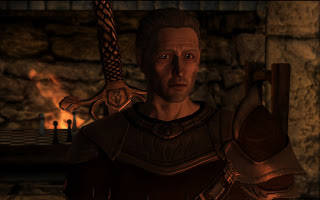
Norvac participated in numerous skirmishes against the Darkspawn during the blight, including the defense of Denerim. He is ill suited to a life without conflict, and is a proud warrior. He cares little for diplomacy nor dealing with the general troubles in the Frostbacks, but recognises the need to maintain cordial relationships for the sake of discipline and moral.
However, the troubles of the region seem to be affecting him more than usual, and his normal stoic demeanor has sometimes been replaced with visible worry.
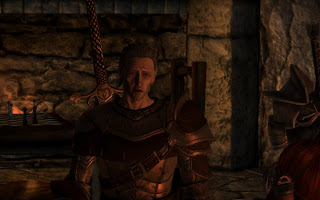
Only a significant danger could cause a seasoned leader like Commander Norvac such concern. His assistance and advice may be crucial in overcoming the troubles in the Frostback Mountains, whatever they may be...

"We are not here to mother everyone who comes begging for help."
Norvac participated in numerous skirmishes against the Darkspawn during the blight, including the defense of Denerim. He is ill suited to a life without conflict, and is a proud warrior. He cares little for diplomacy nor dealing with the general troubles in the Frostbacks, but recognises the need to maintain cordial relationships for the sake of discipline and moral.
However, the troubles of the region seem to be affecting him more than usual, and his normal stoic demeanor has sometimes been replaced with visible worry.

"No wars are won without sacrifice. You will learn that soon enough."
Only a significant danger could cause a seasoned leader like Commander Norvac such concern. His assistance and advice may be crucial in overcoming the troubles in the Frostback Mountains, whatever they may be...
Saturday, October 23, 2010
Shattered War Map
Thanks to the extremely useful map tutorial by TimelordDC on BioWare's toolset wiki (and his blog post on the subject), Dragon Age modders are able to implement custom world maps for their modules.
Since The Shattered War is designed to give players the "full Dragon Age experience", this means that I had to implement a world map. Which is exactly what I've been doing today!
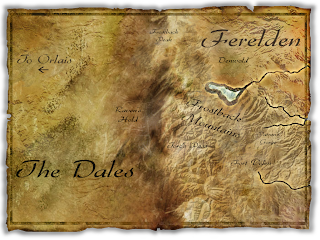
This map shows some of the locations that players will visit during their adventure. I would have taken an in-game shot to demonstrate, but then I might be giving away a few things!
The map has the same frayed edge look as those within the original game and uses a portion of a high resolution (6680x5010) Thedas map as the source image. One thing that I could not locate is the original font used by the game. Instead I decided to use the Gabrielle font, which seemed to be the best fit of the fonts that I could find. The hours I spent on this probably could have created quite a lot of extra dialogue for players to experience, but in my opinion the small details like this really help to make a mod special and give it a professional feel.
Since The Shattered War is designed to give players the "full Dragon Age experience", this means that I had to implement a world map. Which is exactly what I've been doing today!

The world map for The Shattered War
This map shows some of the locations that players will visit during their adventure. I would have taken an in-game shot to demonstrate, but then I might be giving away a few things!
The map has the same frayed edge look as those within the original game and uses a portion of a high resolution (6680x5010) Thedas map as the source image. One thing that I could not locate is the original font used by the game. Instead I decided to use the Gabrielle font, which seemed to be the best fit of the fonts that I could find. The hours I spent on this probably could have created quite a lot of extra dialogue for players to experience, but in my opinion the small details like this really help to make a mod special and give it a professional feel.
Make Content Accessible
In general, it is good if content is as easy to access as possible for the players. What do I mean? I mean that much of the content and gameplay within a game should be found as a matter of course, and not require the player to go searching for it.
To demonstrate, I'll refer to two characters from the original Baldur's Gate. Alora was a particularly cheery halfling thief that you could only get to join your party if you happened to go to Hall of Wonders at night. Alternatively, there was the character Skie, where you had to traipse around with a bard named Eldoth (who was somewhat annoying) and take him to a particular location to get her into the party. For Alora, it required that you be lucky enough to be in the right place at the right to get her to join your party. For Skie, you had to keep Eldoth around and potentially travel with him for quite some time. How many people really would have ended up using these characters?
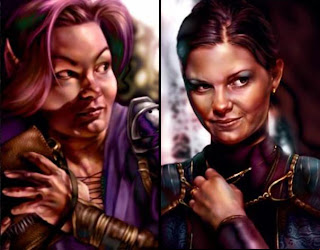
The point here is that content in general should be made fairly accessible to the player. I have no problem with content being located in an obscure location; say, I have to visit the abandoned building off the market at midnight. But, there should be something (maybe a book, scrap of paper or an overheard conversation) that I could reasonably encounter as part of my ordinary adventure to indicate that I have to follow this set of steps to find this additional content. I'm not saying that everything should be handed to the player on a silver platter, and there should be some content that players must search for. That content is a reward for the dedicated player, but typically should be a relatively small amount of content. Perhaps the only exception might be if you're playing a sandbox game where exploration itself is a major part of the gameplay.
We should be careful not to confuse content that comes around as a result of consequence with content that comes about because of exploration of a location in obscure circumstances. The two are completely different things.
Compare and contrast:
Both might take approximately the same amount of development time, but the former offers far greater value for the player base in terms of average hours of gameplay per hours of developer time.

But designers must also not confuse easily-accessible with optional. Some players explore every nook and cranny, talk to every NPC and generally try to exhaust every available option within the game. However, these players are not the norm. The statistics for both Dragon Age and Mass Effect were that approximately 50% of people finished the either game. That's right, only half of the people who played the games finished them. Content that is extremely difficult for players to find is probably only going to be experienced by a very small percentage of the player base.
I'm not arguing that content should be stripped down to cater for the lowest common denominator, but designers have to understand their audience and what will make their game popular. If content is not accessible in a reasonably straightforward manner, it will be missed by a large proportion of the player base. Designers should reward the curious player, but they have to keep in mind that if they only cater to 5% of their potential audience when making AAA titles, they're probably not going to be making a commercially successful game.
To demonstrate, I'll refer to two characters from the original Baldur's Gate. Alora was a particularly cheery halfling thief that you could only get to join your party if you happened to go to Hall of Wonders at night. Alternatively, there was the character Skie, where you had to traipse around with a bard named Eldoth (who was somewhat annoying) and take him to a particular location to get her into the party. For Alora, it required that you be lucky enough to be in the right place at the right to get her to join your party. For Skie, you had to keep Eldoth around and potentially travel with him for quite some time. How many people really would have ended up using these characters?

Alora and Skie, rare party members
The point here is that content in general should be made fairly accessible to the player. I have no problem with content being located in an obscure location; say, I have to visit the abandoned building off the market at midnight. But, there should be something (maybe a book, scrap of paper or an overheard conversation) that I could reasonably encounter as part of my ordinary adventure to indicate that I have to follow this set of steps to find this additional content. I'm not saying that everything should be handed to the player on a silver platter, and there should be some content that players must search for. That content is a reward for the dedicated player, but typically should be a relatively small amount of content. Perhaps the only exception might be if you're playing a sandbox game where exploration itself is a major part of the gameplay.
We should be careful not to confuse content that comes around as a result of consequence with content that comes about because of exploration of a location in obscure circumstances. The two are completely different things.
Compare and contrast:
- A sidequest with two alternate paths of content because of a choice the player makes, each amounting to 2 hours playtime each. 95% of players will experience this content, and the two alternate content paths are experienced by approximately 50% of that player base.
- A sidequest with one linear path amounting to approximately 5 hours playtime. 95% of players will not experience this content because it can only be discovered through an obscure series of events.
Both might take approximately the same amount of development time, but the former offers far greater value for the player base in terms of average hours of gameplay per hours of developer time.

Miranda will be unhappy if you don't do her side quest...
But designers must also not confuse easily-accessible with optional. Some players explore every nook and cranny, talk to every NPC and generally try to exhaust every available option within the game. However, these players are not the norm. The statistics for both Dragon Age and Mass Effect were that approximately 50% of people finished the either game. That's right, only half of the people who played the games finished them. Content that is extremely difficult for players to find is probably only going to be experienced by a very small percentage of the player base.
I'm not arguing that content should be stripped down to cater for the lowest common denominator, but designers have to understand their audience and what will make their game popular. If content is not accessible in a reasonably straightforward manner, it will be missed by a large proportion of the player base. Designers should reward the curious player, but they have to keep in mind that if they only cater to 5% of their potential audience when making AAA titles, they're probably not going to be making a commercially successful game.
Thursday, October 21, 2010
Adventure Game Problems
If you design games, you should play games. It's that simple. Not just the genre you create, but other genres as well. I'm perhaps guilty of playing too many RPGs, but over the past couple of months I have also played Alan Wake, Just Cause 2, Serious Sam HD and Tales of Monkey Island (and a few others) between my modding sessions. The last is something I've been playing recently, and as a result I have been reminded of the frustrations of adventure games. They can be really fun, but they have a few problems that arguably make them less enjoyable when compared to era in which they were among the best games around. There are three significant ones that come to mind...
Arbitrary Solutions
Frequently the means to solve a puzzle is not obvious, or completely unintuitive. Now it could be argued that this is part of the fun, but it's not particularly enjoyable to randomly try combined items in your inventory until something works, or attempting to use every single item in your inventory with an object until you find the right one. Part of the enjoyment in an adventure game is the problem solving of coming up with the solutions. Solutions can be as crazy and off the wall as the designer likes, but there should be some means for the player to identify a solution.

Tales succeeds in some cases (like escaping from a crazy doctor while strapped to an operating chair - above), but fails in others (smashing glass unicorns by firing a cannon pointing in the wrong direction). Of course, a game can't always get it "right", but it can be frustrating for the player when they had no real way of identifying the correct solution beforehand.
Pixel Hunting
To this day, I remember my frustration with playing the original version of The Secret of Monkey Island. The particular puzzle that stopped me for a long time was getting past a group of vicious piranha poodles guarding the Governor's mansion. I could feed them a hunk of meat, but this would not occupy them for long enough. The correct solution was to use a yellow flower on the meat (or to place it in a pot in which you stewed the meat) which would then send the dogs to sleep. This gave you the amusing message: "These dogs are sleeping, NOT dead. No animals were harmed during the creation of this game." The problem was you had no real way of knowing you could interact with the flowers unless you happened to move the mouse over them and noticed the status bar change text. They were also found in a forest that you visited for completely unrelated reasons, which also ties back to problem 1.
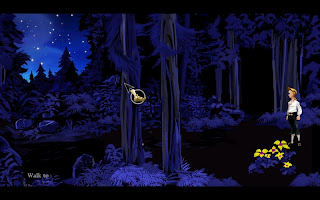
Identifying which objects you could interact with was a significant problem in older adventure games. Tales of Monkey Island goes some way to fixing this, by allowing you to press a key to "highlight" interactive objects. However, sometimes there are multiple objects with which you can interact within a single highlight, which can lead you to miss important object that you need to use.
A Single Path
Adventure games are typically fairly linear. This is because they rely on story (and frequently humour) in order to keep the audience engaged. This is a good thing because it helps the narrative, and also prevents the player from getting into a situation where it is impossible to beat the game - yes, that is A Good Thing. But this does result in problems when the player wants to pursue a particular task but they are unable to do so because they need to complete something else first. Generally there is no easy way to tell the player the exact order to do tasks in. Moreover, doing so would feel very heavy handed and likely annoy players with blatant railroading. As such, sometimes you can be stuck trying to solve a puzzle that is currently impossible.

All these problems can potentially be fixed, but do those fixes come with a cost? The arbitrary solution that initially makes no sense can turn out to be hilariously wacky and amuse players. Pixel hunting... actually, I think we can safely ditch that entirely. Highlight all usable objects in the scene, using a specific outline for each object if necessary. The designers can even throw in a few red herrings if they want to avoid making puzzles too easy. The single path is perhaps the hardest to address, as a linear story will almost certainly be more entertaining than a non-linear one, and the story and humour are probably the two major reasons for playing adventure games.
Of course, it might be interesting to discuss the adventure game genre as a whole, why it fell into decline, and why it has only gained attention again in recent years with the episodes of Tales and Sam and Max, but that's probably a post for another time...
Arbitrary Solutions
Frequently the means to solve a puzzle is not obvious, or completely unintuitive. Now it could be argued that this is part of the fun, but it's not particularly enjoyable to randomly try combined items in your inventory until something works, or attempting to use every single item in your inventory with an object until you find the right one. Part of the enjoyment in an adventure game is the problem solving of coming up with the solutions. Solutions can be as crazy and off the wall as the designer likes, but there should be some means for the player to identify a solution.

Guybrush escapes from a crazy doctor using only his feet
Tales succeeds in some cases (like escaping from a crazy doctor while strapped to an operating chair - above), but fails in others (smashing glass unicorns by firing a cannon pointing in the wrong direction). Of course, a game can't always get it "right", but it can be frustrating for the player when they had no real way of identifying the correct solution beforehand.
Pixel Hunting
To this day, I remember my frustration with playing the original version of The Secret of Monkey Island. The particular puzzle that stopped me for a long time was getting past a group of vicious piranha poodles guarding the Governor's mansion. I could feed them a hunk of meat, but this would not occupy them for long enough. The correct solution was to use a yellow flower on the meat (or to place it in a pot in which you stewed the meat) which would then send the dogs to sleep. This gave you the amusing message: "These dogs are sleeping, NOT dead. No animals were harmed during the creation of this game." The problem was you had no real way of knowing you could interact with the flowers unless you happened to move the mouse over them and noticed the status bar change text. They were also found in a forest that you visited for completely unrelated reasons, which also ties back to problem 1.

Monkey Island's sleep-inducing flowers
Identifying which objects you could interact with was a significant problem in older adventure games. Tales of Monkey Island goes some way to fixing this, by allowing you to press a key to "highlight" interactive objects. However, sometimes there are multiple objects with which you can interact within a single highlight, which can lead you to miss important object that you need to use.
A Single Path
Adventure games are typically fairly linear. This is because they rely on story (and frequently humour) in order to keep the audience engaged. This is a good thing because it helps the narrative, and also prevents the player from getting into a situation where it is impossible to beat the game - yes, that is A Good Thing. But this does result in problems when the player wants to pursue a particular task but they are unable to do so because they need to complete something else first. Generally there is no easy way to tell the player the exact order to do tasks in. Moreover, doing so would feel very heavy handed and likely annoy players with blatant railroading. As such, sometimes you can be stuck trying to solve a puzzle that is currently impossible.

The only way to lose Monkey Island
All these problems can potentially be fixed, but do those fixes come with a cost? The arbitrary solution that initially makes no sense can turn out to be hilariously wacky and amuse players. Pixel hunting... actually, I think we can safely ditch that entirely. Highlight all usable objects in the scene, using a specific outline for each object if necessary. The designers can even throw in a few red herrings if they want to avoid making puzzles too easy. The single path is perhaps the hardest to address, as a linear story will almost certainly be more entertaining than a non-linear one, and the story and humour are probably the two major reasons for playing adventure games.
Of course, it might be interesting to discuss the adventure game genre as a whole, why it fell into decline, and why it has only gained attention again in recent years with the episodes of Tales and Sam and Max, but that's probably a post for another time...
Tuesday, October 19, 2010
Let's add a little character
What do you think of when you hear a game's name? What images comes to your mind when I say Mass Effect, Halo and Mirror's Edge? I'm going guess something like this...
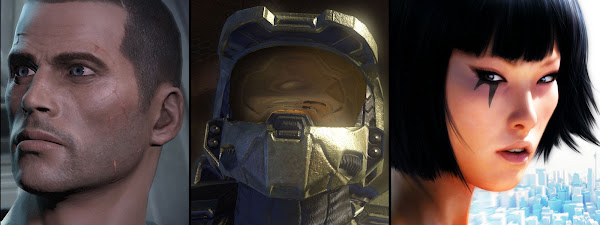
Recognisable characters help with the marketing of a game. Everyone can identify Mario, Lara Croft, Gordon Freeman, Sonic the Hedgehog or Pacman. Lead or likable characters that stick in the minds of players help raise interest, spark curiousity, and make people love the game. Take Duke Nukem Forever: if it were not for the love held by fans for the lead character from games over 10 years old, the idea of finishing the development of the game would have been ditched long ago. This is the kind of loyalty and dedication (though it could be aruged it's now delved into the realm of pure stubbornness) that game developers would love to be able to incite in fans for every character they create.
We've all experienced our share of games with bland main characters, but even with characters that on paper might seem the same inspire different reactions. Why is it that Gordon Freeman from Half-life was popular, whereas Isaac Clarke from Dead Space was bland? Both are silent protagonists (though Isaac does give the occasional grunt), but Gordon for some reason has charm that Isaac does not. Is it because of the way people react to Gordon compared to Isaac? Is it because Gordon is a regular man in an amazing suit? Arguably Isaac is the same. Or maybe it's simply because of Gordon's ridiculously manly beard?
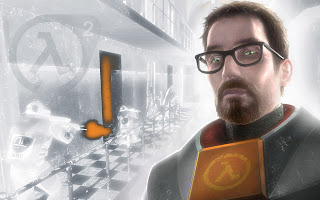
So what is it that makes a character likeable or memorable? What is it that makes a character a hit with fans? In games we don't often get to have the protagonist develop as a character which frequently endears people to someone as in a book or a movie. Video game protagonists are frequently static in terms of their character and behave in exactly the same manner from start to finish (even if they become more powerful or dangerous as the game progresses), though there are exceptions to this rule. Take Altair from Assassin's Creed, who goes from a self-centred egotist to a somewhat humble character trying to make up for past mistakes, and I'm sure you can think of others. Of course, this isn't to say that a static protagonist is bad. Duke Nukem and Gordon Freeman aren't changed by the events they experience, neither is Ryu Hayabusa from Ninja Gaiden nor Master Chief, and Guybrush Threepwood is still a bumbling wannabe pirate throughout all his adventures. Yet all these characters are endearing, fun, or just plain butt-kicking-for-goodness-awesome in the minds of the players who have played their games.
Characters have to be unique and have less time to sell themselves to players (or potential players) than in other media. There has to be something that immediately says "I'm interesting", or marks the character out as different or worth our time. Garrett from the Thief series is a master of his craft and a gravelly voiced cynic to boot, April Ryan from The Longest Journey is a art student struggling with life, Alan Wake is a troubled writer who ends up fighting zombies, Ryu Hayabusa is a death-dealing ninja without equal. Of course, there also the problem that so many characters and protagonists are white males, but that's opening up a whole different can of worms. Regardless, there are plenty more individual characters that are immediately recognisable without having to resort to low-grade tactics...
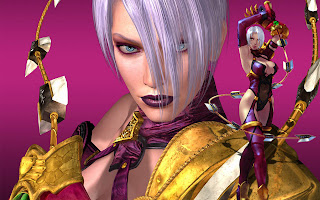
Do we really demand our characters be physically attractive in order to get players attracted to a game? Are video gamers really that shallow that sex sells in a wholly interactive medium? Surely we can have a lot more variety in the characters within modern video games, and surely developers owe it to gamers to provide that? Of course, it's also up to players to support developers when they create something that doesn't conform to the norm. That said, there are certain things that can be difficult because games are an interactive medium, like for example an unlikeable protagonist. There are certain movies where the viewer does not find the main character(s) particularly endearing. Try The Godfather or District 9, where generally viewers don't particularly like the main character for most (or all) of the film, yet typically they still want the character to succeed. If in a video game and you're playing a character you don't like, the chances that you're going to simply stop playing the game are fairly high. This is totally undesirable.
So video game developers must make characters likable yet not blatantly sexualised, have an individual personality yet one that is quickly accessible, and recognisable yet not stereotypical. In each of these aspects, creating characters for video games is much like creating characters for any medium. But developers have the means to convey characters in an interactive medium and can allow players to shape character development according to their choices. What if a player could actually help redeem an initially unlikable protagonist, or be the push that sends a noble character tumbling down the slope of morality? Or does creating a character that is mutable based on a player's choices actually dilute the strength of their personality and hence potentially weaken the strength of that character's persona?
I don't know the answer, but I look forward to playing games that explore these possibilities.

The poster children
Recognisable characters help with the marketing of a game. Everyone can identify Mario, Lara Croft, Gordon Freeman, Sonic the Hedgehog or Pacman. Lead or likable characters that stick in the minds of players help raise interest, spark curiousity, and make people love the game. Take Duke Nukem Forever: if it were not for the love held by fans for the lead character from games over 10 years old, the idea of finishing the development of the game would have been ditched long ago. This is the kind of loyalty and dedication (though it could be aruged it's now delved into the realm of pure stubbornness) that game developers would love to be able to incite in fans for every character they create.
We've all experienced our share of games with bland main characters, but even with characters that on paper might seem the same inspire different reactions. Why is it that Gordon Freeman from Half-life was popular, whereas Isaac Clarke from Dead Space was bland? Both are silent protagonists (though Isaac does give the occasional grunt), but Gordon for some reason has charm that Isaac does not. Is it because of the way people react to Gordon compared to Isaac? Is it because Gordon is a regular man in an amazing suit? Arguably Isaac is the same. Or maybe it's simply because of Gordon's ridiculously manly beard?

There is no chin behind Gordon's beard. Just another crowbar.
So what is it that makes a character likeable or memorable? What is it that makes a character a hit with fans? In games we don't often get to have the protagonist develop as a character which frequently endears people to someone as in a book or a movie. Video game protagonists are frequently static in terms of their character and behave in exactly the same manner from start to finish (even if they become more powerful or dangerous as the game progresses), though there are exceptions to this rule. Take Altair from Assassin's Creed, who goes from a self-centred egotist to a somewhat humble character trying to make up for past mistakes, and I'm sure you can think of others. Of course, this isn't to say that a static protagonist is bad. Duke Nukem and Gordon Freeman aren't changed by the events they experience, neither is Ryu Hayabusa from Ninja Gaiden nor Master Chief, and Guybrush Threepwood is still a bumbling wannabe pirate throughout all his adventures. Yet all these characters are endearing, fun, or just plain butt-kicking-for-goodness-awesome in the minds of the players who have played their games.
Characters have to be unique and have less time to sell themselves to players (or potential players) than in other media. There has to be something that immediately says "I'm interesting", or marks the character out as different or worth our time. Garrett from the Thief series is a master of his craft and a gravelly voiced cynic to boot, April Ryan from The Longest Journey is a art student struggling with life, Alan Wake is a troubled writer who ends up fighting zombies, Ryu Hayabusa is a death-dealing ninja without equal. Of course, there also the problem that so many characters and protagonists are white males, but that's opening up a whole different can of worms. Regardless, there are plenty more individual characters that are immediately recognisable without having to resort to low-grade tactics...

Do we really need to see video game characters like this?
Do we really demand our characters be physically attractive in order to get players attracted to a game? Are video gamers really that shallow that sex sells in a wholly interactive medium? Surely we can have a lot more variety in the characters within modern video games, and surely developers owe it to gamers to provide that? Of course, it's also up to players to support developers when they create something that doesn't conform to the norm. That said, there are certain things that can be difficult because games are an interactive medium, like for example an unlikeable protagonist. There are certain movies where the viewer does not find the main character(s) particularly endearing. Try The Godfather or District 9, where generally viewers don't particularly like the main character for most (or all) of the film, yet typically they still want the character to succeed. If in a video game and you're playing a character you don't like, the chances that you're going to simply stop playing the game are fairly high. This is totally undesirable.
So video game developers must make characters likable yet not blatantly sexualised, have an individual personality yet one that is quickly accessible, and recognisable yet not stereotypical. In each of these aspects, creating characters for video games is much like creating characters for any medium. But developers have the means to convey characters in an interactive medium and can allow players to shape character development according to their choices. What if a player could actually help redeem an initially unlikable protagonist, or be the push that sends a noble character tumbling down the slope of morality? Or does creating a character that is mutable based on a player's choices actually dilute the strength of their personality and hence potentially weaken the strength of that character's persona?
I don't know the answer, but I look forward to playing games that explore these possibilities.
Subscribe to:
Posts (Atom)

 Posts
Posts

