Showing posts with label Mass Effect. Show all posts

Thursday, June 28, 2012

Mass Effect 3 Extended Cut

In case you hadn't heard, the Extended Cut for Mass Effect 3 has been realised. This is apparently BioWare's "clarification" of the endings that shipped with the game. After repeated adamant and somewhat sanctimonious statements that the ending could not and would not be changed, BioWare have demonstrated that their original ending was poorly written and overlooked basic elements of the Mass Effect lore and setting. However, it seems that the people responsible ultimately failed to recognise its fundamental flaws.

Bandaid solutions were implemented to solve basic and superficial flaws like Joker's inexplicable retreat and crash landing, the magical appearance of your squadmates on the Normandy and why Hackett suddenly attempts to communicate with Shepard on-board the Citadel. However, each one of these introduces more completely irrational consequences and questions. How Normandy wasn't shot by Harbinger as a result of landing right near the Conduit beam it was supposedly protecting, why the Normandy decided to land on a random jungle planet for some rest and relaxation after the biggest galactic war ever, or even why the ridiculous stargazer sequences is included when the epilogues suggest a huge technologically advanced spacefaring galaxy, are just some of the new issues introduced.

 We could always just forget everything after this

What's arguably worse is the fact that BioWare did change their ending despite saying that it was unchangeable. The destruction of the Mass Relays, which was specifically stated as an outcome from the Catalyst no longer occurs. In fact, this line has been removed entirely from Shepard's exchange with it. After BioWare staff insisted "the relays are only disabled" despite the Catalyst explicitly stating they would be destroyed, and The Arrival DLC indicating the destruction of a Mass Relay was equivalent to a star going supernova, BioWare were seemingly forced to recant this assertion from the Catalyst. Other changes, including adding a completely new ending where Shepard can refuse the options presented and instead ensure the galaxy's defeat also is a change to the ending. In doing this, BioWare have seemingly attempted to appease fans, but ultimately all they've done is admit through their new content the original ending was grossly flawed and poorly executed. To simultaneously insist it was not in any way flawed or that fans "misinterpreted" the original ending is a misappropriation of blame. The blame lies squarely on one end: BioWare's.

Furthermore, the Extended Cut does nothing to address the fact that the Catalyst's arguments classically beg the question (i.e. it uses its own assertion as proof of its assertion), are logically inconsistent for every provided option, and the ending is inherently at odds with virtually all the key themes pushed by the series up until this point. The Extended Cut is a series of bandaids across a series of mortal wounds that do nothing to address the ultimately fatal blow to the coherency of the Mass Effect series.

It's okay if everyone turns into this. We have green lights instead of red! That's makes it good! You watched Star Wars, right?

That the Extended Cut just presents a new flaw for each one it attempts to solve is a testament to its failure. I thought for a while on how I would describe the Extended Cut to Mass Effect 3 in one word. Eventually I managed to think of something suitable, though it applies equally to the original ending, and it disappoints me greatly to have to say it:


Wednesday, June 6, 2012

ME3 on Wii U

So today you may be aware that EA announced that their title Mass Effect 3 would be released on the Wii U platform. Now, aside from the whole controversy about the ending, this raises one question: Why?

Some BioWare employees have said that Mass Effect 3 itself was an ending, as in that the aim of the game was for the entire game to be an ending to the story of Commander Shepard and the individual stories of the characters players had come to know and love. If this indeed was the whole point of the game, then what purpose is there in releasing an ending to a group of players who have not experienced the rest of the story?

 Shepard... why are we here?

Admittedly, BioWare faced a smaller version of this problem when they released Mass Effect 2 for the PS3. PS3 owners had not experienced the first game, and thus had to rely on an interactive comic to introduce the setting, characters and key plot points of the first game. They still got to experience a raft of new and returning cast members in ME2, which then carried on to ME3. Wii U owners have none of this, and thus have no reason to care about the culmination of the struggles as they reach an emotional crescendo in ME3.

Simply put, ME3 is primarily designed to cater for an invested player. It brings to a head the moral conflicts that have played out through the rest of the series, and relies on the context of those struggles and their effect on the characters that the player knows for their impact. Without that context, these scenes have little meaning to the player. All the cameos, the deaths, the sacrifices, and the decisions have very limited impact because the player does not know the characters. Shepard might, but the player doesn't, and they have been given no reason by the game to care.

 A new player isn't going to care about the Genophage

The harsh truth is that this is a failure of basic storytelling. A player cannot care about a conflict unless they are invested in it, and the key way the player becomes invested a conflict is through characters. A player needs someone to empathise with, and when the conflicts are happening between two other characters (as is the case for virtually all conflicts in ME3), a new player has no real reason to feel empathy for either side because they are jumping in with no backstory. Anyone going straight to the end of a story with no context does not actually care about the story, and herein lies the rub.

The release of ME3 on the Wii U sends a disturbing message of: "We don't care if you haven't experienced the story we've told this far, it doesn't matter." Or even worse, it says: "We don't actually care about the story; the gameplay is fun." Sure, Mass Effect 3 might be a great game (sans ending), but this release appears to be nothing more than an attempt to make money while simultaneously rejecting the value of the writing of the series. This is possibly one of the worst indictments on the series that has been made, as sacrificing the integrity and value of the writing of the series for sales on a new platform is nothing short of appalling.

For shame.

Saturday, March 31, 2012

Fan predicts ending to Mass Effect 3... 2 years in advance

There's really little more to say except that if you follow this link, you'll see spoilers for Mass Effect 3's ending.

Basically, in a throwaway comment saying what a person would not like to see in the ending...it described the conclusion to Mass Effect 3 exactly. Read down to the second post by a user named "screwoffreg".

Sunday, March 25, 2012

The Mass Effect Controversy

Okay, spoiler warning. If you haven't finished Mass Effect 3, you will probably want to stop reading. I'm going to discuss the ending, the controversy and give my own opinions on a whole bunch of stuff. Every second person on the Internet is doing it, so I may as well join in the chorus. This is a long way, so strap yourselves in.

I'll start by saying that the discussion and debate over the ending has reached a surprising level of hype and debate. Not since the Star Wars prequels have we seen such an outpouring of fan rage and Internet anger. $80,000 has been raised for Child's Play in the "Retake Mass Effect 3" movement. Gaming sites have been filled with backlash over the ending, and then others telling those people that they are "entitled whingers" and then the usual barrage of EA hatred. This thrust Mass Effect 3 and BioWare/EA into the limelight, and not necessarily in a good light.

Unfortunately for them, they're in a bit of a damned-if-they-do, damned-if-they-don't situation. If BioWare changes the endings, then according to many, they will have surrendered their artistic integrity by "giving in", but if they don't, then they risk alienating tens of thousands of fans who found the ending to be disappointing. Just to clarify my own position, I thought the ending was awful. 1/10 awful. That said, right up until the ending, I was loving the game and would have been verging on a 10/10 score (notwithstanding my hatred for common interpretations and definitions of review scores).

So final spoiler warning now. If you keep reading, don't say I didn't warn you.

No, this is your last warning.

One of the more ridiculous elements of this controversy is the lengths that both sides are going to in order to make their point. Someone filing a lawsuit for false advertising is ridiculous. On the flip side, journalists who go "I haven't played it but, BioWare shouldn't change a thing because of artistic integrity" is equally fallacious. Sites dismissing all complainers as "entitled whingers" is just as unhelpful as those issuing threats against BioWare staff. Debate needs to be reasonable and informed, on both sides.

I'll pull a specific example here, an article from GamesRadar. It starts off with the disclaimer: "I don't know what the ending of Mass Effect 3 entails, and I don't care.". This is right before launching into two pages of discussion as to why the ending shouldn't be changed. This writer forgot rule number one: write about what you know. Later it pulls out the line: "The Matrix sequels were crap, but their crapness wasn’t the biggest tragedy. The biggest tragedy was that a concept so huge and open to almost infinite interpretations was tied to a single linear trilogy following a single narrative path." Of course, since this argument is made without any knowledge of the ending, the writer doesn't realise that this is precisely the issue with Mass Effect 3's ending. Way to shoot yourself in the foot.

Your real choice

Anyone who is going to comment on the ending of the game, please, play and finish the damn game first before you start speaking. Artistic integrity argument or not, you have to know what you are talking about. I respect the concept of artistic integrity, but at the same time, an ending must maintain the integrity of the artistry. Mass Effect 3's ending doesn't do that, because it's filled with so many gaping holes in its presentation that it falls to pieces under even the most cursory examination. The player gets blasted by a giant Reaper laser, which apparently vaporises everyone, except Shepard and Anderson. Yet the rest of the allies believe that everyone is dead and no one survived, so they retreat. Yet Shepard gets up and makes his/her way to a teleportation beam that takes him/her to the centre of the Citadel, where they have a showdown with The Illusive Man and then some Machine God or Reaper deity where they make an ultimate decision to destroy all synthetic life, attempt to control the Reapers, or achieve "synthesis" where man and machine are fused in a final evolution.

Now, if we assume that Indoctrination Theory is incorrect, then we end up with some bizarre and incomprehensible inconsistencies within the final ten minutes. Firstly, it's reported that everyone dies in the laser blast on Earth, which is why they break off their attack. Yet when Giant-Deus-Ex-Machina-Plot-Device (aka the Crucible) docks with the Citadel and locks into place, the military command communicates directly with Shepard. If they knew Shepard wasn't dead, why did they report that everyone had died? We've also got the issue of the Normandy crash landing on some mysterious planet at the end of the game's final cutscene with several members of Shepard's crew - all of whom except for Joker were present on Earth before the final push, and some of whom can potentially be with Shepard in the final attack where they also supposedly got hit (and vaporised) by the Reaper laser.

If only Shepard had magical plot armor earlier on

This is even ignoring the issue of the Mass Relays exploding, which from The Arrival DLC, we're told will obliterate the entire system with a supernova-like explosion. BioWare staff have supposedly issued statements saying "That relay was special" or "this explosion is special", but there's no indication as such given by the game (and I've not seen these reassurances). If anything, we're led to believe those explosions will destroy everything - because Joker is desperately trying to escape from the coloured explosion shockwave, but gets hit by it and it forced to crashland on a jungle planet. That hardly indicates that the explosion is harmless, but instead explicitly demonstrates to the player that it is. I could go into many more details, but how about I just leave a link to this article and be done with it?

I'd hate to think that BioWare's writers were so short-sighted as to not realise how awful and inconsistent the ending is. If they didn't, then I'm afraid I have little faith left in their writing abilities, nor the ability of any of the playtesters or design team to not see these problems. I was concerned enough by the inability to import faces from previous Mass Effect games into Mass Effect 3. How did the designers possibly think it was acceptable to have import a Shepard and have that face appear entirely different in the third game? Players who have played through the first two games are going to be attached to their Shepard - and the developers have the greatest responsibility to allow continuity for those players, as the whole point of the series was to chart the journey of Commander Shepard. Needless to say, if Indoctrination Theory isn't correct, then BioWare have their work cut out for them to explain all these inconsistencies. If it is correct, then they've pulled one hell of a stunt... and all I can say is that the DLC that provides the real ending had better be provided to players for free. Else they can kiss lots and lots of fans goodbye right now.

I hope the end is Shepard fighting against becoming another Saren

In order to understand why is Mass Effect 3's ending such a failure, it is important not simply to analyze at a superficial level. Let's analyze it as part of the series. More importantly, and this is where so many writers and reviewers and others are missing the point, let's analyze it as a game. To analyze Mass Effect 3's ending purely as a narrative structure is to undermine the entire medium through which it is conveyed. We cannot analyze story-telling in video games in the same way that we do books or film media, because the gameplay should inform the narrative and vice versa.

Mass Effect is an adventure in the classic sense: it's a journey of discovery and exploration, where you come to know your true enemy as a result of the twists and turns of the plot. You get to know the universe, the characters, who gets along with who, and who doesn't. What are the burning historical issues that inform the backdrop of the setting and individual conflicts. As part of this, in a gaming context you're given two decisions that have a real impact on the game and the series: Does Wrex die and does Ashley or Kaidan die? Now, while these may feel like trivial points, and some people hate Kaidan/Ashley, it's a significant because as part of the same game, it can have a direct impact on your ability to play the game. You're romancing Kaidan, but you've traveled with Ashley all the time for the firepower? The player is forced to pick between Kaidan or Ashley, and they potentially lose Wrex as well. There are potential real gameplay ramifications from player choice.

 Who died on Virmire?

Mass Effect 2 brought a few changes. One, for the sake of gameplay, the infinite ammo guns of the first game were taken away and replaced by a standard ammo system. Many fans were up in arms about this "rewrite" and "lore breaking rubbish", but it was included for the sake of gameplay. Personally, I had no issue with this; the change helped improve the gameplay significantly over the firtst game which started off with you having to meticulously watch your heat meter, but you could ignore it entirely by the end of the game and hold down the trigger indefinitely. Here the established writing and lore was "re-written"/"reworked" so as to improve the gameplay. From a pure writing perspective, it's a cheap and poor device, but the writing changed to suit the gameplay. You won't see this in other media, which is why games can't be treated the same as other media.

Plot-wise, the game also forced the player to work with Cerberus (whom most probably didn't like), and had them gather a number of allies to their cause. The player did missions to ensure their loyalty (or at least attempted to) and as a result of player choices, there was a definite possibility that characters could die during the end game. If the player did badly enough, even their character could die. Again, this kind of story-telling is exclusive to video games. The player is responsible for what happens to individual characters, and thanks to their emotional involvement, that resulted in some players being distraught when their favourite squad member(s) died. (Of course, some deliberately attempted to get certain individuals killed) Again, this can potentially have an impact on the player's ability to succeed in the end-game - a favoured squad member with complementary abilities to the player's can die (or be needed elsewhere), forcing them to adopt new strategies and tactics in order to succeed in gameplay.
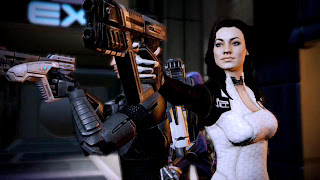
 Maybe you lost Miranda's loyalty in an argument. She might be dead.

Mass Effect 3 sees the conclusion of the hero's journey in the final trial, the attack against the ultimate enemy. By gathering all allies together (though potentially losing some along the way), the player is getting together all the military might possible in order to assist for the final battle. Throughout the game, the player has a bar that builds showing them the potential chance of success of this final onslaught. Yet ultimately this doesn't appear to have any real effect, and there is virtually no appreciable game difference from not having built up anything, nor from your decisions during the game, or the past three games. At best, it's possible to lose/gain one single party member as a result of choices made in Mass Effect 2 and Mass Effect 3, but this party member only appears in the final third of the game. The only other difference is the ending to destroy synthetic life will indiscriminately target everyone on Earth should the player have insufficient war assets.

This is where Mass Effect 3 fails so terribly as a game in terms of its narrative. The previous two games have set the stage of a game where choices have real and concrete effects on the way that the game plays out. The player will suffer as a result of bad decisions or be forced to sacrifice others and potentially make their own gameplay more difficult. The narrative affected the gameplay. However, Mass Effect 3's ending (not to mention game as a whole), summarily dispenses with this concept and expectation. The travesty is that it is a mess not only in terms of the details of its execution in a narrative sense, but in it entirely forgets the responsibilities of the trilogy as a game.

 Give me back my game. Now.

Now, the odd thing personally, is that while I've seen many people argue that BioWare shouldn't change the ending because of reasons of artistic integrity, and plenty of articles on why it's a terrible ending, I've seen very little from arguments of those who liked the ending as to why it was a good ending. I have a friend who is a writer and budding game designer who gave his thoughts on the ending. I have to give him credit, because he's done better than "professional critics/reviewers" who have failed to develop a single coherent argument as to why the ending is good except for "the writers made it that way." I'm sorry, but from people who get paid to write articles, that's simply not damn good enough. If you're going to declare the ending is great and deride everyone picking (serious and significant) holes in the delivery and details, then you'd damn well better be able to back it up with something better than "that's what we got given."

The funny thing is that thematically, I can see the argument that the ending is well written. The argument that the entire series has always been about order versus chaos does strike a little bit of a chord. However, the problem is that it is a retcon (retroactive continuity) of a theme. i.e. The writers decided to change the ending of the game, from the originally intended one, and forced people to reinterpret existing material in a new way. This change is why the first and second game don't entirely gel in a thematically consistent fashion with the third. Mac Walters took over as the lead writer during the development of Mass Effect 2, and in hindsight you can see that divergence and some of the dropped plot ideas from the first two games... just as you can retroactively see the theme of order versus chaos come through. The problem is that it takes until you talk to the dying Reaper on Rannoch before the concept of order versus chaos is finally presented to the player in any sort of coherent manner.

Tali doesn't think it's about order and chaos

For two entire games, the Reapers are insistent that they "are beyond our understanding", but when we reach the conclusion they say "actually, you're all going to be killed off by synthetics, so we kill all advanced races so that doesn't happen." Hate to point this out, but that's an idea that has been floating around in human culture, and specifically sci-fi, for decades. Given you've studied us (and all other races), you'd know that. Heck, when the dying reaper said that on Rannoch, my thought was "Really? You're just recycling the idea from Battlestar Galactica? That's your idea of 'beyond understanding?' Please tell me you're just trying to get inside my head." It's just such a ham-fisted and simple explanation that it doesn't do justice to the catch cry of the Reapers thus far, nor their vast power and arrogance.

The problem is that Mass Effect has explored some interesting themes, put players in some difficult moral quandaries, and likely put them through the emotional wringer with character deaths. There are so many good points to the series that the inconsistencies and retroactive application of thematic ideas throughout decisions and events in the series doesn't do justice to universe that has been created for players, nor the experiences they have had within it.

 So we explored for what purpose exactly?

This isn't simply an issue of the ending failing to live up to player expectations, it's an issue of the ending failing to live up to the rest of the narrative experience provided by the Mass Effect games. It is a failure to live up to the gameplay experience delivered by the rest of series. True enough, a story should be about the journey, and not the destination, but the issue is that every single destination is exactly the same. For the ending we have, it turns out that Harbinger and the Reapers were right. You can struggle all you want, but nothing you do will make any difference in the end. Kind of makes you wonder why you were fighting throughout all three games.
Monday, December 20, 2010

An IGNoble disgrace

Regular readers of this blog will know that I hate console wars or console versus PC zealotry. Each platform has its own strengths and weaknesses, and using individual games to compare them (and say "this one is the best!") is something I generally consider to be a sign of fanboy postulating. So when I saw a "professional game website", which IGN claims to be, doing a (please don't click this link, for reasons I will explain) head-to-head video comparison of Mass Effect 2 on XBox360 and PS3 and sparking a raft of "PS3 is so much better" claims across various other websites, I was a little disappointed.

A still from the video (PS3 left, XBox360 right)

You can click the two images in the post for a higher resolution image. But, just taking a quick look at the above shot, it looks like the PS3 version has better contrast and colour saturation. That was my overall impression from watching the video, which struck me as an odd thing. Now, there might be some graphical differences between the two consoles but I knowing the Unreal Engine and its precalculated lighting for static surfaces, I wouldn't have thought the differences would have been quite so noticable as they are in this video. I would have attributed to the game being run on a different television, but I would hope for IGN's sake that they created the two videos using the same television so as to remove such bias.

Unfortunately, I'm not sure that I can even give them that much credit, because their comparison seems to be wholly unreliable. Check out the screenshot below.

What is that? (PS3 left, XBox360 right)

Now, aside from the slight difference in the position of the frame for both the screenshots here (that's right, they're slightly out of sync), there's some serious frame-blurring present in the picture on the right. If you take a screenshot from a game, it shouldn't end up blurred - and particularly not to the great extent that can be seen in this shot. Go pause a gameplay video from a console game and see if you get blurring. If it's a high quality video, you won't. If it's not... well, guess what can happen?

This "comparison" appears incompetent at best, and blatantly biased at worst. It appears that these are two videos of different quality placed side-by-side in a console comparison - if IGN demonstrated that they produced these videos on the same television using the same video resolution and compression, I'd happily retract this post. But as it stands, their video appears to be nothing more than a shameless attempt to garner website hits by provoking a console flame-war.

I expect more from gaming sites that claim to provide "video game journalism", as should every person who relies on these sites for a supposedly unbiased and objective analysis of games.  Shame on you, IGN.

Monday, October 4, 2010

Mass Effect 2: DLC Done Right

Part of the reason I discussed DAO's DLC was not only to lament that it could have been so much more, but also so that I would have a good counterpoint when analysing the DLC released for Mass Effect 2. So let's give a quick recap of each of its (playable) DLC and discuss why they've succeeded in a way that Dragon Age's offerings have not.

Zaeed
Roughly equivalent to DAO's Stone Prisoner, it adds a new party companion with a personal quest.  Perhaps a little less content than Stone Prisoner, but Zaeed has a group of dedicated fans for being one of the toughest characters in space.

Normandy Crash Pack
This was a bit of a let down, although it appeared to be mostly for nostalgic reasons and closure regarding the destruction of the Normandy and the deaths of its crew members. It was effectively a treasure hunt.

Firewalker Pack
This was another shallow DLC, but free. It was basically designed to introduce the Hammerhead, a new land vehicle to replace the (unwieldy) Mako. This was largely a bit of platforming/driving with the Mass Effect universe, and while it did not receive overwhelmingly positive reviews, it did do something different.

The Hammerhead: Agile and Fragile

Stolen Memory
Adding the master thief Kasumi to Shepard's crew, this DLC offered a few interesting things.  A new weapon got many players excited, as did Kasumi's new combat abilities. The mods also featured an investigation sequence where the player had to determine how to get into a locked vault. While the solution could be pursued in a mostly linear fashion and was fairly straightforward, it did offer something different in terms of gameplay.

Project Overlord
Overlord took the Hammerhead and showed its true potential, and delivered a nice story in addition. Turning the Hammerhead's exploration into an interesting game element, including a set piece fight in the vehicle and "frogger-like" sections. It also featured "regular" ME2 gameplay, wit a surreal cutscene and an enjoyable set-piece boss fight for its conclusion, not to mention a great moral choice.

Lair of the Shadow Broker
While it was always going to gain attention and sales because it reunited Shepard with Liara from Mass Effect 1, Lair of the Shadow Broker was the real deal in its own rights. While it started with another clunky investigation (arguably worse than in Stolen Memory) it soon hit its strides.  Combat sequences featuring enemies using Kasumi's Flashbang Grenade, followed by a car chase sequence, a defense segment and two set-piece boss fights all combined to make the gameplay really enjoyable.

Hold the line!

So what is it that makes ME2's DLC successful and popular, whereas DAO's wasn't as warmly received?  For starters, ME2's DLC took more risks. There was no Warden's Keep or Return To Ostagar which just offered "more of the same" as had been given to the player in the main game.  The firewalker pack consisted entirely of flying around in the new vehicle, and none of the standard combat present in the main game. So while it was fairly straightforward, it was a testbed for what was truly to come in Overlord, which really put the new vehicle through its paces and showed that it was capable of integrated smoothly into the main game as a viable alternative to ME1's Mako. The flying vehicle section of Lair of the Shadow Broker (I'm going to use the abbreviation LotSB because that name is simply too long) was another out-of-the-box bit of gameplay, which was fun despite not being terribly difficult.  It perhaps erred on the side of being too easy, but it was really well implemented because you really felt under pressure, and combined with Liara's "encouragement" it really felt like you were taking charge of a chase scene in a sci-fi movie. It was fun.

LotSB chase scene: better than a silly pod race

Stolen Memory tried something different when it tried to integrate an investigation into the game, but unfortunately it amounted to little more than moving around and talking to people. It was almost as though it was trying to bring an adventure game playstyle in Mass Effect, but there wasn't a whole lot of thinking the player had to do, meaning it didn't quite work. This was reduced even further in the beginning of the LotSB, amounting to little more than hunting for the interactive items in the level. This was probably the weakest part of both respective DLCs, but again, it was experimenting with something different. I imagine it could provide an interesting diversification of gameplay if it were more enjoyable and required a bit more grey matter. 

Mention should also be given to the set combat pieces of Overlord and LotSB that help make them standout, and truly showcase that Mass Effect 2 has managed to bring its gameplay mechanics on par with actual Third Person Shooters. Hardline RPG fans might decry this as an example of how it is no longer an RPG, but I'd argue that the genre need not be constrained to mechanics that rely purely on character leveling and the luck of invisible dice rolls. But that's a digression I could spend a whole post on... in fact, I'll probably do that in the future.

The point is that ME2's maturity and mastery of its mechanics as evidenced in its DLC brings with it more challenging and more interesting fights within the game. Putting the player into new situations not only makes for increased variety and interest, but it makes the game more fun. No one wants to do the same boss fight over and over again. Simply shooting or attacking an enemy until it dies doesn't really make a fight feel special. It just makes a game repetitive and repetition leads to boredom, which is something a designer never wants their players to feel.

We just need to kill 65,340,285 boars

The reason that ME2's DLC have worked better than DAO's is because they not only fully integrated with the main game (only 3/7 of DAO's DLC do this), so that they contribute to the overall storyline of the series and the game itself in a coherent fashion, but they also experiment with new gameplay. Not simply choosing to present the same gameplay from a different perspective (Darkspawn Chronicles), or the same gameplay to act as a hook for the sequel (Witch Hunt), ME2's DLC changes the gameplay dynamic significantly. It takes risks.

It is doing something even better because it's using the existing player base as a test bed for potential new gameplay styles and sequences that could be adapted for use within the final chapter of the series. Taking fans of the series and giving them a cheap way to explore new types of content for a low cost allows the developers to see what works and what doesn't and then use this to inform their decisions for future games.  They don't have to spend time creating a full game for millions of dollars that could potentially be a failure, but instead can dedicate time to producing a small amount of content for an already established and eager audience to see how it is received. If something works, then it can be taken and used in a sequel as part of its gameplay and fans will be happy. Similarly, if a particular mechanic does not work, then it can either be tweaked to correct the issues and potentially get another test run in a second DLC, or it can be ditched entirely.

Kasumi's "heist" didn't quite work, but the DLC still did

In my opinion, this is a good use of DLC. This is what DLC should be used for by commercial studios. Using DLC to test out the mini-games and new gameplay styles that the developers are contemplating putting into the next installment of a franchise. Using them to push the boundaries of the game and see if players would like to have a taste of a slightly new direction in addition to the core gameplay that they've already demonstrated they love by buying the game in the first place. But it should not replace the existing content wholesale, as that's not what players want.

This is exactly why Firewalker wasn't well received, as it wasn't until the Hammerhead was combined with the original gameplay that players loved it. Admittedly, in Overlord the developers had already experimented with the Hammerhead once before, but this only reinforces the point. They didn't get it quite right the first time, but on its second outing, the Hammerhead was a lot of fun. It still needs a little bit of tweaking, as it feels as though it has less firepower and durability than Shepard does on foot, but if we see it in yet another DLC or even in Mass Effect 3, I imagine those issues will be addressed.

Frogger minus frog and cars, but with bonus molten lava

While DLC has been maligned by players at times, it offers both players and developers a means to improve games. The ideal DLC isn't a new weapon, outfit, vehicle or map. ME2 has these as well, but they don't interest me. These are micro-transactions, or just regular transactions if you're milking people for $10 for maps they've already played before - yes, I'm looking at you Modern Warfare 2! (I know I'm making a small habit of attacking MW2, but it did so many things wrong that it's hard not to come back to it) The ideal DLC also isn't simply a mini-expansion offering an hour of gameplay in the same vein as the original game, which is where the Dragon Age: Origins DLC suffered.  They act as small improvements to a game, but they're not the best use of DLC to benefit the game itself.
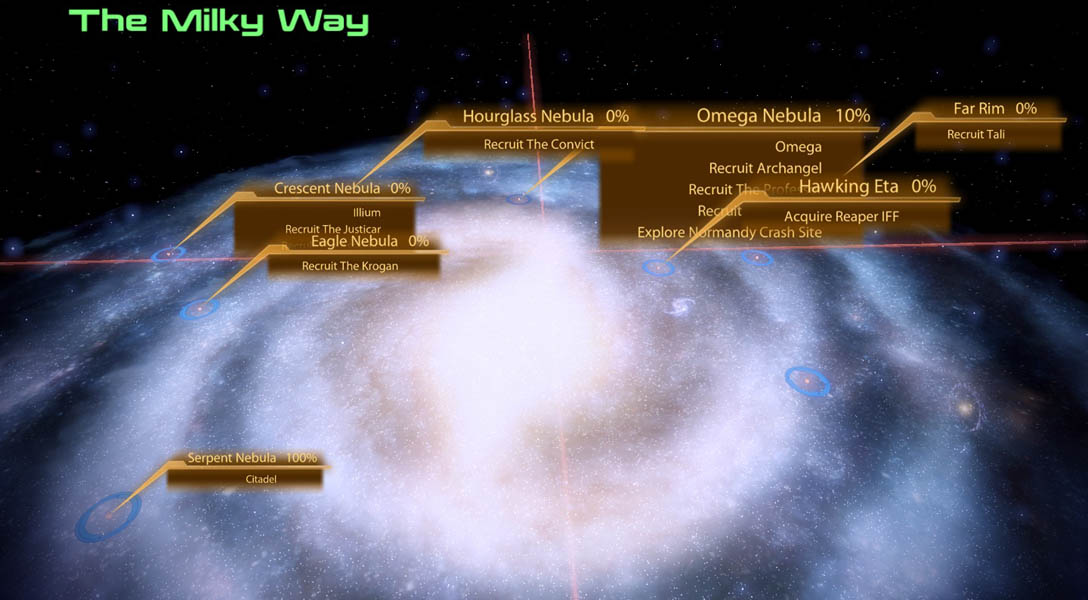
The ideal DLC adds to the game as a whole, developing it and any franchise it might be a part of into something better. It should help explore what the game can and cannot do, and how it might improve or modify its gameplay. Ultimately, the ideal DLC will serve to make the core gaming experience more interesting and more engaging for the players.

Monday, September 27, 2010

Antagonists: Mass Effect

Mass Effect was a bold step in RPG production, a new setting, a new style, an adoption of FPS mechanics into an RPG, a highly cinematic experience with a fully voiced protagonist. The game wasn't perfect, but it certainly made a big impact on the gaming scene. I also felt it offered a fairly interesting antagonist to the player, and one worthy of discussion.  So here's a plot spoiler and a long post warning before I dive into an overview...

Mass Effect puts you in the role of Commander Shepard, an elite space soldier. The game starts off with a trial mission to become a Spectre (SPECial Tactics and REconnaisance) - a select group of individuals operating for the good of the (multi-species) galaxy. The aim of the mission is simple: retrieve a Prothean Beacon. This is a device from an ancient space travelling race (the Protheans) who has provided much of the technology for the advancement of all races in the galaxy.

However, this simple mission goes wrong when your Spectre ally and new mentor Nihilius is assassinated by another Spectre named Saren as he attempts to destroy a human colony on the planet of Eden Prime. Even worse, the beacon is destroyed, but not before it caused Shepard to have visions of death and the destruction of all life in the galaxy.  In light of this, Shepard's petition to join the Spectres is denied, and without proof, Saren is free to do as he pleases. Undeterred, Shepard finds evidence of Saren's wrongdoing. He is stricken of his spectre status, and Shepard is given a place among the spectres with the explicit purpose of hunting him and his army of sentient machines (known as Geth).

Whoops, I think you broke it.

Through a series of missions, Shepard discovers that the visions from the beacon are a warning of an ancient race called the Reapers, who will destroy all life in the galaxy. The key to their return is something called "The Conduit", which Saren is searching for. Shepard must track leads in order to find Saren and the location of The Conduit, overcoming the dangers of his allies.

Shepard eventually travels to the planet Virmire, where it is revealed that Saren's ship, Sovereign, is itself a Reaper! The Reapers are giant sentient machines with technology far beyond anything else in the galaxy. Worse still, its presence takes over the mind of people, bending them to its will. Shepard speaks with the machine, who turns back to attack the planet.  Shepard and Saren fight, and Saren declares he is trying to save life by allying with Sovereign.

Saren and Geth on Virmire

Shepard eventually tracks Saren to the planet Ilos, to discover that The Conduit is a secret means to gain access to the central point of the galaxy, a giant structure known as The Citadel. The Citadel is actually the means for the Reapers to return, and Sovereign's role is to signal for the Reapers to attack. However, the Protheans altered the Citadel so that this signal could not be sent. Sovereign must attack The Citadel and send the signal manually, but needs Saren's assistance in order to do so. Shepard fights to the control room of the Citadel to find and confront Saren. Saren dies, but is possessed by Sovereign through cybernetic implants that were helping control Saren's mind and actions. This weakens Sovereign's shields and allows the Reaper to be destroyed by the human space fleet, saving the galaxy from the Reaper threat... for the time being.

So we have a fairly epic plot about saving the galaxy from an ancient evil, and we're again put in the position of having two antagonists.  We have Saren, whom the players comes to dislike from their early interactions and Saren's hatred of Shepard and humans in general. Saren is presented quite deliberately as a villain and an obnoxious character to provide the player with extra impetus for hunting him down. It happens not only through direct interaction, but also the tale of your Captain, who previously suffered as a result of Saren's actions.

Saren in full obnoxious hologram glory

After this initial flurry Saren is joined by the threat of the Reapers, who will return because of his actions. The main quest lines revolve around following Saren's footsteps and trying to discover the same information he is seeking. The game attemps to reinforce Saren as the threat multiple times through your interactions with his henchmen during these quests.  There are vague allusions to Saren controlling the minds of those onboard Sovereign, and then even after they leave the ship.

Yet Saren still feels a little distant in these interactions. He's off somewhere, doing something, but we're not sure what. Then we get the message to head to Saren's base on Virmire... but he's not there either.  At least not until after we speak with Sovereign through a terminal and discover it is a Reaper. Virmire is one of the highlights of the game for many reasons: The great interaction with Sovereign, being forced to abandon one of your squadmates to die, and a confrontation with Saren.

No amount of plot armor is going to save them from that

Interactions help to make a good antagonist. It's good to know your enemy and a little about the motives behind their actions. Saren proves to be distant for quite some time, but when you finally confront him, you get to face a foe deluded that he can save people by allying with the Reapers. He still hates humans and murdered civilians, but he thinks he will save others by helping Sovereign.

This is pushed again when you meet him for the final battle, as he repeats his claims of trying to save lives. However, here it is actually possible to convince Saren that he himself has become brainwashed (or indoctrinated, if you wish to use the lore terminology) by Sovereign to blindly obey its every command. If you do so, Saren will commit suicide in an attempt to stop Sovereign's plans. I felt this was a very nice roleplaying touch, as it showed that the villain still possessed some essence of virtue. He displayed regret that he had allowed himself to become Sovereign's tool, and left a slight doubt about his true character and which of his actions were at Sovereign's behest.

"He just doesn't seem like himself anymore!"

Another interesting point is that Sovereign is the true threat as the catalyst for the return of the Reapers, yet its true identity is hidden from us for most of the game. However, if you replay the game, there are hints given along the way that suggest and support this. Yet it serves as part of the greater threat of the Reapers that we learn more about as the game progresses, and one that the player becomes driven to defeat. Perhaps the desire to stop the Reapers is an even greater driving force than Saren, which makes Sovereign's reveal more powerful. However, it is not Sovereign itself that makes the finale meaningful, it's the threat of the complete and utter destruction of the entire galaxy. This is only moments away if Shepard does not win, and that is what makes the climatic battle with Sovereign a triumph. Saving the galaxy might be a somewhat common story, but the presentation means that the player is completely engaged to achieve it.

Bye bye, Sovereign

The antagonists of Mass Effect are a little distant and removed from the player for much of the game, yet due to some key interactions they play out as powerful and effective enemies within the game's climax. Saren in particular could perhaps have done with a little more exposure to drive the player towards his defeat, but the overarching threat of the Reapers means this is not entirely necessary. The sense of victory after the final fight is still up there with the best games around.

Saturday, September 11, 2010

Consoles != Dumbing Down

There was a time back in the days of the PS2 and the original XBox that I might have accepted the argument that consoles weren't played by "real gamers". But not any more. The technical increases in the power of consoles and the popularity of console gaming means that PC gamers can no longer get on their high horse of superiority and declare that console gamers are "kids" or don't want games with any depth.

I can't provide a definitive reason for the rise in popularity in console gaming compared to PC gaming, as there are many factors that have potentially contributed to this: PC piracy, gaming becoming "mainstream", affordability of consoles, and many more besides. Regardless of the reason, consoles have truly become a proper gaming system in their own right, and the superiority espoused by PC gamers needs to come to an end. For me personally, there are some games I'll get on PC, but others I'll buy on console. Console gamers are not necessarily after a "simpler" gaming experience.


It doesn't have to be one or the other

But don't take my word for it... compare the recent statistics that have been gathered on Mass Effect 2 playthroughs on both PC and XBox360. Now, I could write a whole post on how these results are interesting and the insights that these could provide for design issues, but that's been discussed elsewhere. This is a massive trove of information on player choice and preference (more people play soldier than all the other classes combined and 80% of Shepards are male?!?), but I was interested in the differences between console and PC gamers.

Across millions of playthrough, PC gamers spent about an hour longer to finish the game (not much considering the average playtime was around 30 hours), whereas XBox players did about 10% more loyalty missions on average (which pretty much amounts to 1 more). However, most PC players did Miranda's (touchy-feely plot) quest, whereas console players tended not to, but console players favoured the combat-focused mission for Grunt's loyalty.

It's hard to draw conclusions based on a simple loyalty mission choice. Do console players like Miranda's character less and Grunt's character more? Or was it the emotionally charged story of finding Miranda's sister that they didn't care for?  Perhaps PC players didn't particularly like Grunt's personality or maybe thought an unstable Krogan might be more dangerous for their enemies? Maybe less PC players didn't even let him out of his tank?  There are plenty of reasons why either of these decisions could have been made, so I'm not sure it would be responsible to try and draw conclusion on the rationale behind the differences in these choices.

Grunt: Krogan extraordinaire and console gamer favourite

While these differences are interesting, there's no clear difference in choice that indicates a "bored" audience on the console market. Some gamers who decry ME2 as "not being an RPG" would probably argue that is because the game is already "dumbed down" to suit the console audience, but I'd argue that these statistics but a bullet right to the head of that argument. Mass Effect 2 still has a lot of dialogue in it, and only 15% of that dialogue was skipped by players (unfortunately there's no PC/console breakdown of that statistic). It appears from this information that console players are every bit as dedicated to experiencing a good story as the PC gamers.

In short, if you ever feel the urge to insult a proponent of your non-favoured system, please reconsider. There are advantages and disadvantages of both platforms, and people should recognise that. There's no reason that there has to be an "us" and "them" mentality among gamers playing a multi-platform game on different systems. After all, we're all gamers, right? The games themselves should be the important thing, and not the choice of hardware on which we play them.

Saturday, August 7, 2010

Baldur's Gate 2 vs Mass Effect 2

Okay, I know might seem like a bizarre topic, but bear with me here. There are actually a lot of design similarities in the structure of the two games. I'll issue a spoiler warning for both games before I start.

Baldur's Gate 2 places you with the goal "raise money to reach Imoen/Irenicus", but leaves it up to you how to pursue it. It floods you with choices of sidequests in order to achieve that goal. It offered you freedom in terms of those sidequests, you were inundated with them at the start, and had to decide which ones were most important to you as a character. As you progressed you took along your party members and got to know them a little (or a lot) better during the process. As you progress, must perform some of the linear plot (the guild war), and eventually track down Irenicus and kill him. But a large proportion of the game is in the sidequests to explore the gameworld. Each party member even has their own dedicated "side-quest" so you get to know them better.

PC gains Jan's loyalty. *tick*

Mass Effect 2 placed you with the goal "form a team to defeat the collectors", but leaves it up to you how to pursue it. Once again, you're given a number of tasks to achieve and freedom in the order in which to pursue them. You have to decide which members sound the most important to you in order that you want to "hire" them first. Again, you get to know your party members better if you take them along, and even if you don't you can still chat with them in the Normandy. You get thrown into part of the linear main plot along with way (Horizon, Collector Ship), and eventually kill the collectors. Again, the sidequests are the focus, and party members have their own dedicated "side-quest".

So why does Mass Effect 2 get panned for this focus on side quests but Baldur's Gate 2 never does? Simple. This might sound like a "I WANT MOAR!!!" argument, but Mass Effect 2's biggest problem is that the main quest isn't long enough. The main quest consists of Freedom's Progress, Horizon, the Collector Ship, Reaper IFF and the Collector Base. Five missions, probably accounting for at most 8 hours of the gameplay. The Collectors and Harbinger simply weren't in the game enough for you to care about them sufficiently. Compare to Irenicus who hassled you at every turn, you spent time fighting with his sister (who later had the potentially to really get to you by stealing your love interest), and he even had the assistance of the Drow.

Sorry, I lost the plot a little in these side quests...

The problem in ME2 was that the "side quests" occupied the majority of the game, and didn't matter until the last mission. That said, the final mission where you got to assign other team members to roles really succeeded in terms of tying together the "mission" of the game to collect a team. You actually got to put that team to use by assigning their roles during the assault. I still think this was excellent, and I don't think it should have been included previously in the game, as it makes a fitting climatic finish. If you'd had the same thing occur earlier, the finish wouldn't have had the same impact.

The weakness of the game was that it lacked the strong overarching narrative present in either Baldur's Gate 2 or the original Mass Effect. What it really needed were a few more mandatory missions in the middle of the game to reinforce the threat of the Collectors and the need to eliminate them. The threat of the Reapers almost took a backseat through the game, and we merely dealt with their pawns in an intermediate struggle until the final showdown promised by the third game.

Thursday, May 6, 2010

The Hidden Choice

I must preface this post by saying it contains Mass Effect 2 spoilers! If you have not finished Mass Effect 2, please tune out right now!


I read an interesting post today of someone complaining about the possibility that your crew can die in Mass Effect 2. Specifically, it talks about the attack that occurs after the Reaper IFF mission, where your crew members get abducted. Unless you immediately rush to the Collector Base, then your crew gets turned into synthetic reaper paste. The player concerned was not happy that they had no warning that this would occur.

My initial response was to reply that the player is warned repeatedly that they need to prepare for the IFF mission. This prompted many players to do everything they could before undertaking the IFF mission, allowing them to save all the crew. However, it can also be argued that urgency is pressed upon the player for many different sidequests that have no repercussions should the player not immediately undertake them. Not pursuing the collectors is the only situation in which mission choice has a tangible in-game effect.

The complaint raises an interesting RPG design point, in that the player is making a choice, but they do not necessarily realise that they are making a choice. In many cases, the player is asked to deal with something as quickly as possible, but this is the only one in which that actually matters. Should the player suspect that something might be amiss? Certainly a lot of dialogue reflects the potential need to build up a team before doing the IFF, and also rescuing the crew immediately after they are kidnapped.

Arguably the reason some players consider it an issue is because it was unexpected, and players assumed they could carry out jobs in whatever order they want without penalty. However, this isn't necessarily the case in sandbox games with time like Oblivion or Fallout 3, and even Baldur's Gate 2 had some in-game time/date dependent occurrences.


Yet the screenshot above indicates the clear difference between Mass Effect 2 and those games. Time was obviously and clearly worked into all three of those games. You have a clock and a calendar and the appearance of areas changed from day to night, giving you the clear indication that time was actively passing and you were in a timely game environment. In Mass Effect (and Dragon Age), there is no dynamic lighting - even if you stay in an area for an entire real-time day, it will remain exactly the same.

Should a player be expected to realise that there is a time dependent quest in a game that does not indicate the passing of time in any significant manner? Arguably not, despite the multiple verbal warnings they receive. Time is never impressed upon the player as something that matters, and has little effect on the game as a whole.

Alternatively, we could accept this as a new "standard" RPG mechanism, and players can now expect more effects to come as a result of which quests or exploration they pursue at points within a game. Obviously this presents a massive overhead on developers. Now designers not only have to cater for the "active" choices that players makes (whether to kill an NPC, or pick a good/bad dialogue choice), but also "passive" choices like whether they pursued a particular quest line "in time". So I don't expect that it will occur on a large scale - perhaps a few key instances at most.

A "macro" level time limit imposed by quest choice presents an interesting dilemma for players. Even used sparingly, if the player "suffers" as a result of delaying a quest, no matter how small that effect, it now places a seed of doubt and urgency into their mind. Players are typically complacent when it comes to most quests, simply because they know as a function of accessibility and choice, quests can typically be left as long as the player likes to complete. If this isn't the case, the player could miss out on content, which tends to upset players, so game companies (typically) don't do it.

Yet even a few quests which present consequences if not performed in a timely manner will impress a sense of urgency upon the player. They will potentially feel torn about which quest to pursue next, rather than trying to pick which quest will give them the most xp/best loot/romance/etc.

Of course, it's still possible to cheat this system. Gamers can find out which quests have these effects, complete them, and then explore and quest freely to their heart's content when they are able. But in a general sense, a few well implemented quests that have consequences if not completed in a timely manner could be a great boon, and significantly improve the overall realism of the fictional world of an RPG.

Wednesday, February 3, 2010

Add-In/DLC Integration: Part 4


As part of my posts on Add-In DLC (Down-Loadable Content) integration, I'd like to take the opportunity to discuss cohesion as it relates to Dragon Age: Origins and Mass Effect 2. These two games offer a great comparison of DLC in terms of adding new characters. Both games have DLC that was available from day 1 that introduce a new party member that the player can take along.

Shale's integration into DAO is much more cohesive with the main game than Zaeed's into ME2 for two reasons:
1) Shale has more interjections. This is a pure content thing, but the more a character says, the more it feels like they are part of the story.
2) Zaeed's interactions within the Normandy are different to every other NPC that can join Shepard's crew. You don't get a proper dialog chain with Zaeed - he just spouts dialog at you, which really makes him feel like an afterthought rather than a core part of the game.

That said, Zaeed's sidequest fits in with the atmosphere of the game far better than Shale's sidequest. With Zaeed, you get a good insight into his character and history, and have to make some tough choices, as with many good quests in Mass Effect 2. By comparison, Shale's personal quest feels a little stale, having no real choices to be made, although learning about Shale is a somewhat interesting discovery.

Which is the better DLC? I guess that's up to individual taste. Personally, Shale feels more like a part of the game than Zaeed does, and I would argue that when DLC appears to truly part of the game as a whole, it is well designed DLC, as it maintains the immersion of the game.

Friday, January 29, 2010

Mass Effect 2 - The Good, The Bad, and the Ugly

The Good
  • Classic BioWare RPG goodness
    Great characters in a tight and interesting story all presented in a slick fashion. BioWare make the best RPGs because they deliver on these aspects consistently across their titles, and ME2 certainly delivers in this regard.

  • Choices matter
    BioWare have excelled themselves here. The truly wonderful thing is the number of decisions from ME1 that you see pop up as you explore the universe in ME2. Some of them are simply emails you receive from individuals, but there's plenty of returning characters that reference your previous actions involving them. It's a small thing, but it makes the continuity across the first two games of this series better than anything else out there.

  • The action
    The FPS nature of the game has really been stepped up by several notches, and it really does deliver. But this is no plain shooter where you just gun down your enemies. Like any good RPG, tactics are still required, as you can (and must) use several different powers at your (or your teammates') disposal in order to take down enemies. However, it's very easy to set these up and use them in the midst of a firefight. There's no need to pause like in ME1, which keeps the action going very nicely.

  • Presentation
    Slick, pretty, and cinematic. Graphics have been amped up a notch, and the texture pop issue of ME1 is gone. The voice acting is also excellent, though there are a couple of characters that are a little too melodramatic. An asari on Omega is probably the worst case of this.
The Bad
  • Lack of inventory
    This is a bit of a downer, even though ME1's inventory system was one of my most disliked GUIs for a long time. Yes, this is a much more action oriented game, but I'd like to have more variety in my gear. But barring that, I really should be told the differences between my available weapon choices. For example, the first new heavy pistol I picked up has a significantly reduced amount of ammo I can use. But this isn't listed anywhere. And how many extra damage am I doing per shot with those fewer bullets?
The Ugly
  • Disc Switching
    ME2 comes on two discs, so I decided to install both discs to my XBox Hard Drive to avoid having to switch discs. No dice. It still asks to switch disks every now and then, even though all the data should be on the HD. I haven't had to switch discs since the C64. I really don't like this. We're not in the early 1990s. Personally, I think this should be on the "must fix ASAP" list of issues.

  • Planet Scanning
    Well, BioWare listened to the complaints about resource gathering being dull, but seemingly missed the point of why. The tedious process of clicking on planets in the map and hitting a button to scan or driving across the planet in the unwieldy Mako has been replaced. Unfortunately, it has been replaced by an equally tedious process of continually holding down the left trigger (on the Xbox360) while you move the thumbstick methodically across a planet's surface and occasionally hit right trigger to mine resources. This was fun for the first couple of minutes... but having to do this for several mind-numbingly boring minutes for each planet gets very old, very quickly.
I haven't yet finished the game, and might write up something more detailed once I'm done, but these are my thoughts on the game so far.