Showing posts with label Antagonists. Show all posts

Tuesday, December 7, 2010

The Generic Antagonist

My previous posts on antagonists have primarily dealt with games that have a strong focus on individuals, looking at enemies that you get to know somewhat personally to give you a motivation to defeat them. Most of these have been RPGs. But what about games where you're placed in a situation where you're not dealing explicitly with one enemy? What about when you're fighting against a massive faceless horde? For example, Gears of War pits you against The Locust, Half-life has you fighting the combine, Just Cause 2 has you shooting at... pretty much anything and anyone who gets in your way. These games are all popular and manage to successfully install a desire to win and "defeat" your enemies on par with many of the successful antagonists I've previously discussed.

I'm not about to advocate that these games are masterpieces of story-telling, but despite their varying cinematic impact and strength of writing they all are quite successful in making you feel like you're in an environment that is increasingly hostile towards you and your actions. As a player, you're very concerned about surviving your next encounter and getting to do the next thing of your list of objectives. They give you a great sense of wanting to "just play a little bit longer" or "I really hope I can take this enemy down".

On three, or three and then go?

Admittedly all three games have characters that serve as some sort of figureheads for the hordes of the generic enemies you fight, but they're typically far removed from the action until the very end of the game. They're typically not given the same sort of weight that an antagonist is given in an RPG. They might have some influence on the troubles that the player is facing, but in general I'd say they aren't fully realised characters with depth - at least not depth which is exposed to the player in any significant way. So why are these games so successful in making the player want to keep going, and why can't RPGs deliver in the same way?

Perhaps some of the reason is that RPGs rely heavily on narrative to provide player interest. Or rather, rely on narrative delivered in the specific form of dialogue in text or speech form. Of course, if we're dealing with narrative in computer games, there are so many more options available to a designer than text and speech. Take Half-life or Gears of War and see how their narrative is delivered in many different forms: scripted events or cinematics, combat scenarios, art style, the player's environment, sound, music, and so much more. Sometimes they are able to do so much more with one line of dialogue than an RPG ever could...

We don't go to Ravenholm...

One simple line sets the scene for Ravenholm, and all the visuals sound serve to reinforce the eerie and foreboding delivery of Alyx's warning. Gears of War pits you against increasing tough enemies as the stakes of the battle rise, and Just Cause 2 sees the army becoming increasingly tense and quick to send everything they have after you. By not having a single specific antagonist to focus the player's main ire upon, each enemy and sequence poses its own challenge and interest in a way that other games don't capture.  Compare the threat of fighting a group of locust in a set piece in Gears of War to yet another darkspawn battle in the Deep Roads of Dragon Age.  Which is the more exciting and engaging piece of the two? I love RPGs, but if I had to pick which of the two was more likely to get my heart going, I'd have to choose Gears of War.

I don't believe having an "epic story" makes fights around the henchmen or grunts of the "great enemy" that you're faced against inherently boring. There simply appears to be something in RPGs that frequently causes these "trash mob" fights to become repetitive or otherwise uninteresting. Have RPGs become too reliant on explicitly telling the player everything through dialogue rather than letting them figure things out for themselves? Has this dependence then made every fight that is not accompanied by relevant dialogue to give it a direct context and meaning becomes dull or potentially pointless to the player? Or perhaps it is that RPGs simply need to experiment with attempting to provide narrative in the same way that it is done in a more action oriented game.

Monday, September 27, 2010

Antagonists: Mass Effect

Mass Effect was a bold step in RPG production, a new setting, a new style, an adoption of FPS mechanics into an RPG, a highly cinematic experience with a fully voiced protagonist. The game wasn't perfect, but it certainly made a big impact on the gaming scene. I also felt it offered a fairly interesting antagonist to the player, and one worthy of discussion.  So here's a plot spoiler and a long post warning before I dive into an overview...

Mass Effect puts you in the role of Commander Shepard, an elite space soldier. The game starts off with a trial mission to become a Spectre (SPECial Tactics and REconnaisance) - a select group of individuals operating for the good of the (multi-species) galaxy. The aim of the mission is simple: retrieve a Prothean Beacon. This is a device from an ancient space travelling race (the Protheans) who has provided much of the technology for the advancement of all races in the galaxy.

However, this simple mission goes wrong when your Spectre ally and new mentor Nihilius is assassinated by another Spectre named Saren as he attempts to destroy a human colony on the planet of Eden Prime. Even worse, the beacon is destroyed, but not before it caused Shepard to have visions of death and the destruction of all life in the galaxy.  In light of this, Shepard's petition to join the Spectres is denied, and without proof, Saren is free to do as he pleases. Undeterred, Shepard finds evidence of Saren's wrongdoing. He is stricken of his spectre status, and Shepard is given a place among the spectres with the explicit purpose of hunting him and his army of sentient machines (known as Geth).

Whoops, I think you broke it.

Through a series of missions, Shepard discovers that the visions from the beacon are a warning of an ancient race called the Reapers, who will destroy all life in the galaxy. The key to their return is something called "The Conduit", which Saren is searching for. Shepard must track leads in order to find Saren and the location of The Conduit, overcoming the dangers of his allies.

Shepard eventually travels to the planet Virmire, where it is revealed that Saren's ship, Sovereign, is itself a Reaper! The Reapers are giant sentient machines with technology far beyond anything else in the galaxy. Worse still, its presence takes over the mind of people, bending them to its will. Shepard speaks with the machine, who turns back to attack the planet.  Shepard and Saren fight, and Saren declares he is trying to save life by allying with Sovereign.

Saren and Geth on Virmire

Shepard eventually tracks Saren to the planet Ilos, to discover that The Conduit is a secret means to gain access to the central point of the galaxy, a giant structure known as The Citadel. The Citadel is actually the means for the Reapers to return, and Sovereign's role is to signal for the Reapers to attack. However, the Protheans altered the Citadel so that this signal could not be sent. Sovereign must attack The Citadel and send the signal manually, but needs Saren's assistance in order to do so. Shepard fights to the control room of the Citadel to find and confront Saren. Saren dies, but is possessed by Sovereign through cybernetic implants that were helping control Saren's mind and actions. This weakens Sovereign's shields and allows the Reaper to be destroyed by the human space fleet, saving the galaxy from the Reaper threat... for the time being.

So we have a fairly epic plot about saving the galaxy from an ancient evil, and we're again put in the position of having two antagonists.  We have Saren, whom the players comes to dislike from their early interactions and Saren's hatred of Shepard and humans in general. Saren is presented quite deliberately as a villain and an obnoxious character to provide the player with extra impetus for hunting him down. It happens not only through direct interaction, but also the tale of your Captain, who previously suffered as a result of Saren's actions.

Saren in full obnoxious hologram glory

After this initial flurry Saren is joined by the threat of the Reapers, who will return because of his actions. The main quest lines revolve around following Saren's footsteps and trying to discover the same information he is seeking. The game attemps to reinforce Saren as the threat multiple times through your interactions with his henchmen during these quests.  There are vague allusions to Saren controlling the minds of those onboard Sovereign, and then even after they leave the ship.

Yet Saren still feels a little distant in these interactions. He's off somewhere, doing something, but we're not sure what. Then we get the message to head to Saren's base on Virmire... but he's not there either.  At least not until after we speak with Sovereign through a terminal and discover it is a Reaper. Virmire is one of the highlights of the game for many reasons: The great interaction with Sovereign, being forced to abandon one of your squadmates to die, and a confrontation with Saren.

No amount of plot armor is going to save them from that

Interactions help to make a good antagonist. It's good to know your enemy and a little about the motives behind their actions. Saren proves to be distant for quite some time, but when you finally confront him, you get to face a foe deluded that he can save people by allying with the Reapers. He still hates humans and murdered civilians, but he thinks he will save others by helping Sovereign.

This is pushed again when you meet him for the final battle, as he repeats his claims of trying to save lives. However, here it is actually possible to convince Saren that he himself has become brainwashed (or indoctrinated, if you wish to use the lore terminology) by Sovereign to blindly obey its every command. If you do so, Saren will commit suicide in an attempt to stop Sovereign's plans. I felt this was a very nice roleplaying touch, as it showed that the villain still possessed some essence of virtue. He displayed regret that he had allowed himself to become Sovereign's tool, and left a slight doubt about his true character and which of his actions were at Sovereign's behest.

"He just doesn't seem like himself anymore!"

Another interesting point is that Sovereign is the true threat as the catalyst for the return of the Reapers, yet its true identity is hidden from us for most of the game. However, if you replay the game, there are hints given along the way that suggest and support this. Yet it serves as part of the greater threat of the Reapers that we learn more about as the game progresses, and one that the player becomes driven to defeat. Perhaps the desire to stop the Reapers is an even greater driving force than Saren, which makes Sovereign's reveal more powerful. However, it is not Sovereign itself that makes the finale meaningful, it's the threat of the complete and utter destruction of the entire galaxy. This is only moments away if Shepard does not win, and that is what makes the climatic battle with Sovereign a triumph. Saving the galaxy might be a somewhat common story, but the presentation means that the player is completely engaged to achieve it.

Bye bye, Sovereign

The antagonists of Mass Effect are a little distant and removed from the player for much of the game, yet due to some key interactions they play out as powerful and effective enemies within the game's climax. Saren in particular could perhaps have done with a little more exposure to drive the player towards his defeat, but the overarching threat of the Reapers means this is not entirely necessary. The sense of victory after the final fight is still up there with the best games around.

Wednesday, September 15, 2010

Antagonists: Dragon Age Origins

I'll happily admit that I'm a huge fan of Dragon Age Origins (DAO), but I'm not afraid to point out that it does have weaknesses. Unfortunately, one of those weaknesses is its antagonist.  Perhaps I should say antagonists, as the game almost has two. Plot spoilers ahead...

The game begins with an "origin story" of your choosing - a backstory you play that details how you come to join the Grey Wardens, a famous order of warriors. Regardless of your choice of origin, you end up at Ostagar to prepare for a great battle. Hideous creatures known as darkspawn threaten to spill out into the land of Ferelden, consuming it in an event that has happened four times previously, called a "blight". This is marked by the appearance of a fearsome beast known as an archdemon, a dragon corrupted by the "taint" that makes darkspawn monstrosities. However, this creature has not been seen yet, and in an attempt to stem the tide of these creatures in its absence, the King, his chief tactician (Teryn Loghain), and the Grey Wardens make a stand to stop the blight before it starts. The Grey Wardens are famed for ending the blights whenever they have occurred and bravely face off against darkspawn wherever they are found. However, the battle goes badly, and is lost as Loghain retreats from the field instead of marshaling his forces to save the King.

You and a junior Grey Warden named Alistair are the only survivors of the Grey Wardens from the nation of Ferelden, and the order is blamed by Loghain for the defeat and declared traitors to the crown. Thus it falls to you to gather armies to help defeat the blight and eventually confront Loghain over his betrayal at Ostagar. Yet Loghain and his ally, Arl Howe, dog your efforts along the way by attempting to kill and capture you. They even send a deadly assassin after you... but you defeat him and can even have him join your party.

Zevran. Not quite as ridiculously awesome as you.

Eventually, with the assistance of another noble named Arl Eamon you call for a Landsmeet - a meeting of all the important nobles in Ferelden. Here you unmask Alistair as the bastard brother of the former King, someone with a claim to the throne. You argue to either place him or the Queen (who also happens to be Teryn Loghain's daughter) on the throne... or both.  However, in order to do so, you must defeat Loghain in combat and take control of Ferelden away from him.

With this done, the blight is truly upon the country as the Archdemon appears. While you have seen it only in visions in your sleep (due to the Grey Wardens possessing a small amount of the darkspawn "taint"), you must fight your way to the top of the tallest tower in Ferelden's capital and defeat it in order to end the blight.

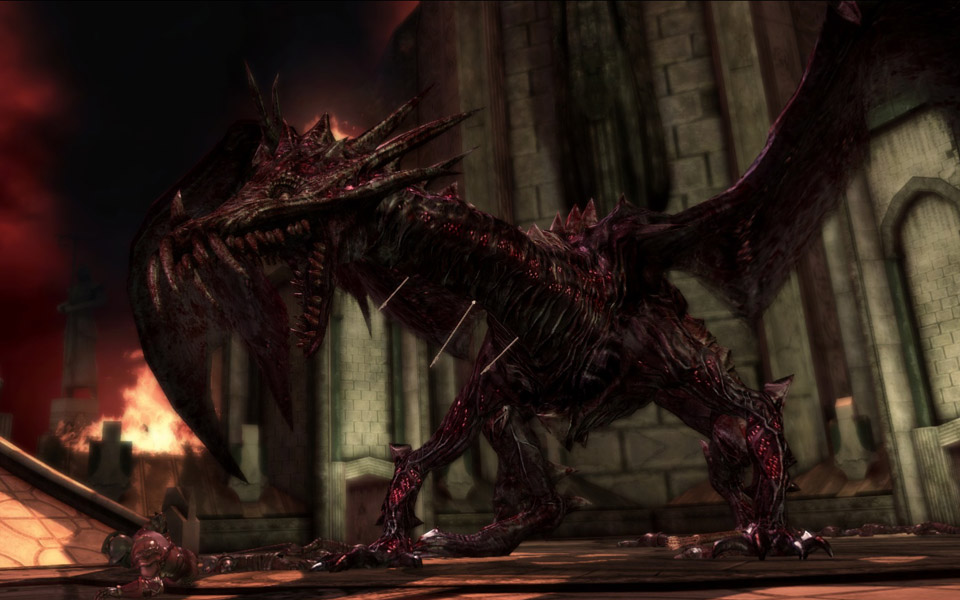
It's a dragon. Only uglier.

As I said at the start of this post, DAO has weak antagonists.  It is almost a sad fact that the game's secondary antagonist, Loghain, is a more powerful force in the game's narrative. Loghain's betrayal and his actions divide players, for the player is given the chance to kill him or have him join the Grey Wardens after the events of the Landsmeet. Some consider he deserves death for his crimes and ambition, whereas others argue that he did what he thought was necessary to preserve Ferelden in a time of great strife.  This makes Loghain an excellent character, but unfortunately he still doesn't quite manage to become a strong antagonist.

Loghain considers the Warden a pest, but does little to act directly against them, preferring to let others deal with the issue. He is more concerned with ensuring that he is able to rule Ferelden effectively than killing the Warden, and therefore does not draw a great deal of ire from the player. He has you declared traitor and attempts to kill you, but from his perspective this is done to secure his position rather than out of direct malice. The player is left to rely on these indirect attempts on their life, Loghain's complicity in slavery and Alistair's personal grudge to provide the impetus for disliking Loghain. Unfortunately, none of them really feel so strong that they provide a true drive to dispatch him.

This said, in a way Loghain's failing as a direct antagonist to the player is actually a good thing. His attempt to bring the player undone is not what defines his character, as his desire to dispatch the Warden pales in insignificance compared with his desire to see Ferelden prosper. It makes him an excellent and complex character, but not entirely the grand enemy you might expect.

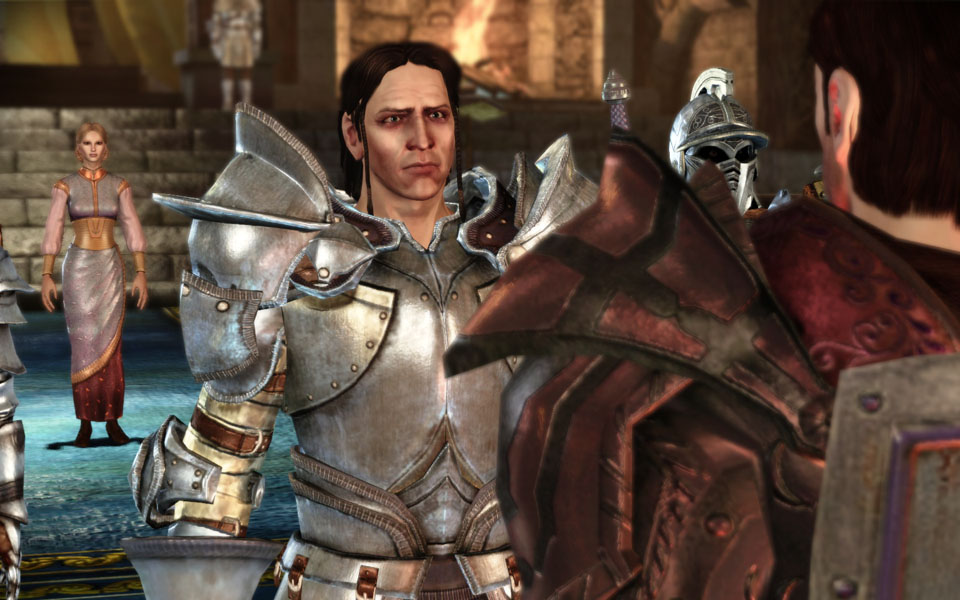
Loghain: villain or misguided hero? You be the judge.

The main problem with Loghain not playing a strong antagonist role is that DAO's final battle with the archdemon is against an antagonist that has no character. The archdemon is little more than a faceless creature that you must defeat simply because it is evil and its continued existence will destroy Ferelden. This is not to say that all antagonists need to have a personal relationship with the protagonist, but the archdemon's greatest failing is that it is a "classic" nemesis with no morals, no purpose, and no goals except to be "evil" and destroy. Even worse, it does not really appear in the game until the game's final few hours apart from a few discussions about the archdemon and the aforemention dream sequence. 

As such, the player has nothing directly invested in the archdemon's defeat except for the moral duty of being the hero to save Ferelden. The player has incentive for this noble cause and the self-serving desire to not die in the blight, but there is very little else to make the fight more personal for the player, meaning that the final fight of the game lacks the punch that the gripping and forceful climax of a game so desperately calls for. The player still gets a great sense of victory from the fight, but far less than if the archdemon had been more than a simple beast.

With a complex character who does not act as a true antagonist and a faceless evil creature, DAO almost manages to tick a lot of boxes when it comes to the checklist of creating a great antagonist. Its problem is that those ticks are spread across two characters rather than one, and split in such a way that you don't quite ever get that feeling of overcoming a truly great and memorable adversary.

Friday, September 10, 2010

Antagonists: Planescape Torment

Planescape: Torment was a game that wanted to be a novel. The amount of words in this game is huge by any standard, and anyone who isn't keen on reading will never finish it. Created by Black Isle using BioWare's Infinity Engine, the game now looks very dated, but this doesn't actually detract from the game in a huge way. Perhaps this is because in no small part because there is so much that happens within the game that is described in text rather than shown, constantly reinforcing that it is the writing that makes this game special. It also features one magnificent antagonist... so heed the spoiler warning and tune out now if you ever want to play this game!  I'll give a quick disclaimer that this is one of the longest posts I've done, but there is a lot to discuss here.

The game starts off with you getting over a small illness: death. That's right, you're immortal, and in fact, the game hinges around this characteristic. You are "The Nameless One", waking up in a morgue, without any memory of how you got here, what you were doing, or anything about your former life. Your only assistance is in the form of a talking, floating skull named Morte. If this sounds a little bizarre, that's because it is. The Planescape D&D setting is perhaps one of the more confusing creations you might come across, for it is a place where your very thoughts and actions can cause things to come into being. As an example, throughout the game, you can tell people that your name is "Adahn". If you do so enough, then a person actually named Adahn magically pops into existence.

Starting off dead... Well, that's... different.

Searching for answers on how you came to be in the morgue, you find you were dumped there by a man named Pharod. Lacking any other leads, you decide to seek him out. After a series of events including an encounter with a collective entity of sentient rats, you discover Pharod, who gives you a few precious clues to follow. After leaving, the player is privy to a short cutscene where Pharod is beset and killed by creatures called Shadows. These soon begin to attack The Nameless One as well, seemingly acting as an agent for a more sinister enemy.

You eventually discover that your immortality may have been caused by a night hag named Ravel Puzzlewell, who is currently imprisoned in a magical maze by the ruler of the city, a mysterious being known as the Lady of Pain. After a series of trials, The Nameless One finds his way to Ravel, to find that she was indeed the one who made him immortal. It turns out that his mortality was separated from him so he could never die permanently (see, I told you Planescape was weird), but that with each death, he loses some of his memory. She send him to the fallen angel Trias to try and find his mortality.

A being introduced as "The Transcendent One" kills Ravel after the player leaves Ravel's maze, and appears to be the greater evil commanding the Shadows to kill The Nameless One. The player frees Trias who claims to not be able to not know the answer, but instead directs The Nameless One to other planes, where they eventually discover that their mortality is in a place called "The Fortress of Regrets". It is revealed that Trias lied and has betrayed The Nameless One in a past life as well as this one. After defeating Trias, The Nameless One discovers that the entrance to this Fortress is in The Mortuary, where the player began the game.

Shadows, the dangerous allies of your enemy

Once there, the player encounters three of his past incarnations: one practical, one good, and one paranoid. The "good" incarnation is the original, who made himself immortal after committing terrible deeds and wishing to avoid retribution after death and correct the evil he had wrought. These previous incarnations have left the clues that have allowed him to travel his current path and learn about his past and reach this place. However, upon reaching his mortality, the player finds that it is in fact the mysterious being known as The Transcedent One that has been trying to kill him all this time. His mortality has come to enjoy freedom and wishes to erase all of The Nameless One's memories to live in peace. The Nameless One can kill or convince his mortality to rejoin with him, finally allowing the him to "defeat" his enemy - ultimately dying and receiving the retribution he tried so hard to avoid.

Yes, that is honestly the condensed version of the story, and even that leaves out a lot of points.  There are around 800,000 words of text in the game, so trying to distill it down to key aspects is no simple task. Due to this massive amount of text (and a few other reasons) Torment is a unique proposition in that it doesn't obey lots of standard conventions. For one, it is extremely hard to die permanently - in most cases death will simply cause you to be reincarnated not far from where you died, with everything else pretty much as it was. This alone means the "challenge" of the game is unusual, forcing the game to rely on its narrative more than a game where your death means a reload. So how does this affect the game's antagonist?

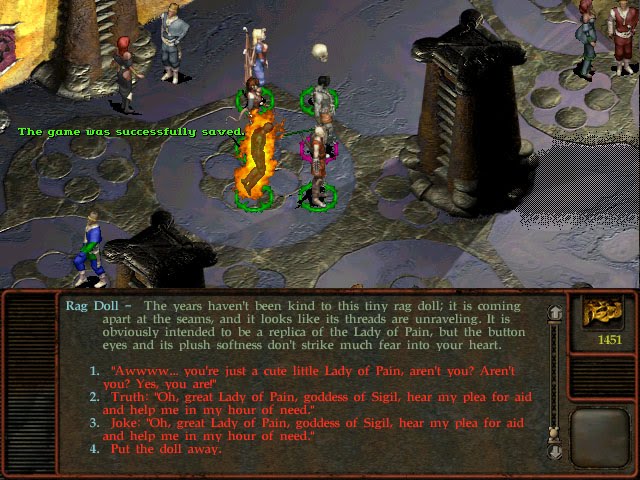
Yes, the game has a lot of dialogue

For one, defining the game's antagonist is a curious prospect, because in reality, the main character is the protagonist and the antagonists. Yes, I said antagonists, because it's not just the Transcendent One that stands in the player's way. The previous incarnations of The Nameless One both assist and hinder the player, feeding misinformation and outright lies as well as truths; setting traps as well as laying the trail of breadcrumbs for them to follow. The clues left behind are mysterious and reveal the truth of the situation in disjointed fragments, constantly leaving the player trying to find out more. The player quickly deduces that The Nameless One left some clues for himself in a Momento style scenario, but just as in the movie, it's unclear as to exactly how accurate those clues are.

From the moment the player sees Pharod murdered by Shadows, the game takes a darker turn. There is very obviously something or someone trying to kill The Nameless One, but the player isn't exactly sure why. There is a sense of constant malice, and there is still an essence of danger despite the Nameless One being immortal. Oddly enough, it is the lack of information about your antagonist that makes him such a great "villain". The game is more a journey of discovery where the pieces of a puzzle eventually fall into place than a traditional adventure with a villain you are striving to defeat. After all, the eventual aim of the protagonist is to find a means to die, an aim that requires some fairly serious motivation on the part of the player.

Closing the book on the game and The Nameless One's life

It is this nature of the game's narrative that makes The Transcendent One an effective villain. The story revolves around the fact that you're trying to find out what happened to you, to discover who did the terrible thing of giving you immortality that causes you to lose your memory and to harm the lives of those people whose fates have become inextricably (or in one case, quite intentionally and deviously) linked to your own. The villain initially appears to be attempting to kill you for its own inscrutable means rather than directly opposing you, and all your instincts and the advice you receive indicate that you should run rather than attempting to attack what appears to be an incredibly powerful being. The plot twist that eventually reveals that you must instead face that opponent, and that opponent is in fact part of you makes it all the more powerful a reveal.

The fact that the player is pushed towards avoiding confrontation makes the antagonist an interesting proposition. The player is somewhat fearful of The Transcendent One despite being immortal, and doesn't have any direct reason to hate it except for basic self-preservation. But given The Transcendent One seems content to not act directly against The Nameless One, it almost raises the tension further, raising the question "Why?" Why is The Transcendent One, who is shown to be extremely powerful, not attempting to kill the player, when it seemingly possesses the power to do so? The actions, or rather, the lack thereof, of the antagonist serve to provoke the player's curiosity rather than ire. In an excellent example of writing helping shape the design of a game, this means that they wish to find out about their enemy rather than simply kill them, which is exactly the tone of the entire game and precisely what the plot requires.

Planescape: Torment features an unusual antagonist befitting an unusual game. It revolves around the main character and the reconciliation of their past, which due to the fantastical nature of the setting provides an exposition of what would otherwise be an internal struggle. The desire of the protagonist to avoid responsibility for past actions is what placed the player in their initial predicament, giving them the sombre task of facing up to the required judgment for the countless lives that have been destroyed as a result of the both selfish and noble goal of trying to cheat death and correct those mistakes. All of these aspects combine to make Planescape: Torment interesting and thought provoking, not to mention a great game.

Friday, August 13, 2010

Antagonists: Morrowind

Morrowind is a curious game for me. It took me half a dozen goes before I actually enjoyed it enough to play more than a couple of hours, but once I got over that hump, I played it with a moderate amount of dedication. Now, while it's an open world game and so the focus isn't necessarily on the main plot, there was actually a fair amount involved in the main quest line. Thus with the requisite spoiler warning, let's dive into the (lengthy) plot summary.

You are shipped to the island of Vvardenfell (in the province of Morrowind, hence the game's title) at the Emperor's command. You were a criminal but released upon his command. You are told to assist one Caius Cosades, a member of the Blades who are effectively the Emperor's "secret police" to protect the Empire. You are tasked to investigate the cults of the Nerevarine and the "Sixth House". Through a series of quests you discover that the Nerevarine is a prophecy that will see the rebirth of Nerevar, a former hero of the island. His rebirth will mark the end of the "blight storms", storms of red dust that causes disease and are slowly destroying the entire island. The "Sixth House" is trying to bring about the rebirth of a "great house" (akin to a major political faction) which was destroyed centuries ago.

After some more machinations, Caius Cosades reveals that the Emperor intends to use you to fulfill the Nerevarine prophecies. You are the means by which he ensure that the stability of the Empire is not threatened. You are sent to one of the Ashlander tribes (specifically belonging to a Nerevarine cult) to find out more about the Nerevarine and to attempt to convince them that you can fulfil the prophecy. After some convincing, their "Wise Woman" agrees that you may be able to. As such, she asks for your help in finding a set of documents: the lost prophecies on the Nerevarine.

Are the walls keeping the monsters inside... or us outside?

By this time, you have learned a little more about the troubles of the island, and most likely its history. This is actually crucial to the plot, as the whole reason for the blight storms is due to the actions of several mortals who became Gods through their actions. The cause of the island's troubles is Dagoth Ur, who is hiding deep within Red Mountain. The blight storms seem to emanate from this volcano, allegedly due to Dagoth's influence. Even worse, the magical barriers protecting the island are weakening, and the Sixth House is attempting to regain power on the island for Dagoth Ur. As a result, Caius Cosades sends you off to destroy a newly discovered Sixth House cult base. You do so, killing its leader, Dagoth Gares, but at a terrible price - you contract the deadly Corprus disease, a fatal wasting disease that can come from the blight.

However, recovering from Corprus is one of the prophecies regarding the Nerevarine, and with some assistance, you are able to do just that, becoming immune to the disease's ill effects in the process. You then must break an associate out of a prison that is a giant floating rock who has the lost prophecies regarding the Nerevarine, because the temple which rules the island believes them to be heresy. Because of your actions, you gain the respect of the Nerevarine cult, who task you with fulfilling the next parts of the prophecy: gaining the respect of the three major Ashlander tribes and the Three Great Houses by having them declare you the Nerevarine and Hortator (war leader) respectively. After a long and involved process, you do so.

The location of one of the best prison breaks ever

At this point, your status makes you a criminal in the eyes of the temple ruling the island in the name of the god Vivec (another former-mortal-turned-deity like Dagoth Ur). But, in a strange turn of events, you meet with Vivec himself, who co-opts you into performing a series of tasks to retrieve the necessary tools to defeat and kill Dagoth Ur. These are legendary items by which their rise to immortality was performed, and you must undo their actions of so many years ago. However, through your actions that allow you to kill Dagoth Ur, you destroy the very thing making Vivec immortal. But due to your success, the blight storms end and the future of Vvardenfell seems assured.

Now the curious thing is that Dagoth Ur is never really presented to you directly as your antagonist. You're basically given the role of Nerevarine (whether you like it or not), effectively forcing your hand to deal with Dagoth Ur at the Emperor's command. He does take a personal interest in you, and you get Corprus disease from Dagoth Gares more or less at his behest. However, the plot does not directly revolve around him as a personal antagonist to you.

That said, Dagoth Ur still makes a fairly convincing villain, in that his presence and actions will see the blight storms spread over the entire island and ultimately everything and everyone being destroyed. You didn't necessarily have a personal vendetta against him, but the pure fact that his continued existence would result in your death (along with everyone else's) was sufficient motivation. I'll confess that it actually made me develop a strong desire to dispatch him. I think perhaps the major weakness was that I didn't feel like I got enough of a sense as to what Dagoth Ur's plan was through his actions. His entire character as an antagonist seemed to be that he was entitled to the godhood that he had "earned" through his actions with the magical artifacts you collect and use against him.

Levitation. A cool trick of an immortal.

Perhaps more interesting is that a significant amount of the back story behind his rise to god status is not given to you explicitly by the characters. If you're not making an effort to get involved in the plot, much of it can be left out and you can be wondering exactly what is going on. I greatly appreciated the effort that had been put into creating the story behind the individuals involved in the machinations that saw the creation of the Tribunal (the three "gods": Dagoth Ur, Vivec and Almalexia). Their actions, rise to power and the subsequent effect that they had on the island are documented in many books through the game, and effectively permeate the entire societal structure and religious beliefs on the island. Dagoth Ur is so much of a legend in their history that he is the bogeyman used to scare children into their beds at night. Except he's real.

For me, the main problem with the game was the lack of a hook. After meeting with Caius Cosades the first time, the player could literally be tossed out with a "come back when you've levelled up" message. For me, even though I wanted to play it, the game proven impenetrable (and got me utterly destroyed in early fights) the first few times I tried to play it. I got progressively further each time I returned, but it was months after I'd first bought it before I finally was able to actually get past the initial hurdle. I was extremely happy when I did get over it, because I really enjoyed the game once I started to make some progress. I was a contented gamer upon dispatching Dagoth Ur and freeing Vvardenfell from the blight storms.

I see skies of blue, clouds of white (okay, brownish white)

The thing is that hook did not need to be, nor should it have been, the antagonist. The power of Dagoth Ur's character comes from being so entrenched in the history of the island on which the game is set. In that sense, I'm actually reminded of Arcanum, which developed its antagonist in a similar fashion. This very different narration style of developing the overall picture of the ultimate antagonist through the lore of the game's setting is a really interesting design approach.

This style rewards the player who gets into the setting, and by its nature practically encourages them to accept the reality of the game. This is a very powerful technique to draw the player in, but may demand an inquisitive mindset and a player willing to invest themselves in the setting. I wonder if the number of players that are willing to do so is sufficient to justify the expense of a modern AAA game title? If it means that we will see more titles like Morrowind, where the world created by the game's writers is so closely tied to the narrative of the game itself, then I surely hope so.

Tuesday, July 20, 2010

Antagonists: Baldur's Gate 2

Jonoleth. The Exile. Jon Irenicus. Baldur's Gate 2: Shadows of Amn is still considered by many to be the pinnacle of computer RPGs. While I won't argue the merits of that point here, there's no denying that Irenicus is one brilliant antagonist. He hounds you from the very start of the game, and despite on the surface appearing to be a megalomaniac with visions of power and grandeur, he is actually a complex and interesting character. So with the requisite spoiler warning, let's dive into the plot overview... (Strap yourselves in, it's a long one)

You start the game with an introduction of the events of Baldur's Gate 1, most importantly introducing you as a Bhaalspawn. It seems you have been captured and are being tortured by an unknown villain. Your captor, a mage, speaks of power before he is drawn away by an attack. With the assistance of your allies, you escape his dungeon, making your way to the streets of the city of Athkatla. Your friend/"sister", Imoen joins in an attack on your captor by the mysterious Cowled Wizards, who police the use of magic within the city. As a result, they are both taken prisoner and whisked away.

I know dungeons are meant to be creepy, but this takes it to the next level...

Thus begins your search for the means to follow Imoen and this mage, who goes by the name Jon Irenicus. As you gather money to pay for the services of some expensive friends, you are taunted in your dreams by him. Irenicus speaks of power, of your heritage as a Bhaalspawn and the power it brings. You end up siding or opposing a group of vampires led by "Bodhi", a sinister female vampire that seems a little too familiar with you. You make your way to the island of Brynnlaw and the Spellhold Asylum where Imoen and Irenicus are being held captive. However, before you even arrive, it is relayed to you that Irenicus has taken control of the asylum, and so you are merely walking into his trap.

Spellhold before it became Spellhold

He imprisons you with the help of a traitor he placed in your midst within the dungeon in which you escaped at the very start of the game. Using his powers, Irenicus drains you of your godly essence, stripping Bhaal's spark from your body. It is revealed that the same has been done to Imoen, who (unbeknownst to either of you) is also a child of Bhaal. He has absorbed your essence, and Imoen's has been taken by the vampire Bodhi, who is now shown to be Irenicus' sister. Subsequently imprisoned again, you escape despite Bodhi's attempts to hinder you.

During this process, you become overwhelmed by the taint of Bhaal's presence (I'm not exactly sure how), and you transform into "The Slayer", which was the fearsome Avatar of Bhaal when he walked the land as a mortal. Bodhi flees at the sight of this startling development. It seems even though having the taint stripped from you has not killed you, you will die before too long if you do not get it back. The stakes for catching and defeating Irenicus just became even higher.

You attempt to follow Irenicus and Bodhi but fail as your ship is destroyed as you are yanked beneath the sea. You fight your way through the underdark and a drow city to find a group of elves who mention "The Exile", who is none other than Irenicus himself! In order to save Imoen's life, you must kill Bodhi and take back her spirit, and then you must find and kill Irenicus to save yourself. However, Irenicus is assaulting the elven city of Suldanesselar to take the power of the "Tree of Life" in order to become immortal. This is in fact the second time he has attempted to do this - the first time he and his sister conspired to do so, they were stripped of their elvish heritage; turned into twisted shells and forced to turn to dark arts merely to survive. You finally kill Irenicus (twice!) and reclaim your soul, saving Suldanesselar in the process.

Well, looks like we're Big Damn Heroes

Phew! I know that was possibly unnecessary for many of you, but it's still nice to condense the plot (yes, that is condensed!) and remind everyone of the key points. It deserves some time, because I know there's a lot of people that have been hanging out to read this post. (That's part of why it's taken me so long to get to - I've revised this post a lot)

Simply put, Irenicus is a fantastic villain. Right from the start, you've got a reason to hate him. He's captured you, tortured you, and stolen your childhood friend. Even if you're a selfish player, his promises of power should be enough to tempt you. His megalomanical taunts in your sleep seem to hint that you could become more than you are, but still indicate that he is (and will remain) more powerful than you unless you try and harness your divine heritage.

He comes across as a power-crazed lunatic even though he is already an incredibly powerful mage, but you always get the impression something more is going on. He's not simply crazy, he's Machiavellian in his schemes and ruthless in the pursuit of his own interests. He cares nothing for those that do not suit his purposes, and (rightfully) has a great disdain for most individuals because they are simply nowhere near strong enough to challenge him. His excellent voice work just adds even more to his character, particularly given this was a time when only small snippets of dialogue were voiced.

Irenicus plays the tortured villain

Irenicus is great because he's just so damn powerful and he's constantly hassling you, even in your dreams. He's a continual thorn in your side, even when he's not actually there. You get to know part of his character, the cold power-mad villain, but then that persona is developed further as the story really hits its strides. He has a crazy lust for power and revenge (but you don't know on whom he wants revenge or why), yet he still goes out of his way to protect his sister, who he seemingly still cares for after years of torment in their shared broken states. There is still some shred of compassion in him, but it is never entirely clear if it is real compassion. There's always the suspicion that part of it is simply faked through a process of logical reasoning and the shared benefit they gain from banding together. This extra depth of character really adds to him, and it is further developed at the tail end of the game.

It is revealed the Irenicus used to be Queen Ellesime's lover before he fell from grace, and he is genuinely indignant and tortured by having his elvish heritage stripped from him: "I do not remember love, Ellesime. For years I clung to the memory of it, then the memory of the memory, then nothing. The Seldarine took that from me too." Again, the manner in which this line is delivered is brilliant in that it harks bark to an encounter at the very start of the game that made no sense at the time. In an attempt in capture his emotion of love, Irenicus attempt to create clones of Ellesime that you found in his dungeon. The fact that his character is exposed to its almost vulnerable core by you seeing his inner sanctum at the very start of the game, only for you to finally make sense of that information right at the end is a masterstroke of antagonist development.

"You sly dog! You got me monologuing!"

Irenicus proves he is beyond redemption through his actions and continued refusal to back down from his ultimately destructive path, but he truly conveys to the player that for him there was simply no choice in the matter. His initial brutal punishment left him with no alternative but to pursue a path of revenge and to wreak destruction upon those that cursed him and his sister so horribly, to the point where you can almost feel sorry for him. You can understand his position that the elves manufactured the trouble they are in by destroying him so completely, yet you are still determined to bring him undone.

This is why Irenicus is such a fantastic computer game antagonist and part of the reason why Baldur's Gate 2 was such a great game. He is a complex character that you truly come to understand and potentially even respect as an adversary, yet you still have every reason to want to defeat him. In this case, the adage "better the villain you know" is proven accurate in a whole new way. You come to know Irenicus very well, you grow to hate him through his actions, you understand and almost pity him, but you want to kill him anyway.

Viva le grand antagonists!

Monday, July 19, 2010

Antagonists: Ultima Underworld 2

When I played Ultima Underworld 2 (which I actually played before the original Ultima Underworld), I came to realise that I loved this style of game. At the time, I probably didn't even think about gaming genres... At the time I think I might have described it to a friend as "like Dungeon Master, except you can move around like Wolfenstein, and you can jump!" At that time, games were games - there wasn't anything more for me except answering the question "Is it fun?" Now, I still expect games to be fun, but I also expect a lot more from them - yes, I'm a demanding gamer. Anyway, plot overview and spoilers to follow...

The game starts with an introduction via a letter acting as written narration for the video. The letter is addressed to "The Avatar", and I quickly assume that must be me. Apparently I defeated "The Guardian" a year ago, and have been invited by one "Lord British" to attend a feast in honour of that victory. But the next morning, a giant black dome forms over the top of the castle, trapping everyone inside. As the game starts, I am the Avatar, and I meet Lord British and along with a host of people who are apparently my friends, try to form a plan to escape the castle. No sooner have we finished talking than an eerie red face appears "Yes, British, hasten to thy vain struggle" it taunts. Obviously this is The Guardian, the one who has sprung this trap.

Like a rat caught in a... big black rock.

As a player, you must then venture beneath the castle, where you find a strange glowing black rock, which appears to be made of the same substance that forms the giant dome around the castle. In a stroke of simplicity, it's called "blackrock". Walking into a lit facet of this octagonal gem, you find yourself teleported to another land, a prison tower manned by goblins. Either fighting or talking your way past them, you find that this tower has its own troubles, and that it too has felt the influence of The Guardian. Within, you find a small blackrock gem and eventually retreat. Returning to the keep, you find the Nystul, a mage, is able to treat the gem, allowing you to fuse it with the blackrock beneath the castle.

The blackrock changes and the ground shakes as you do so, which then allows you to access more worlds through the gem, each of which has been tainted by The Guardian's influence in some way. However, something is amiss in the castle, as one of the inhabitants is murdered by someone or something. You are unable to identify the killer, but tensions are high. You travel to a land called Killorn Keep, which is in a land controlled by The Guardians servants, yet even there you find an ally to your cause. She eventually gives you a rod that allows you to dispel The Guardian's influence. Thus in each land, you discover that you must find a Blackrock Gem to fuse the rock beneath the castle, and use the rod in a specific location to diminish The Guardian's influence.

"What is it?" "It's a hole through time." "Oh, a magic door! Well, why didn't you say?"

Yet as your quest progresses, you discovered that you are betrayed within, as a man named Patterson murders your friend Nelson before you as he is about to tell you something important. You deal with the unrepentant Patterson, but The Guardian has already demonstrated his power once more. The places you visit include: a destroyed mage training academy, a city destroyed by ice, the tomb of a king who does not know he is dead, a glorified gladatioral arena and the mysterious "Ethereal Void". Eventually, you discover that weakening the Blackrock will not be enough, and instead you must perform a ritual... You must capture the essence of an earth djinn in your body, and then using a magical horn, release the djinn with a furious blast that will shatter the blackrock dome.

Even when you are prepared, The Guardian has a last gasp effort to stop you, as his servant Mors Gotha from Killorn Keep invades the castle through the Blackrock gem and attempts to take you and the others hostage. You kill Mors Gotha and make your way to the Throne room, where you destroy the blackrock dome in its entirety. Now, if you want a really long version of the game, complete with screenshots and amusing commentary try this link. It's not complete, but it's still gold.

Ahh, there's nothing like a big angry tree to get you in a fighting mood

First things first - I'd never played (and still have never played) an Ultima game, so I came into the game with zero knowledge of The Guardian, or the world of Britannia. Did that impact on my enjoyment of the game? Not one bit. It felt strange to be told by all these people that I was their friend, and I probably wouldn't be happy with that from a modern game, but I was young and didn't complain. Even now, I'll give the game a pass because of its age and because they probably assumed (incorrectly) that their audience would have familiarity with the series. Yet, right from the start, I got the impression that I didn't like "The Guardian". I've defeated him before, now while I'm celebrating my triumph, he has the gall to strike a grave blow and imprison in the castle with the Lord of the land. Then he taunts me as I seek to find a way out of his trap. Audibly. That's right, he has a voice I can hear rather than just read. In fact, he is the only character in the entire game that is voiced.

So I immediately have a reason to dislike The Guardian - he's placed me in a giant prison that he says will also be my tomb. What's more is that everything you hear about The Guardian is bad. He's always killing, controlling, capturing, enslaving... to the point where when I reached Killorn Keep, which contained his apparently loyal subjects, I wanted to kill them all. In my righteous fury, I would smite all allies of The Guardian. While this proved to be very difficult, I succeeded... eventually... but then found that I couldn't really do much more in the game... good thing I saved beforehand and can reload...

Time for the "stab first and ask questions later" policy

The great thing about the game was that everywhere (else) I went, The Guardian had done something to destroy or corrupt it. He ruined an entire city by turning it into an ice cavern, he annihilated a once bustling mage academy, he created a society in which he who kills the most in brutal combat rules the land. He even tainted the "Ethereal Void" a land of dreams in which nothing makes sense, and a place that should belong to no one. And occasionally he would taunt me... laughing as he sprang a trap, or gloating over the destruction he had wrought within a world. He was even able to turn one of my supposed friends to his fold (or more accurately, back to his fold, as apparently Patterson had served the Guardian before) and have him kill my friends within the castle.

You know what, Guardian? Nobody likes a braggart.

The funny thing about the game is that I never actually get to defeat The Guardian. I destroyed his blackrock dome, but I never faced him. I also have no idea what he might have in store for me (or Brittania) in the future, yet I felt a great sense of accomplishment. I had thwarted his plans and weakened his influence not only in Brittania, but many other lands besides.

The Guardian worked as a antagonist on several levels. Firstly, he gives you a reason to hate him right from the start. He has you imprisoned; you are at his mercy, but even better, he can't kill you. He's not underestimating you, he's just eliminating you from the picture entirely. By the time he realises you're about to defeat him, he sends his best, Mors Gotha, to dispatch you, but she can't stand up to you. He also has his hand in everything and has caused (either directly or indirectly) most of the wrongs that you have to right during the game.

This city sure has gone to the dogs... ehhh, I mean yeti.

For me, I'd say it was the best RPG around until Baldur's Gate was released. The Guardian wasn't the primary reason the game was great, but he was just another good addition to the myriad of places you visited, quests you finished, monsters you vanquished, puzzles you solved... Actually, on that note, at one point I ate a "Mandrake root" and then went to sleep - and woke up in the "Ethereal Void". This allowed me drop a "moonrock" in my dream, which I could then teleport to in order to reach an otherwise unreachable location. Sounds like "drug use related to incentives or rewards" - whoops, I guess it should have been banned in Australia!

But I digress - the fact remains that Ultima Underworld 2 was a great game - and if you're able to deal with "outdated" games, probably still worth a play even now. Otherwise, check out that link giving a run down of (most) of the game. The only suggestion I might give is to not give into the temptation that so freely exists on the Internet nowadays. Don't look for a walkthrough. Tough it out and figure out the puzzles for yourself. When I played this game, I had no walkthrough (heck, I had no Internet!). You don't want to be outsmarted by a teenager, do you?

PS Yes, I know there's some nostalgia reviewing in this post. If looked at with modern standards, the game has significant flaws beyond its outdated graphics and controls, but it is still an interesting game.
Wednesday, July 14, 2010

Antagonists: Knights of the Old Republic

Knights of the Old Republic still marks a high point in computer games within the Star Wars franchise. It was my first foray back into the universe on a computer since the days of X-Wing, and I wasn't disappointed.  I'll confess I'm not a Star Wars fanatic, but I was still keen to give the game a shot when it finally came out for the PC rather than the XBox. Spoilers ahoy...

The player starts off as a lowly officer onboard a ship which is attacked. They barely manage to make it off the ship alive along with Carth Onasi, a pilot. The pair land on Taris, a Sith controlled planet, and must find Bastila Shan, a powerful Jedi with the "Battle Meditation" ability.  After rescuing her, the player is ordered by the Jedi council to counter the plans of the dangerous Sith Darth Malak, who betrayed his former master Darth Revan to assume control of Sith forces.  He is hunting for something called The Star Forge, which can only be located by finding a number of Star Maps scattered about the galaxy.

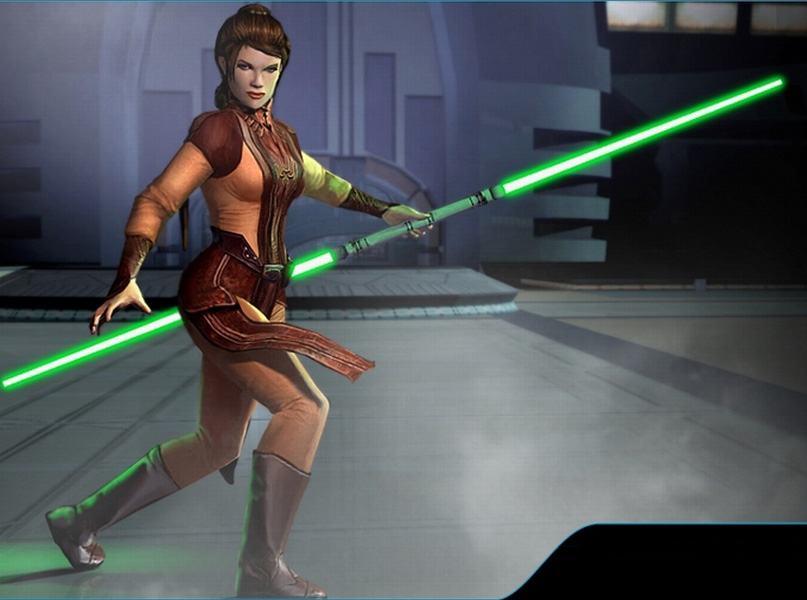
Bastila Shan proudly wears designer Jedi clothing.

With Bastila and other allies who you gather upon the way, you retrieve several Star Maps and fight some of Malak's forces, eventually killing his apprentice Darth Bandon.  However, you are then captured by Darth Malak along with all your allies. You, Bastila and Carth are then tortured, and Darth Malak reveals that you have been duped by Bastila and the other Jedi. You are in fact Revan, stripped of your memories through the powers of the force and sent to fight the apprentice who betrayed you. You escape, but Bastila is captured during the attempt.

You track Darth Malak to the Star Forge, which is a giant structure capable of creating thousands of starships. There you find that Bastila has been turned to the Dark Side due to Malak's torturing. After dealing with her, you finally make you way to Malak and dispose of him, either choosing to reclaim your role as a Sith lord or saving the Republic by destroying the Star Forge.

Just wondering, Malak... have you heard of breath mints?

Malak starts off as the classic bad guy, particularly in the Star Wars universe. He turned on his master in attempt to kill him along with a group of Jedi, and wants to rule everything. He sends a bounty hunter to kill you, though a very talented one, then his favoured apprentice.  In this he falls slightly into the classic arch-villain threaten of underestimating his opponent, especially seeing as when he sends his apprentice after you, he should know your real identity. Then Malak reveals your identity personally, and then steals your ally/friend/love interest in the form of Bastila, and turns them against you giving you another reason to want to destroy him. So he gives every for you to hate him, yet for me, he never quite achieved greatness. Why?

Lightsabers, lightsabers... everybody's got lightsabers...

Perhaps it's because of that twist sequence in the game, in which you first meet Malak face to face. Having been chasing your own tail (quite literally) to catch up to him, you're suddenly captured and placed under his control.  When the reveal of your identity comes, directly from Malak himself, it both weakens and strengthens him as an antagonist. On one hand, you've got even more reason to want to defeat him, because he's already betrayed you and attempted to kill you once before.  But on the other, the twist of the plot makes the whole encounter feel more about you as a character/player than it does about him as a villain.

This is even further pushed by the fact that when you escape from his ship, Bastila stays behind to prevent him from defeating you. You saved her at the start of the game, but now she considers you to be the key to defeating Malak. You were his master once before, and you will prove to be his better once again.

At this point, Malak strangely ignores you and treats Bastila as the tool of his victory through her battle meditation. The problem seems to be that Malak is not the vanguard of destruction, but merely uses others to do his bidding. He rose to power in your shadow before seizing control, doesn't kill you when he has the chance, then treats Bastila as his new toy. There's plenty of reasons to dislike or hate Malak, but there's never any real reason to fear him besides the admonition of NPCs that "he is a powerful Sith".

He looks deadly... why not show that side of him?

The problem is that his actions don't match his reputation as a fearsome warrior until you finally face him in battle, and even then, he's only powerful because of his tools in the form of captured Jedi he uses to fuel his power. He's constantly made out as the ultimate warrior, but in reality, he doesn't live up to the hype.

In defeat, he possesses some remorse, questioning what would have happened if your positions had been reversed. This comes across as a slight attempt for redemption that is a particularly nice touch for the light side player. So ultimately, Malak comes off as a somewhat complex character, from the scheming villain masterminding his rise to power and willing to do anything for victory, to regretting his failure in defeat and disgrace. He comes off as an interesting and worthy adversary, but never truly achieves the lofty heights of a grand villain that you love to hate.

There's some really nice elements to KotOR, and I've heard many people declare it their favourite game/RPG. It has the flaw of requiring a lot of backtracking during play, and is also a little hamstrung by the Star Wars moral dichotomy of "Light Side saviour of everything and everyone" vs "Dark Side puppy-murderer", but it's still a great game. Maybe Darth Malak isn't the greatest video game villain of all time, but when the story ends up revolving around you as the player to such a great degree... does he really need to be?

Wednesday, June 30, 2010

Antagonists: Fallout 3

I'm going to jump forward in time and cover a game that I personally found really disappointing. My apologies if I end up rambling/ranting here and going a little off-topic, but there's so many things I didn't like about Fallout 3 that it is somewhat hard to concentrate solely on the antagonists - or lack thereof. Major spoilers warning...

Fallout 3 starts out with you in Vault 101, with Liam Neeson as your dad.  You grow up through a few events in the game, starting from your birth, where your mother dies. Then just as you're old enough to be a real person, dad breaks out of the vault and turns everything upside down. The whole place goes crazy and the leader (bearing the title of "overseer") of the vault seems to blame you for the trouble.  So you escape into the wilderness of a nuclear wasteland Washington DC to find your father.

The main plot, as thin on the ground as it is, first involves you trying to track down your father. So you head to a radio station because the broadcaster apparently knows your father, who tells you to head to Rivet City (a town in an aircraft carrier) to speak to a scientist there. That scientist then directs you to find a vault in the wilderness where your father was headed. He's attempting to restart "Project Purity" in the Jefferson Memorial building which will remove the radiation from the water in the tidal basin. You end up rescuing him from a virtual reality program in an abandoned vault.

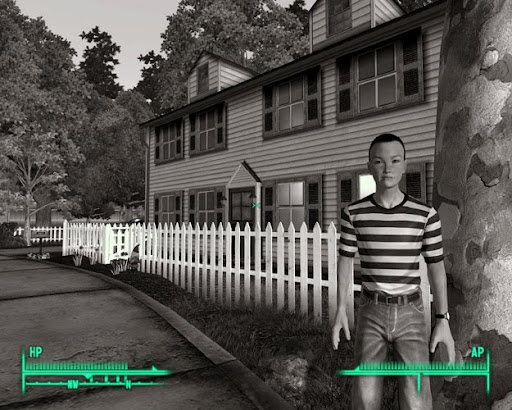
It's "The Matrix" meets "Pleasantville"

Re-united with your father, you return to the Memorial, where soldiers from "The Enclave" have taken over. They are apparently the game's true villains and as a result of this encounter, several Enclave soldiers and your father are killed by radiation in the main chamber of the device. The player must then escape from the Enclave and ends up meeting with "The Brotherhood of Steel", who oppose the enclave. You end up collecting a "technological macguffin" to enable Project Purity to continue. However, after collecting it, you're captured by the Enclave and meet its leader "President Eden", who is actually giant computer.

Eden asks you to "poison" the water when you purify it, so that it kills off anyone/anything that has any sort of mutation. You take the vial, and in all likelihood either convince Eden to self destruct, or program him to do so. However, the second in command, Colonel Autumn, takes over the Memorial again, forcing you to enlist the help of the Brotherhood of Steel to capture it. With the assistance of their giant robot, you break into the facility and then kill Autumn in the shortest boss battle of all time. However, the chamber is damaged and filled with radiation, so you or someone else has to die in order to purify the water.

It's hard for me start with where I dislike this game. For one, you can short-circuit much of the start of the main plot by simply stumbling onto the vault in which your father is located. And given this is an open world game, that's entirely possible. That said, going through various areas in a "find your father" quest is fairly unsatisfying anyway. But the main plot on the whole is fairly tedious. The "enemy" is the radiation and the hordes of monsters, so you're more fighting for survival than any greater purpose. Fighting to live isn't a bad reason, by any means, but it's not really that gripping.

Part psychopathic human supremacist, part weak-willed suicide-victim... all computer

When I was finally introduced to the game's real antagonists, "the Enclave", they just seemed so dull. They're at war with The Brotherhood of Steel, who have helped me before, so I guess they're my enemy by association. Oh, and then they kill my dad. Fine, I can hate them for that. The problem is that they're so very boring. They're basically Stormtroopers covered in rust. If I wanted to kill Stormtroopers, I'd play a Star Wars game. Autumn is a boring and one-dimensional sidekick villain who may as well be nameless. Then we have Eden, the computer brain behind The Enclave. Convincing him to self-destruct or shut down the Enclave might seem like a good design idea, in the great vein of talking the enemy down. Unfortunately, the delivery is sadly lacking. The dialogue behind the exchange is weak and thus largely destroys any impact it might have had.

Some might say it's an open world sandbox game, so I shouldn't expect an epic main plot. That the game is about exploring the world and the environment. That's fine, except much of that environment is also interminably dull. Yes, I get that it's a nuclear wasteland... but that doesn't mean it's not dull to explore a world that's got the Quake and Morrowind colour palette of 32-bit brown. There's a whole lot of fetch quests and lots of places that offer little more than "dungeons" with enemies. There's a distinct lack of plot throughout much of the game. Don't get me wrong, there are some good quests, but they are sparse in a game of this size.
Even the NPCs are mostly dull. Your interactions with characters are very limited and there's no real meaty dialogue trees to explore. You do get the opportunity for some "party members" aka followers, who you can interact with to a basic degree. However, this is what caused the ending to irk me so much. Fawkes, a gentle and friendly supermutant, who is out to do good in the world, refuses to enter a chamber filled with radiation to purify water because, "it is my destiny". It is apparently my destiny to die needlessly, despite that Fawkes is both a good character, and calls me his friend. I don't even care that this was "fixed" in a DLC, it should have never existed in the first place and is probably my most hated piece of writing in an RPG or computer game ever. And that covers a lot of bad games.

Possibly the worst line of dialogue in RPG history

Some might argue that the antagonist of the game is man itself, and the desolation that humans caused to create the wasteland of the game's setting. I'd argue that's a load of poppycock and that as a computer game, Fallout 3 needs an actual antagonist, because it doesn't have one. If it sounds like I'm annoyed, it's because I am, even this long after finishing the game. The hype around Fallout 3 before I played it had told me that it was fantastic and truly delivered a great experience. I went to Washington DC in Fallout 3 and all I got was this unnecessary suicide mission.

Monday, June 28, 2010

Antagonists: Neverwinter Nights 1

Neverwinter Nights 1 was BioWare's first game that came with a toolset. Now, it wasn't the first RPG game I'd modded, as way back in the days of the 486 I'd dabbled with a 2D RPG creating toolkit. Admittedly I was in primary school at the time, so didn't produce a masterpiece, but it certainly gave me a taste for making my own game worlds. So NWN held a great deal of promise for me. Unfortunately the original campaign left me a little disappointed, and that was in no small part was due to the mediocre antagonists... spoilers to follow.

The game starts off with a plague killing off many people in the city of Neverwinter. You play a young adventurer academy recruit undergoing basic training, and you graduate in a ceremony attended by Aribeth de Tylmerande, a famous elven paladin. Yet suddenly you're plunged into a battle as enemies assault the academy, which for some reason is being used to house creatures to be used in a cure for the plague. Why they're stored in a recruit academy and not protected by trained soldiers, I'll never know. Regardless, the creatures escape and are quickly distributed across the city. As a result, it comes down to you to track them down.

"You, brave adventurer, must find the magical macguffins to cure this plague!"

So you collect the four creatures (or the relevant ingredients from their corpses) for a cure, but they are immediately stolen by a traitor named Desther whom you then chase. Upon capturing him and returning to the city, his friend, Fenthick, who is also Aribeth's lover, is put to death. Unwittingly supporting a traitor is apparently sufficient cause to be hanged. As a result of this escapade, you leave the city to find out information about the cult behind the attack.  Your investigations eventually lead you to someone called Maugrim and "The Old Ones", an ancient powerful race attempting to return and conquer the land. Aribeth's bitterness at Fenthick's treatment along with the magic of the Old Ones cause her to betray Neverwinter and join her former enemies. Thus it is then up to you to find four "runes of power" which will prevent the Old Ones from returning. Yes, that's right, both the first and third acts of the game have you collect four items to further the plot.


More giant bug beasts... wait, who is the antagonist again?

You spend the entire third act running around defeating a myriad of enemies in bizarre situations that actually have nothing to do with the Old Ones. Yet no sooner have you collected the runes and sent them to Neverwinter for safekeeping than Aribeth assaults the city, paving the way for their invasion anyway. Thus you must defeat Aribeth, Maugrim and finally travel to the dimension in which the Old Ones are imprisoned in order to defeat their leader and save the day.


Ahhh, the bad guys. The ones I haven't seen for an entire act. I forgot about them.

I have several problems with the story, from Fenthick's trial to the repeated "magical macguffin" finding main plot, to the fact that much of the plot revolves around Aribeth and not the player. But one of the biggest issues for me is that the antagonists are so muddied and weak. It's Desther, then his cult, then Maugrim, then Aribeth, then the Old Ones... yet none of it makes any sense. The secondary antagonists have at best slim reasons to follow the Old Ones, and your actions in all but the last act have very little to do directly with those antagonists.

Those alien features must ooze charisma to wannabe villains.

In the first act, the cult causing the plague virtually has no involvement in the location of the animals except for setting them free in the first place. In the second act, you spend all your time investigating the cult, but do very little to actually track or combat its leader.  What's worse is that Maugrim is introduced in the second act, but you don't face him until the last, and the same goes for Aribeth with her betrayal.  The third act is then entirely about collecting the "macguffin" runes, but you don't deal with your antagonists at all, so it just feels like a pointless distraction.

Only in the fourth act, which is very short, do we actually start dealing directly with the antagonists. All the three major antagonists were saved for the last 5% of the game, and as a result, you don't really care that much about any of them.  The reasons for Aribeth's betrayal are shallow, Maugrim is a mindless servant to an evil power yet lacking any motivation whatsoever, and Morag (the Queen of the Old Ones) is just a vanilla "destroy and rule the world" villain with absolutely zero character depth. Your enemies are so one-dimensional that it is hard to muster any significant degree of anger towards them, and your collective ire for the three of them is so diluted that it lacks any potency except for the desire to finish the story.

This is the fourth boss fight in the last 30 minutes. Please just end...

The game pitted you against a great evil, but never gave you a personal reason to want to defeat it. Certainly, wanting to save the world from the Old Ones is a noble cause that you want to achieve (unless you're an evil mercenary type, in which case you're only doing it to save your own skin), but there's very little to make you personally invested in it. The only way you could have a direct link with the antagonists was if you were romancing Aribeth, but even that felt very tenuous. Without that personal connection and drive to want to see your enemies defeated, the climatic battle felt more like a showy letdown lacking substance than the epic battle with the forces of evil that it was made out to be.

The antagonists are one of the major failings of Neverwinter Nights. The player is forced to want to kill the antagonists simply "because they're evil", and the antagonists have virtually no motivation beyond "I'm evil".  Their irrelevance to much of the story and their complete absence in major portions of the plot mean that even when you do finally meet them, you don't really have any reason to want to defeat them. As such, they make the entire game, and particularly the ending, flat and lacklustre.

Sunday, June 27, 2010

Antagonists: Thief 2 - The Metal Age

Now, I know what you're thinking... Thief 2 isn't an RPG. No, it isn't, but I feel that from time to time I need to remind people that I do actually play games aside from RPGs. I think I would actually have to rate the Thief games my favourite computer game series. I must also say that another huge favourite of mine is the Prince of Persia series, well, the Sands of Time trilogy. I haven't played the last two, nor been inspired to do so based on reviews.  But, I'm meant to be talking about game antagonists, not my gaming habits.  So, requisite spoiler alert for Thief 1 and 2.

Thief 2 begins with a crackdown on you and thieves in general, and pits you against a Sheriff Gorman Truart who is trying to get rid of all criminals in the city. Given you're a thief, that's bad for business. As a result, you start going after the Sheriff himself, only to find that someone beats you to punch. Suddenly, the real danger is presented as a group called "The Mechanists" a fanatical religious group led by someone called Karras. At this point, you're actually accosted by Viktoria, an antagonist from the first game. Viktoria is part woman and part plant/tree spirit, and has the power to command trees and plant life.  Using these powers, she actually plucked one of your eyes out of your skull with vines in the first game.  This is why Garrett has a mechanical eye with the ability to zoom in on objects, to replace his stolen eye.  Needless to say, Garrett isn't happy to see her, but despite the past relationship, they reluctantly agree to work together against a greater threat.

That's a serious skin condition...

Karras was the one pulling the strings forcing the sheriff to do his dirty work. While building an army of steam-powered robots with the help of his followers, Karras found a means to turn the criminals Truart captured into robotic slaves, which are distributed to the homes of the wealth to act as obedient servants. Ultimately it is revealed that Karras has found a means to produce a gas which turns organic material into rust in a self-sustaining reaction. In an act of true fanatacism, he believes that cleansing the world of all organic life except for him and his robots will pave the way for his deity "The Builder" to cause the world to "ascend" to glory.


Biological weapons are a novelty in a steampunk setting.

So Karras plans to seal himself in "Soulforge Cathedral" while the servants release the gas across the city. The homes of the wealth are where so many of the plants are, so the reaction will continue and consume everything. Viktoria hatches a plan to draw the servants back to cathedral and place plants there and seal it off so that Karras destroys himself instead.  Garrett disagrees, but is convinced to help after Viktoria assaults the cathedral alone. Viktoria dies in the process, but Garrett vows to finish the mission.


I guess Karras and Magneto go to the same helmet shop.

The odd thing is that you never actually encounter Karras directly. You do see him in paintings or the game's cutscenes, but the best look you get at him in person is a small glimpse in the final level. So Karras an antagonist that you never fight directly... but in truth, that's fitting, because Garrett isn't a warrior and neither is Karras.  However, like Arcanum, he's not really the driver of the game until later.  Your initial perceived enemy is Sheriff Gorman Truart, and Karras only because the villain later.  Even then, you have no real idea what he is up to until the briefing before the final level, possessing only the knowledge that it is likely to be bad news.

So why is it when you're doing that final mission, you've developed such a passion to make sure Karras is eliminated? I believe it is because of the way he's introduced and painted throughout the game. The first time you encounter him, he is preparing to blackmail the sheriff and is creating his slaves from the "lowlifes" that Truart brings him. After meeting with Viktoria, Karras leaves a message taunting you in his Angelwatch Monastery, and sets the whole place on high alert, making your life very difficult. All the robots speak in "his" voice, and his emphatic zeal and devout insanity all give you a villain that you want to defeat.  Even Garrett, who is typically not one for violence, gives the distinct impression he wants to get rid of Karras not just for the sake of the city, but also to avenge Viktoria's death. The final level also sees him taunt you frequently through his loudspeaker system, just furthering your desire to see him defeated.

Karras turns out to be a highly memorable antagonist because of the way he's presented. You really get the impression that he is a crazy zealot who believes what he is doing is the right thing, but you never really feel sorry for him. He really is a murderous villain, but the morals he espouses through his words and actions let you know that he is so deluded that he believes he is only a holy mission, but also that you have to stop him. His nasal voice and insane ramblings left a lasting impression, and for me he ranks as one of my favourite game villains.

Saturday, June 26, 2010

Antagonists: Arcanum

Arcanum goes by the full title "Arcanum: Of Steamworks and Magick Obscura". That's one heck of a mouthful, hence it just gets shortened to Arcanum.  It was a great game for its time, and had one heck of a plot. It was long and it was involved, but you never got to see very far ahead in the story. It always felt as though you were trying to piece together the bits of a picture you couldn't quite make out.  Its steampunk setting and myriad of quests made it a complex and interesting game despite some technical issues, and a series of vignettes at the end of the game detailing what happened to certain characters based on your actions really made it feel as though your adventure had made a difference to the world. Spoilers abound in the rest of the post...

The game starts with you in a zeppelin that is shot down by flying machines. You soon find out that your character is supposedly the reincarnation of Nasrudin, a historical figure who long ago defeated a villain named Arronax. Your return is meant to be the portent for an upcoming clash between the two once again.  Yet it takes a long time for the entire picture of the situation to form, and you progress the plot slowly through a series of intermediary steps beforehand.

First you try to find out why assassins want you dead, then discover a plot of a missing dwarf clan, who you eventually discover have been banished to "The Void" in order to weaken the barriers between the world and The Void to facilitate Arronax's return.  Arronax himself even turns up as a magical projection to taunt you that you will be unable to stop him.  It's later revealed the Nasrudin never died... and you even get to meet him.

One dwarf? I don't think you can be called a clan anymore...

Arcanum is a strange game in that throughout the entire you're led to believe that your antagonist is Arronax until the very end, at which point that notion is turned on its head and reveals your enemy is actually Kerghan, a necromancer. During the game, you did find out information about Kerghan and a few other powerful individuals that played a prominent role in Arcanum's history. This meant that despite you being sprung with this turn of events, you still felt as though you knew a little about your ultimate enemy.

Howerver, your supposed antagonist, Arronax, turned out to be quite different from what you expected. He regrets his past misdeeds and offers to assist in defeating Kerghan.  When you meet Kerghan, he states that he believes that death is the natural state of the world; that life is an abomination and souls cannot be at peace unless they are dead.  One of the great aspects of this final encounter was that you could actually convince Kerghan that he was in the wrong. Having the option to defeat the final antagonist of a game through dialogue instead of combat is a fantastic choice in my opinion.

 A bait and switch on the game's main villain...

It terms of antagonists, it's actually hard to judge Arcanum.  You're posed with a greater evil in the background, but your struggles earlier in the game don't appear to have a connection to him, despite the knowledge that there must be one somehow. Unfortunately, the missing information weakens the strength of your dislike for your perceived antagonist somewhat. It can feel like you're moving towards a far-off confrontation, but no real knowledge of why you're doing so except to advance the plot or because it is your supposed destiny.

Overall, the antagonist in Arcanum provides some interesting points. While it does not possess the strongest antagonist in terms of driving you towards the finish, at least not until the later stages of the game, the reveal of the real enemy made the final confrontation an interesting proposition. As such, it's a game that is not really driven by its antagonist, but instead by developing the plot and the history of the world. Kerghan feels less fleshed out as a character than Arronax, and if you're like me, you probably felt a bit confused as to how it tied in with some of the prophecy delivered in the game and what it was describing.

So strangely enough, despite being a great game, Arcanum's antagonists, both the decoy and the real one, are not really that strong. You don't feel terribly driven to finish the game at their behest, mainly because it takes a long time before you actually understand their involvement within the plot. Yet it is that same plot that places all the pieces of a puzzle together in an magnificent landscape of lore to make the ultimate outcome satisfying anyway.