Thursday, September 30, 2010

BG2 isn't the definitive RPG

I'm sorry to have to burst this bubble for some people, but it's completely necessary. As I've stated before, I was/am a big fan of Baldur's Gate 2, but I think it's time to put to rest the concept that BG2 is the ideal RPG. This seems to be a disturbingly common train of thought for RPG fans, and it appears it has been for a while. I recently chanced upon a link to an old preview video of Dragon Age: Origins...


Seriously, how many times did they have to say "Baldur's Gate" in that video? I vaguely remembering that they seemed to be harping on about it a lot when I first watched it (which was quite some time ago), but it really hit home for me watching it recently.  Do RPG fans really still need to cling to a game released ten years ago as the be-all and end-all of what RPGs should be? I surely hope not. Yes, it does some things really well, but it's not the epitome of class in all areas. The game was great for its time, as was the entire series, but isn't it time people stopped letting one game define our entire concept of what RPGs should be like?

I'm going to focus primarily on BG2 in these posts, as it is generally regarded as the definitive chapter of the Baldur's Gate saga. There are points where I will touch on the series as a whole, but for the sake of brevity, I'll try to direct my focus. Now curiously, this is partially going to be a list of some of the things that BG2 does right, but I'm also going to address why those things don't really hold much sway, or shouldn't be copied for future RPGs. It's also a pretty long post as there is a lot to cover.

AD&D
Baldur's Gate was D&D (specifically 2nd Edition aka AD&D, and to some RPG players, AD&D is roleplaying. For me, that's a very narrow mindset. As someone who is mostly an outsider to D&D, the backlash against 3rd edition and 4th edition upon their release appeared significant. Many players seemed to be greatly attached to the mechanics of AD&D, and did not want to give them up for anything. Now, this may be anecdotal, but other mechanics are frequently viewed with skepticism, and players immediately want the combat mechanics to be broken apart for them so they can know their insides.


A well-perused tome for many pen and paper RPG players

Forgotten Realms
The Forgotten Realms, or Faerun, is probably the most popular D&D setting. I don't have any statistics, but I'd hazard a guess that the number of campaigns, books and computer games set in Faerun is far more than any other setting by a significant amount. There are a massive number of established and popular characters within the setting, and the player gets to meet several of those figures within BG2. There's some definite fan service in their appearance, as there's no real reason for your character (even as a Bhaalspawn) to cross paths with so many famous people except simply to cater for fan desires to interact with them.

Ideal level curve
BG2 puts the player across the ideal level curve for a grand adventure in D&D terms. Warriors don't start off as a fledgling weakling who can die to a single blow, and mages aren't ever stuck only being able to cast two spells a day. Even better, by the end of the game you're a powerful (but not unstoppable) character capable of overcoming some of the more potent dangers that exist within a classic fantasy world. Now, this is a well-picked scope for the game, but the reason it works is because of my next point...

Bestiary
The game starts off with you fighting goblins, but this soon gives way to fighting more dangerous beasts. Golems, trolls, vampires, liches, demons, beholders and even dragons are put in your path before the game finishes, and you triumph over all of them. Now, the fights aren't necessarily easy, but they fit the aforemention level curve and showcase the improvement of your character. People love killing amazing enemies, and dragons are up there with the best things to put in a player's way. Players love killing a variety of different things, as it gives a sense of achievement, even if it's somewhat artificial. 

If you simply pitted the player against increasingly more difficult versions of the same looking enemies with more and more abilities, it doesn't feel as special to them. Players get an artificial sense of achievement through art style and diversity of enemies; the enemies could behave almost identically but look different and players will treat the enemy with a new level of respect. Yes, unfortunately we are that gullible, because players like to kill things that look cooler and more deadly. Don't believe me? Then why do people keep levelling up their characters to reach maximum level in WoW? Why is it exciting to go to a new in Azeroth and kill new enemies that have exactly the same simplistic AI as the ones you've been killing up until now?

Yay! It's dragon-killing time!

Drow
Drow seem to be like crack for many D&D fans. Heck, fantasy fans in general. Dark elves, or fallen elves or their equivalent are extremely common in many settings, for some reason that I simply don't get. Letting the player visit the Underdark, one massive underground dungeon home to Drow and countless other classic enemies, will automatically score points with fans. It's cool, but it's fan service.

Even Bethesda loves "Dark Elves"

Now, many of these are reasonable for a game to include, but the problem is that they're not entirely transferable to other RPGs in general, especially ones set in a new intellectual property. The effect of the ideal level curve is transferable, because that can be implemented by different level mechanics outside of D&D. Implementing a good level curve is great for RPGs that involve levelling, because making the player feel more powerful as they progress without ever making them feel too weak or powerful is generally a good thing.

A large bestiary is the other widely applicable characteristic, more monsters will typically translate to "more fun" for the players. Of course, it is more work to create creatures than back in the 2D isometric days of BG2, as gamers now expect detailed and complete 3d models complete with "realistic" animations befitting their size, anatomy and actions. It's harder, but players will get a kick out of fighting different enemies as they go through the game.

So, let's consider some of the other elements of the game, like its character and gameplay...

The Protagonist
The player is "special", adhering to the classic "chosen one" trope that has plagued fantasy stories for years. Admittedly it is a little better presented in BG2's case than many others, but it's still there and very clear. Turning a cliche into an acceptable cliche is an achievement, certainly, but not one that games should try to replicate. Besides, does it feel more empowering for a player to be a chosen one who realises their destiny, or to be an ordinary person who rises to greatness of their own skill and talent?

Romances
BG2 pretty much established in-game RPG romance with its three female leads: Jaheira, Viconia and Aerie. This basically set the standard for RPGs since that time, and players now expect to be able to have a romance with one or more NPCs in their games. Regardless, BG2 gave RPG players their first virtual romance experience, and many seem to still cling to this fondly. It's almost a little bit disturbing that some seem to treat it like a real-life romance, falling into the same trap of comparing each new romantic interest with their first. On that note, Baldur's Gate pretty much re-established the RPG genre when it was released, so there's probably no small amount of "this was my first real RPG" nostalgia associated with the game as well.

Jaheira and Jaheira 2.0

Choice
I'm a big fan of choice in games, and in RPGs in particular, but in BG2 most of what we get is "choice-lite" or "character-defining choice". There are few decisions that actually effect the lore of the gameworld itself, despite the game being extremely high-powered towards the end - most of the effects the player has on the game world are pre-determined. Modern RPGs really outshine BG2 in this regard, actually giving consequences as a result of the player's choices.

Combat
BG2's combat really doesn't have all that much depth, especially when it comes to the warrior classes, who basically just get pointed in the direction of an enemy and swing away without the player's input. As mages level up, they have the ability to gain a moderate repetoire of spells, but unless you're playing a sorceror, you have to pre-plan every encounter or select a very diverse range of spells because you have to memorise them ahead of time. You can't simply start a combat and pick the appropriate spell for the encounter, meaning that it's possible for your mage to either end the fight in a matter of seconds or have virtually no impact. Admittedly this is an inherent weakness of AD&D, but it's far less enjoyable than DAO's system where you can choose any spell out of those you know to adapt to the situation, and every class has abilities that you can choose to use at specific moments - you're rarely forced to be passive like you might have to be in a BG2 fight.

BG2 Dragon sucker punch

Now, in all of this, I'm not taking anything away from BG2. It's still a well-crafted game and should be played by everyone who considers themselves a fan of RPGs.  However, it's important to understand that some of the things that made it great were fan-service, and cannot or should not be repeated across other RPGs. There are elements of its design than have been surpassed by modern titles, and it's essential to realise the strengths and weakness of both old and new games in order to make games better.

Monday, September 27, 2010

Antagonists: Mass Effect

Mass Effect was a bold step in RPG production, a new setting, a new style, an adoption of FPS mechanics into an RPG, a highly cinematic experience with a fully voiced protagonist. The game wasn't perfect, but it certainly made a big impact on the gaming scene. I also felt it offered a fairly interesting antagonist to the player, and one worthy of discussion.  So here's a plot spoiler and a long post warning before I dive into an overview...

Mass Effect puts you in the role of Commander Shepard, an elite space soldier. The game starts off with a trial mission to become a Spectre (SPECial Tactics and REconnaisance) - a select group of individuals operating for the good of the (multi-species) galaxy. The aim of the mission is simple: retrieve a Prothean Beacon. This is a device from an ancient space travelling race (the Protheans) who has provided much of the technology for the advancement of all races in the galaxy.

However, this simple mission goes wrong when your Spectre ally and new mentor Nihilius is assassinated by another Spectre named Saren as he attempts to destroy a human colony on the planet of Eden Prime. Even worse, the beacon is destroyed, but not before it caused Shepard to have visions of death and the destruction of all life in the galaxy.  In light of this, Shepard's petition to join the Spectres is denied, and without proof, Saren is free to do as he pleases. Undeterred, Shepard finds evidence of Saren's wrongdoing. He is stricken of his spectre status, and Shepard is given a place among the spectres with the explicit purpose of hunting him and his army of sentient machines (known as Geth).

Whoops, I think you broke it.

Through a series of missions, Shepard discovers that the visions from the beacon are a warning of an ancient race called the Reapers, who will destroy all life in the galaxy. The key to their return is something called "The Conduit", which Saren is searching for. Shepard must track leads in order to find Saren and the location of The Conduit, overcoming the dangers of his allies.

Shepard eventually travels to the planet Virmire, where it is revealed that Saren's ship, Sovereign, is itself a Reaper! The Reapers are giant sentient machines with technology far beyond anything else in the galaxy. Worse still, its presence takes over the mind of people, bending them to its will. Shepard speaks with the machine, who turns back to attack the planet.  Shepard and Saren fight, and Saren declares he is trying to save life by allying with Sovereign.

Saren and Geth on Virmire

Shepard eventually tracks Saren to the planet Ilos, to discover that The Conduit is a secret means to gain access to the central point of the galaxy, a giant structure known as The Citadel. The Citadel is actually the means for the Reapers to return, and Sovereign's role is to signal for the Reapers to attack. However, the Protheans altered the Citadel so that this signal could not be sent. Sovereign must attack The Citadel and send the signal manually, but needs Saren's assistance in order to do so. Shepard fights to the control room of the Citadel to find and confront Saren. Saren dies, but is possessed by Sovereign through cybernetic implants that were helping control Saren's mind and actions. This weakens Sovereign's shields and allows the Reaper to be destroyed by the human space fleet, saving the galaxy from the Reaper threat... for the time being.

So we have a fairly epic plot about saving the galaxy from an ancient evil, and we're again put in the position of having two antagonists.  We have Saren, whom the players comes to dislike from their early interactions and Saren's hatred of Shepard and humans in general. Saren is presented quite deliberately as a villain and an obnoxious character to provide the player with extra impetus for hunting him down. It happens not only through direct interaction, but also the tale of your Captain, who previously suffered as a result of Saren's actions.

Saren in full obnoxious hologram glory

After this initial flurry Saren is joined by the threat of the Reapers, who will return because of his actions. The main quest lines revolve around following Saren's footsteps and trying to discover the same information he is seeking. The game attemps to reinforce Saren as the threat multiple times through your interactions with his henchmen during these quests.  There are vague allusions to Saren controlling the minds of those onboard Sovereign, and then even after they leave the ship.

Yet Saren still feels a little distant in these interactions. He's off somewhere, doing something, but we're not sure what. Then we get the message to head to Saren's base on Virmire... but he's not there either.  At least not until after we speak with Sovereign through a terminal and discover it is a Reaper. Virmire is one of the highlights of the game for many reasons: The great interaction with Sovereign, being forced to abandon one of your squadmates to die, and a confrontation with Saren.

No amount of plot armor is going to save them from that

Interactions help to make a good antagonist. It's good to know your enemy and a little about the motives behind their actions. Saren proves to be distant for quite some time, but when you finally confront him, you get to face a foe deluded that he can save people by allying with the Reapers. He still hates humans and murdered civilians, but he thinks he will save others by helping Sovereign.

This is pushed again when you meet him for the final battle, as he repeats his claims of trying to save lives. However, here it is actually possible to convince Saren that he himself has become brainwashed (or indoctrinated, if you wish to use the lore terminology) by Sovereign to blindly obey its every command. If you do so, Saren will commit suicide in an attempt to stop Sovereign's plans. I felt this was a very nice roleplaying touch, as it showed that the villain still possessed some essence of virtue. He displayed regret that he had allowed himself to become Sovereign's tool, and left a slight doubt about his true character and which of his actions were at Sovereign's behest.

"He just doesn't seem like himself anymore!"

Another interesting point is that Sovereign is the true threat as the catalyst for the return of the Reapers, yet its true identity is hidden from us for most of the game. However, if you replay the game, there are hints given along the way that suggest and support this. Yet it serves as part of the greater threat of the Reapers that we learn more about as the game progresses, and one that the player becomes driven to defeat. Perhaps the desire to stop the Reapers is an even greater driving force than Saren, which makes Sovereign's reveal more powerful. However, it is not Sovereign itself that makes the finale meaningful, it's the threat of the complete and utter destruction of the entire galaxy. This is only moments away if Shepard does not win, and that is what makes the climatic battle with Sovereign a triumph. Saving the galaxy might be a somewhat common story, but the presentation means that the player is completely engaged to achieve it.

Bye bye, Sovereign

The antagonists of Mass Effect are a little distant and removed from the player for much of the game, yet due to some key interactions they play out as powerful and effective enemies within the game's climax. Saren in particular could perhaps have done with a little more exposure to drive the player towards his defeat, but the overarching threat of the Reapers means this is not entirely necessary. The sense of victory after the final fight is still up there with the best games around.

Saturday, September 25, 2010

Party members have opinions too

In a short progress update for The Shattered War today, I've been working on getting party member interjections working seamlessly within conversations.  This isn't actually as simple as at sounds given the way that conversations work in Dragon Age. 

Ideally, conversations have a "stage" positioning all the actors at particular locations in a level. This allows for things like camera cuts and character animations to make the conversation more cinematic.  However, this also requires that every participant in the conversation be mapped to a particular stage location. This mapping causes a problem when dealing with party members, as a particular party member could be in varying locations (depending on party order) and they could be absent entirely if the player has chosen to leave them out of their party!

Mannequins and cameras abound

As such, there are generic "henchmen" actors that can be assigned to a particular stage location, but I had to find out the means to allow my new party members to be treated in this manner. Thanks to the helpful TimelordDC in this thread, I was able to correct this issue and I can now happily create conversations where party members interrupt. Of course, their interruptions may not always be welcomed by those you are talking to...

Sometimes it's not easy to make friends

This means that I've been able to turn my concentration to the real task at hand for me today, which is getting a side quest finished. I'm quietly hopeful that I'll have it done before the day is out.

Wednesday, September 22, 2010

Wallpapers!

I'm suffering a sore hand from a sports injury that makes it slightly frustrating to type (read: it hurts when I use the index finger on my left hand), so I've been trying to do things that don't involve me typing.  Do you know how hard it is to temporarily stop touch typing?

Anyway, as a result, I decided that it would be nice to have a couple of large images with shots from The Shattered War.  For those who have a keen interest in the project, I've created two wallpapers for people to decorate their desktop.

Keldrin: Orlesian Mage and Grey Warden

Fort Velen

It's possible to download them in 1920x1200 or 1680x1050 resolution. If people like them, then I'll look at producing more as development continues. (Alternate download available through Photobucket)

Tuesday, September 21, 2010

News!

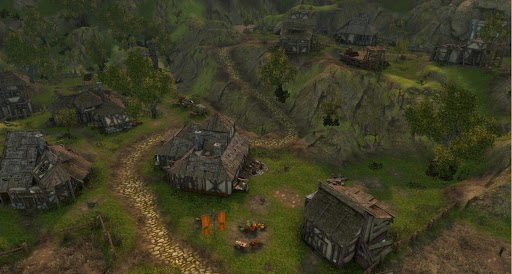
In a stroke of good fortune, I was lucky enough to win the first Dragon Age Community contest! This great initiative from a dedicated group of the people from the Dragon Age community is designed to help modders for the game get additional resources to help improve their creations for the game.

My entry was called "Hillside Village" and I showed one screenshot of it in my post yesterday. This level will be present in The Shattered War, though I won't reveal too much about the location itself just yet!

Entrance to the village

A full download of all the levels submitted for the contest can be found here.  There were some really creative entries in this competition, so I must commend the efforts of everyone who entered. I'm actually hoping to update my entry if I'm able to make a few fixes regarding some props not being drawn from a long distance. This is a fairly minor issue, and the level could be used quite happily as is, but if I'm able to address it, then I think it will be worth it.

An overheard view of the village

So after working on level design for quite a while now, I've recently returned to doing some writing and creating more dialogue for The Shattered War. After all, there's no use having a pleasant village if it isn't populated! Stay tuned for more updates...

Monday, September 20, 2010

Trees are not barcodes

Yet unfortunately sometimes in DAO they end up looking like them.  There's a strange and inconsistent bug in the toolset that means sometimes trees look terrible from a distance. It appears to be an issue in generating the billboards for different levels of detail. For those that didn't understand that sentence, from a distance, trees are not exactly the same as they are close up (hence they have a reduced level of detail), and are often reduced to being represented by two-dimensional images (sometimes known as billboards). When these billboard images aren't generated correctly for some reason, you can end up with something that looks like the image below.

Trees with barcodes

Some might say "just ignore it" or "it's not that bad", but for anyone who knows me or my modding habits, that's simply not good enough. To have such a blatant error in a level isn't acceptable for me.

Now, with a recent level I was working on (for both The Shattered War and the first DAO community contest), I reached a point where I could not eradicate this problem. No matter how many attempts I made to get the toolset to recreate the billboards, they always ended up corrupted. I wasted hours trying different ways to fix it. However, my stubbornness eventually paid off. I eventually decided to look at what was going on, and found that the process of generating tree information creates two types of files: .spt files (tree locations) and .dds files (texture files).

Loading up an earlier version of the level which had less detail but did not suffer from barcode trees, I used the "Post Trees" mechanism to create the tree information for the level.  I copied the .dds files to a safe directory, and loaded up the latest version of my level. I then used that to recreate the tree information again.  However, once this was done, I was able to copy my saved .dds files from the previous step (specifically the ones containing the billboards) to the relevant directory.  With this done, I started up the game... and voilĂ ! The tree barcodes had disappeared.

People are more fun than trees

While I haven't tested it, I imagine that it's not even necessary to backup your level files at an early stage. This is just a guess, but I imagine it would be possible to create a new empty level and simply add one of each of the vegetation types that you have in your working level. Then generate the tree texture information and copy it to the desired location, simply making sure that the files are named in accordance with the naming scheme of the toolset.

Ideally I wouldn't have to resort to this trick/hack, but it delivered a working level. I'd like to hope that it looks reasonably pretty as well.

Thursday, September 16, 2010

What's the point?

I recently read an interesting post regarding games. It was: "Everything in a video game should happen in some form of advancing the action." Now, given this was in a discussion of RPGs, my immediate reaction was to profoundly disagree. However, before I hit the "reply" button, I realised that this somewhat hasty post actually raised a very interesting question - what is the aim of a video game? So in this 100th post for my blog, I'd like to discuss precisely that topic.

Someone could quite easily ask what is the point of a book, movie, piece of art, or many other forms of media, and people would give vastly different answers. In all cases, there are many elements that go into making these creations, and in some cases, there might be an underlying theme or agenda that it is trying to advocate or explore. Political and social issues are often addressed in these forms, but games have yet to delve deep into this realm, at least not as a key message within their delivery. But that's not to say that they could not do so in the future, even though this may raise issues of social responsibility if this starts to happen on any significant scale.

No, this wasn't just about aliens and mechasuits

Regardless, is there one thing that every aspect of a video game should try to support? Do other forms of media/art have a single thing which every aspect should attempt to reinforce? I've read that the driving force of a book should be the author's premise - a key element, value or moral that they are trying to convey - and that each element of the writing should support this premise. I imagine I would find it hard to identify a premise behind most games, it just doesn't seem particularly applicable. This isn't to say that games can't pose some interesting moral and social questions for players as part of their experience (and some games have done this), but they aren't currently used as a defining aspect of games at this point in time.

Coming from my inherently biased viewpoint, my first reaction was a desire to argue that the driving force of a game should be narrative, but I almost immediately realised this was also a grossly flawed perspective. There's no (real) story to games like Doom, Unreal Tournament 2K4, or DotA, or most puzzle, racing, sport, or even multiplayer-centric games. However, that doesn't make them bad games. In fact, games can be fantastic while containing absolutely no narrative elements whatsoever. Narrative can be a strong aspect of a game that can help make it great, but it is not the be-all and end-all of what makes a great game. People don't spend countless hours dispatching enemies online in their favourite FPS due to any narrative reason, they do it because it is fun.

Games are not these

If I had to give a catch-all that could be applied to every game, then I believe this should be it: "Everything in a video game should happen in some form of advancing the player's engagement." A game designer should at every stage be attempting to keep a player engaged with the act of playing their game, whether through gameplay, graphics, story, dialogue, sound, cinematics, level design, items, achievements, or any other aspect that makes up the complete package of a game. If a player is engrossed in their gaming experience, then this is an indication that all the elements that form to make it fit together in s seamless package that demands the player's continued attention. If someone still wants to keep playing even though they've been glued to their screen for hours on end, then that is the sign of a well-crafted game, no matter what the genre.